Beyond Instrumentalism
Director of Creative Industries Policy & Evidence Centre at Nesta & Fellow on Art and Society, Metcalf Foundation
Beyond Instrumentalism: The Aestheticisation of the World
Climate change? Global pandemic? Collapsing biodiversity? Distressed migration? Spiralling inequality? Cutting across many of the urgencies facing humanity is a growing epistemic crisis, a widening gap between our knowledge paradigm and the problems of our day. One surprising response to this growing epistemic crisis, as the contributions in this volume illustrate, is the corresponding turn to art, not as entertainment or distraction, but as problem-solver. While this appears to be largely instinctive—a collective intuition ungrounded by conceptual or methodological clarity—it deserves investigation.
The Crisis of Knowing in the Age of Complexity
How did our problems and our problem-solving get so disconnected? During its rise to prominence, Western, Enlightenment rationality systematically divested itself of subjectivity in order to see the world objectively. Human values, perspectives, and beliefs were dismissed in pursuit of irrefutable facts. The complicated world has become the complex world and with a knowledge paradigm built for the former, we find ourselves, to use a recent metaphor, trying to play three-dimensional chess on a two-dimensional board. Our missing dimension often goes by the name ‘the normative’, indicating elements of identity, meaning, purpose, belief, senses of time and place, and the underlying ontologies shaping our conceptions of the world and ourselves within it. We see this in the declining capacities of our R&D paradigm, privileging science and technology and rendering contributions from the arts, humanities and social sciences illegitimate. The R&D paradigm is built for the problems of two-dimensional chess, but the crises that define our age cannot be resolved in two dimensions alone. Can knowledge creation which enriches our understanding of, and engagement with, these irreducible uncertainties, be of greater societal value in the Anthropocene?1
Art as Magic Bullet
Complexity features an entanglement of normative or human dimensions shaping the problems we are hoping to solve within a paradigm built to ignore those exact dimensions—leading much of the early 21st century on something of a fool’s errand. Yet why the turn to art? Might it weave human values, perspectives, beliefs, and activities back into how we make sense of the world, thereby allowing us to navigate—and manage—our normative entanglements more effectively? Is it, in other words, a means of shifting from the complicated to the complex by adding a third dimension to our chessboard?
From Plato’s suspicion of poets, to church and state controlling art’s expressive range, or Soviet Socialism’s faith in artists as “engineers of the human soul”, and climate activist Bill McKibben crying out “what the warming world needs now is art, sweet art,”2 the idea that art shapes worlds transcends history and ideology. These perspectives share neither politics, epistemology, nor cosmology. Where art happens, faith in its world-making power grows. We turn to art to shape our societies based on a tacit recognition of how art has shaped us, revealing both the durability and vulnerability of art’s relationship to social impact,3 from “did do for me” to “will do for others.” Herein lies the risk of instrumentalising art; often, our enthusiasm for art finds us trying to replicate effects rather than processes. In trying to replicate what art does rather than how art works we jeopardise the means by which art engages life in aesthetic terms, often disenchanting the very power for which its help was sought in the first place. These dichotomies—effects vs processes; what art does vs how art works—are not meant to dim our hopes to apply art to social challenges, but to distinguish between art as a descriptive capacity versus an epistemic capacity. If art is to expand our proverbial chessboard by shifting how we know the world beyond two-dimensional Western objectivity, it must recognise an often invisible fork in the road. Down one path, art forms a tool to serve our two-dimensional, complicated world; down the other, something potentially more transformative awaits. The latter invites the aestheticisation of the world, a reopening of that once-maligned plane of engagement we tried to close over the course of the Enlightenment.
Art as Method
This growing intuition that art offers unrealised capacity to contribute to our growing epistemic crisis deserves enthusiasm. Coordinating the energy and reach of our cultural sectors while bringing them into more applied relationships to societal challenges could prove transformative. Yet such a vision implies an art-society relationship that is necessarily paradoxical—applied yet not instrumentalised, enfranchised yet not autonomous. One approach to this paradox is through a relationship between art and R&D. Historically, these fields dislike each other; art is too impulsive for R&D’s ‘systematic’ approach to knowledge creation, and R&D too reductive to admit the imaginative range of arts practices.4 Yet as art faces a destiny where it is more applied and accountable to its larger impacts, and R&D struggles with the normative dimensions of contemporary challenges, they may not be such odd bedfellows as they seem.
In terms of its value proposition, we often say art is a way of ‘seeing differently’, yet without specifying how, we jeopardise the capacity, while yielding little methodological clarity to contexts of application. Typically, art is considered a power of expression, the sounds, imagery, words, and movements it makes, often leading to its hasty use as a tool for making statements. Yet within this power of expression lies an equally important power of attention. Art is the capacity to attend to the world in terms of the aesthetic; perhaps more than its expressive power, it is perceiving via creative practice that generates such unique value. Consider this within the recursive relationship between mind and world, where mentality produces society, and society produces mentality. Such a dynamic is built for getting stuck. Agency, inspiration, reflexivity and creativity are constrained by design, and design is constrained by agency. Art as a power of attention, a means to engage the world less hampered by this recursive dynamic, offers a unique value that might make the arts vital to innovation. Rendering this explicit articulates a value proposition we can use to operationalise art in service of our worlds while protecting it from being reduced to a charismatic mouthpiece—that ‘power of expression’ alone.
Framing problems in terms of aesthetics is essential to effective applications of arts practices. How do we spot the arts-shaped holes in our world? Here we begin to shape that third dimension on our chess board. Often, we equate the normative with matters of taste and opinion, luring us into thinking that information, data, facts and reason might inspire the reflexivity societal problems like climate change, pandemics, and social and economic justice require. As is far too abundantly evident, divisive dialogue and increasing polarisation are the results of this misconception. Fostering reflexivity, agency, and change at the normative level—that is, navigating that third dimension of our chessboard—requires fashioning carefully constructed passageways that lead from one world to another. Consider how many of us are eager to depart toxic capitalism. Bringing such hope into an applied and accountable relationship with society requires careful consideration of method and evaluation. Clearer problem statements enable more specific questions of artistic method—e.g. what processes engage the problem? And how will stakeholders be involved? In terms of evaluation, words like ‘data’ and ‘assessment’ sound threatening to artists. With clear problem statements and corresponding methods established by the artistic process, can we reconcile the accountabilities of others with our own? In other words, what value does the artistic process seek to produce? Where was this contribution realised or not? What data do we need in order to know? And what processes will be used to interpret and integrate that data in decision-making? This more empowered relationship to assessment allows applied artistic processes to serve more accountable roles in society without trying to prove themselves on foreign terms.
Policy for Playing Three-dimensional Chess
Our core suggestion is that within a much-needed expansion of the R&D paradigm, art might contribute its unique epistemic value to the growing epistemic crisis.
The starting point is to reflect the arts’ distinctive contribution to R&D in the international bible for R&D policymakers, the Organisation for Economic Cooperation and Development’s Frascati Manual: Guidelines for Collecting and Reporting Data on Research and Experimental Development. Now in its seventh edition, the Manual is used by policymakers, statisticians, academics, and others, to help standardise the data collection guidelines and classifications for compiling R&D statistics. In successive revisions, the Frascati Manual has evolved to recognise arts R&D, but it has done so by shoehorning art into scientific understandings rather than extending its own definitions and parameters, e.g., referring to “observable facts” and “knowledge of the underlying foundations of phenomena” not to behaviours, and to “systematic work… directed to producing new products or processes” not to human experiences. Elsewhere in the Manual it is made clear that R&D must aim to resolve scientific and technological uncertainty. It is of fundamental importance that the Frascati Manual and the R&D definitions within it are made fit for purpose for the complexity economy.5
National statisticians in turn must adapt their measurement activities to measure R&D so defined.6 The basics of an approach are already in place with the OECD’s Fields of Research and Development (FORD) classification. Statisticians can use this classification in their R&D surveys to measure R&D expenditure and personnel by fields of enquiry—in other words, broad knowledge domains including the arts–based on the content of the R&D subject matter. Survey returns on R&D spending by FORD are only as good as the accounting data that organisations collect, however, so national statistical institutes need to engage with businesses, public bodies and charities to ensure they too are adapting their R&D measurement systems accordingly.
Armed with more inclusive definitions and metrics, governments can then ensure their R&D strategies, subsidies and tax incentives are fit for purpose too. They can fashion interventions that are designed to fully avail society of the R&D potential of the arts. What, for example, would the missions’ turn in innovation policy look like if artists participated in the setting of grand challenges, foresight exercises, policy design and planning? How would skills and policies for the knowledge economy change if they privileged the aesthetic as much as science and technology, and what would this mean for innovation and productivity? If the qualifying expenditures for R&D tax reliefs were widened to embrace arts R&D, while the arts learned to structure inquiry towards compelling data production, what new interdisciplinary business solutions to society’s problems might we see?
Sources
1 David Maggs, Art and the World After This. Metcalf Foundation, June, 2021.
https://metcalffoundation.com/publication/art-and-the-world-after-this/
2 Bill McKibben. “What the warming world needs now is art, sweet art,” Grist Magazine. April 2005. http://grist.org/article/mckibben-imagine/
3 David Maggs and John Robinson. Sustainability in an Imaginary World: Art and the Question of Agency. Routledge, New York, 2020. See, in particular, chapters 7 & 8.
4 Hasan Bakhshi, Alan Freeman and Radhika Desai. “Not Rocket Science: A Roadmap for Arts and Cultural R&D,” MPRA Paper 52710, University Library of Munich, Germany, revised 01 Jan 2010.
https://ideas.repec.org/p/pra/mprapa/52710.html
5 Hasan Bakhshi and Elizabeth Lomas. “Defining R&D for the Creative Industries,” Nesta/AHRC/UCL, 2017. https://ahrc.ukri.org/documents/project-reports-and-reviews/policy-briefing-digital-r-d/
6 Hasan Bakhshi, Jonathan Breckon and Ruth Puttick.”Understanding R&D in the arts, humanities and social sciences,” Journal of the British Academy, volume 9.
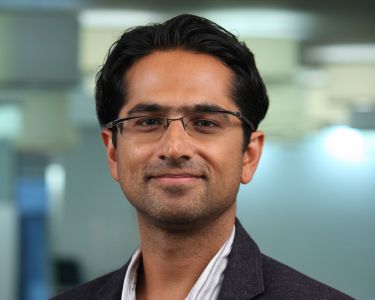
Hasan Bakhshi
Hasan is Director of the AHRC-funded Creative Industries Policy and Evidence Centre, a Nesta-led, AHRC-funded research consortium of ten universities, charged with improving the evidence base for policies to support the UK’s creative industries. Prior to Nesta, Hasan worked as Executive Director at Lehman Brothers, as Deputy Chief Economist at the Foreign and Commonwealth Office and as an economist at the Bank of England. He has published widely in academic journals and policy publications on topics ranging from technological progress and economic growth to the economics of the creative and cultural sector. He is also Adjunct Professor of Creative Industries at the Queensland University of Technology, has an honorary Doctorate from the University of Brighton for his work on economic policy for the creative industries, and in the 2015 New Year’s Honours was awarded an MBE for services to the creative industries. Hasan is a member of the government’s Creative Industries Council, the Department for Digital, Culture, Media and Sport’s Science Advisory Council and Advisory Board for its Culture and Heritage Capital Framework. In 2017, he was elected to sit on the Royal Economic Society Council.
Picture © NESTA
David Maggs
David Maggs carries on an active career as an interdisciplinary artist and researcher focused on arts, climate change, and sustainability. He is the founder and pianist for Dark by Five, has written works for the stage, and collaborated on large augmented reality and virtual reality projects (see Mummer’s Journey). David is the artistic director of the rural Canadian interarts organization Gros Morne Summer Music, and founder and co-director of the Graham Academy, a youth training academy founded in honour of his teacher and mentor, Dr. Gary Graham. He initiated and coproduced the CBC doc channel film The Country, exploring the Canadian government’s handling of indigenous identity in Newfoundland. As a fellow at the University of Toronto’s Munk School for Global Affairs, David co-authored Sustainability in an Imaginary World (Routledge Press, 2020) with mentor and longtime collaborator John Robinson. He is former senior fellow at the Institute for Advanced Studies in Sustainability in Potsdam, Germany, where he led work on culture and climate change. Currently he is the inaugural Innovation Fellow in residence at the Metcalf Foundation where he will explore the role of art in society, with particular focus on innovation, climate change, and cultural policy.
Picture © Grady Mitchell

A Culture of Ecology: the 21st Century Renaissance
Fellow at King’s College London
and The National Gallery X, London
A Culture of Ecology: the 21st Century Renaissance
Beauty, epiphany, neurons
Six hundred years ago a small group of innovators changed history. They lived in Italy, and the name of their era, the Renaissance, is delightfully compact. It means rebirth, renewal and the emergence of new character. Europe has experienced more than one renaissance, but the Quattrocento occupies a special place in the imagination. The reason is clear. Unlike comparable eras, the Italian Renaissance produced colourful characters who embody wide-ranging achievement: Renaissance people who excelled in the arts, science and engineering. The influence of Filippo Brunelleschi, Leon Battista Alberti and Leonardo da Vinci spread throughout Europe, and they continue to inspire the world. In most eras we discourage polymaths, but we make an exception for Quattrocento genius.
Header photo: View from Erte Ale volcano in Ethiopia
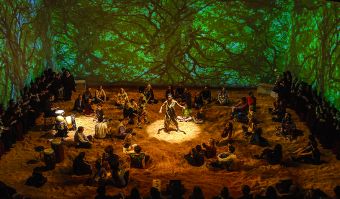
This was a study for the performance installation ›Epiphany: The Cycle of Life.‹ (c) 2015 Ali Hossaini
Photo below: Epiphany: The Cycle of Life
Singer Netsayi and the Young People’s Chorus of New York City perform ›Epiphany: The Cycle of Life‹ at BAM in New York City. (c) 2015 Ali Hossaini
What lessons can we take from the Italian Renaissance? Contemporary society demands specialisation for good reason. Centuries of research, documentation and industrialisation have created deep wells of knowledge. Sub-disciplines of art, science, engineering take long years to master, and they possess cultures that minimise outside influence. Specialisation has brought spectacular results, but perhaps it has limits. One of the Quattrocento’s best-known products, drawing in perspective, offers a case study in the benefits of multidisciplinary training.
Perspective uses optical codes to create realistic images. Painting dominates discussions of it, but the technique’s application goes beyond art. Perspective is a science in its own right, and the ability to represent objects with mathematical accuracy supported a spectrum of progress in Europe. Engineers adapted perspective to develop machines. Anatomy, botany, astronomy and other sciences benefited from accurate drawings. Cartographers created navigational maps, and maritime nations used improved technology to pursue interests at home and abroad. The Renaissance boost to Europe upset the world’s balance of power.

It was not a given that 15th-century Italy would invent perspectival drawing. Euclid codified optics over two thousand years ago, and some scholars argue that the ancient Greeks applied perspective to painting, architecture and theatre. As the name implies, the Renaissance was a rebirth of classical learning. But the Italians of the Quattrocento went further than the ancients, and perspective spread across Europe from Italy, and from Europe to the world. We can describe perspective in one stroke. By applying science to art, and shaping science with art, Renaissance polymaths created the flat panel display.
The beauty of perspectival art reveals the structure of space. Our first guide to perspective is Alberti’s 1435 treatise On Painting, a slender volume which generated incalculable economic value when its techniques were applied to new disciplines. Within a century of Alberti’s treatise, inventors used the camera obscura to automate perspectival drawing, and, within decades, Louis Daguerre and William Henry Fox Talbot industrialised it by inventing photography: drawing with light. To this day, cameras are a locus of innovation, notably in mobile handsets, that charge economic growth. At the same time, the camera is a useful metaphor in digital media. Gaming and animation developers use a ‚camera tool‘ to define the user’s point of view. Today’s 3D design software is one of Alberti’s many heirs.
Here is a curious fact. We perceive the world in three dimensions, and people desire rich immersive experiences. Huge investments have been made in next-generation spatial media platforms since the 1950s. Yet 3D cinema, VR and other forms of immersive media have not replaced flat panel perspective. Investors have waited more than half a century for the transition to spatial media. Why do 600-hundred-year-old techniques—the linear perspective of Brunelleschi, Alberti and da Vinci—continue to dominate creative production?
The stakes are high. When aggregated into XR (Extended Reality), spatial media could transform the Internet into a ‚multiverse‘, a pervasive data environment that merges with the physical world. Nations, corporations and individuals are vying to create the first-generation multiverse, and whoever founds it stands to gain enormous capital through first-mover advantage.

We can speculate on why a spatial multiverse eludes us. Is it because polymaths invented the flat panel display? Renaissance engineers were accomplished artists and scientists; indeed, it is impossible to characterise them with a single word. Their aesthetics embodied intellectual and technical rigour, and they combined innovation with humane values. Consider Brunelleschi’s architectural masterpiece, Il Duomo. Accidents commonly mar construction, but, during Brunelleschi’s management, Florence’s cathedral was erected without a death. Renaissance polymaths studied ancient texts, but they probed nature with tools of their own invention. They envisioned modern science by creating humane environments filled with beautiful objects.
Contrast the Quattrocento with today. Contemporary professionals specialise while the paragons of the Italian Renaissance embodied wide-ranging talent. Perhaps this explains their lasting influence. Drawing in perspective was not instantly popular. Now we take the medium for granted, but 15th-century audiences treated perspective as advanced technology: difficult to learn, marginalised and controversial. Perspective’s utility did not immediately show, and its power to create illusions seemed a gift from Satan. But Renaissance paintings incorporate fine aesthetics. Their masters created paradigms for the media they invented.
Perspective could have been popularised earlier. By the Middle Ages, the science of perspectiva, or optics, was well-established in European universities. After the classical era, Islamic scientists such as Ibn al-Haytham refined it, and mediaeval European painters such as Giotto experimented with spatial illusion. Finally, in the late 14th century, Claudius Ptolemy’s Geography surfaced in Florence’s educated circles. In Geography, Ptolemy describes how to portray the Earth’s sphere on a flat surface, and it is likely that this technique inspired Renaissance experiments. What did Brunelleschi and his colleagues add to the established science of optics? An aesthetic tradition and the desire to draw with scientific accuracy.
Let me speak as an artist. What’s missing from spatial media is a coherent world view. Unlike Renaissance paintings, recent generations of spatial media dropped into a creative and ethical vacuum. Renaissance inventors drew on the ascendence of humane values, and their work embodied visual harmonies that were ethical as well as aesthetic. They were creatures of their time who championed ascendent humanism.

Let me ask again: What lessons can we take from the Renaissance? Aesthetics and contemporary ethics should drive engineering. Technology should express its time; it should express the possibilities and necessities of the moment. Consider another great polymath. In the early 19th century, the Prussian explorer Alexander von Humboldt travelled the world in a quest for grounding principles. Arguably the founder of ecology, von Humboldt published illustrated books that demonstrated interconnections among the physical world, the biological environment and human interventions. Though celebrated while alive, von Humboldt’s star faded and his holistic, interdisciplinary theories were replaced by specialisation and linear causality.
Humanity stands at a precipice, and creative industry is both problem and solution. Our ability to create artificial environments has masked disastrous mismanagement of nature. At the same time, cultural conflicts have paralysed our capacity to act. Why can’t we save ourselves and the innocent creatures who share our planet? The answer turns on the exclusionary cultures we have created—cultures which oppose the ecologically transcendent humanism of Alexander von Humboldt and other ecologists.
The time of art for art’s sake has passed. Likewise, science for the sake of knowledge. Ironically, the culture of purity—the very concept of purity—has created societies antithetical to life. Disciplinary silos, plodding research tracks and philosophy’s retreat from reality into signs maintain this dangerous state. We must engage the world as it is, not as we imagine it. Our paradigms have failed. We need a culture as well as a science of ecology. This is the mission of a 21st-century renaissance.
The people of the 21st century must solve the contradictions caused by specialisation. Paradoxes abound in today’s society. Connections divide rather bind. Governments exhaust a tired planet with economic stimuli. Facts are scorned; forests burn; glaciers melt. To dispel confusion, we must dispel illusions—the illusions created by a fragmented culture that abdicates responsibility for the whole.
Hope lies within the irony of our position. Global infrastructure must be rebuilt, but we need new ways of building that conserve resources. Doing more with less requires new conceptual frameworks. Progress relies on education, innovation and labour—all sources of economic, ethical and aesthetic value. In brief, successfully addressing global crises means growing opportunities. What is the 21st-century renaissance? A context for the cross-disciplinary training, holistic thinking and collective action that creates a sustainable, circular economy: An economy that thrives within nature.

Let us return to spatial media. How should the multiverse evolve? Should it sever humanity from nature, or can it bind society to ecology? Should it enable monopoly, even tyranny, or provide opportunities for all? Markets will determine the multiverse’s form but so will designers. Rather than inventing for its own sake, the multiverse’s engineers need to judge outcomes. Good intentions alone are a recipe for disaster. In the 1990s, I deployed social media into television networks. My goal was to create media for a democratic society. Massive channels, controlled by a few, should be fragmented into capillaries run by individuals. Social media would—I thought—encourage critical thought, dialogue and solidarity.
Here’s another lesson from the Quattrocento. Its polymaths did not separate thinking, making and doing. Nor did they separate ethics, aesthetics and technics. Today holism is deeply unpopular, but I think it is vital for innovators to adopt it. And I argue that holism is vital for producing commercially viable forms of spatial media. The multiverse is not an end in itself: it is the foundation for future generations to innovate. My work in developing standards for ethical design of AI and brain-computer interface has convinced me that media will converge with architecture, urbanism and biology. The next-generation Internet will transcend our current conceptions. Did Alberti imagine streaming media when he wrote On Painting? Imagine the value unleashed by 21st-century infrastructure which supports decades, even centuries, of progress.
Contemporary crises stem from narrow expertise coupled to wishful thinking. Like Quattrocento polymaths, future designers should hold clear aesthetic and ethical values, and they should embed them in their inventions. Alberti, Brunelleschi and da Vinci were humanists, and here they are obsolete. Man is not the measure of things: We need to embrace the biosphere. Like von Humboldt, we should be ecologists who position humanity in nature. A culture of ecology reflects this understanding. It understands the depth of our crisis—the survival of humanity—while driving economic growth.
In a world where inventions are quickly commoditised, culture generates profit. Renaissance polymaths were supported by mecenati, patrons motivated by fame coupled to humanism and social progress. Investors in the New European Renaissance require similar motivations. As Alexander von Humboldt observed, everything is connected. Europe must progress, but European progress should serve, not overrun, the planet.

The New European Renaissance could mesh creative industry, science and engineering with an ethos of global awareness. It would preserve the cohesion of European institutions, and it would support the relevance of European industry—and the European project—in a world of superpowers. Let us invest in a 21st-century Renaissance that starts in Europe but benefits every global citizen. Europe’s institutions, the heirs of the mecenati, can generate vast new wealth, and they can also ensure the benefits of prosperity for future generations. What illuminates this path to a bright future? Humanity, technology and ecology coupled to creative imagination.
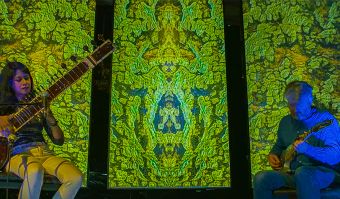
Photo left: GROUPTHINK: The Internet of Neurons
Neuroscientist Shama Rahman and computer scientist Mick Grierson collaborated with Ali Hossaini, an AI and a cohort of artist-engineers to create GROUPTHINK. Performed at National Gallery X in London and broadcast via Ars Electronica Festival 2021. (c) 2021 Ali Hossaini
More info on the artworks
Epiphany: The Cycle of Life.
https://pantar.com/epiphany/
GROUPTHINK: The Internet of Neurons
https://www.nationalgallery.org.uk/national-gallery-x/groupthink
Sources
All portrayed pictures and paintings in this contribution are (c) Ali Hossaini, 2021.
Dr. Ali Hossaini
Fellow at King’s College London and The National Gallery X, London
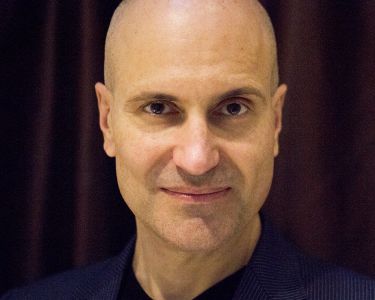
Ali Hossaini works at the cutting edge of art, technology and science. Acclaimed by the New York Times, which calls him “a biochemist turned philosopher turned television producer turned visual poet,“ he is noted for cross-disciplinary work that addresses thorny problems. He is a Visiting Senior Research Fellow in the Department of Engineering at King’s College London. In this capacity, he has developed use cases for 5G with Ericsson, studied unequal healthcare outcomes at the Institute of Psychiatry, Psychology and Neuroscience, and assessed the threat from AI with security think tank RUSI. He serves on IEEE committees developing standards for safe AI and brain-computer interface, and he is active as a visual artist, writer and director. In 2019 he co-founded National Gallery X, a program that researches the future of art and audience, where he serves as co-director.
Picture: © Leslie Cummins

Arts Education for All: The Case of Finland
Managing Director at KAAPELI cultural centre, Helsinki
Arts Education for All: The Case of Finland
Cultural capital supports the capacities of children and young people to actively participate in society. Experiences from Finland show, however, that a generous public service provision doesn’t necessarily mean equal service offering for all. Children with a minority background and children coming from lower social classes are underrepresented among the users of the cultural programs aimed for children and young people. Recent initiatives in Helsinki, the Finnish capital, may have found a new way to tackle this challenge.
A national program for Arts education
Finland was named the happiest country in the world in 2021 by the UN Sustainable Development Solutions Network for the fourth time in a row. Alongside with the other Nordic welfare states, the country is well-known for its generous public services. These services include the public school system as well as the public healthcare system, but Finland invests heavily also in children’s arts education. And for good reason: arts and culture are known to have a positive impact on children and on young people and their future.
The national program called Basic education in the arts provides after-school-hours arts education in the local art schools in Finland. Training is goal-oriented, tied to a national curriculum and taught by professionals in the field. There are nine different art forms to choose from: architecture, circus, crafts, dance, media, music, literary art, theatre and visual arts (Luoma, 2020). Typically, education is subsidised both by the national and the local government. However, as the services are provided by private organisations, participants are required to pay to fee in order to participate.
Although, this model has resulted in admirable results—especially in the field of classical music that can be monitored both in the numbers of people playing classical music themselves and in the popularity of classical music concerts—the system hasn’t been as successful in reaching all demographic groups of the Finnish society. A study conducted by the City of Helsinki in 2016 showed that the proportion of students attending the program was much higher in wealthier social classes than in the lower ones.
Socially disadvantaged children cannot be reached
When dividing Helsinki’s neighbourhoods in three groups according to their socio-demographic profiles, it could be concluded that participation in the arts program was most frequent where the socio-demographic profile was highest, where the services were easiest to reach and where the educational offering was highest. Participation was the lowest in the lowest socio-demographic profile and where the distance to the training places where the longest. An additional finding was that a large portion of the participants in the educational program were children and youth that had already multiple other hobbies (Vismanen et al., 2016).
Another study looking at the cultural policy and cultural diversity in the Nordic countries revealed that “people belonging to minorities, immigrants, and natives with a foreign background are mostly underrepresented both as artists, as people employed by arts institutions and organisations, and as public or audience” (Saukkonen, 2018). In addition, the challenge to reach these underrepresented groups had become more complex over time as the number of minorities had and diversified ethnically, linguistically and religiously.
Academic research and experiments
In attempting to find solutions to the situation, Finns have relied on one hand on academic research and on the other on experimentation with new ideas.
In 2016, The University of the Arts Helsinki started a six-year project called ArtsEqual. It was the largest research initiative in the field of arts ever to have taken place in Finland studying arts as public service and aiming for better equality and resulting in policy recommendations. All in all, six research groups studied the subject from various sides. The group “Basic Arts Education for All” emphasised in one of its policy briefs (Laes et al., 2018) that although arts and cultural education strengthen the cultural capital of children and young people and support their capacities to actively participate in the society, the unequal access to them could also increase the social exclusion of the children that could not participate in the program for some reason. In turn, a policy recommendation (Anttila et al. 2017) by the research group “Arts@School” suggested that public schools should be seen as “Finland’s largest cultural centres, where high-quality, diverse arts and cultural education is equally available to all.”
In parallel to this research work, the City of Helsinki launched a pilot phase of the Helsinki Model of arts education that brought the activities to suburbs and, thus, closer to the disadvantaged groups. Also, an arts education project called “Art Testers”, led by the Association of Finnish Children’s Cultural Centres was launched targeting teenagers.
The pilot phase of the Helsinki Model that lasted three years (2016-18), consisted of four case studies in four different suburbs around Helsinki (Lindholm & Päiviö-Häkämies, 2020). It relied on the cooperation of the cultural department of the City of Helsinki, of neighbourhood associations and of cultural institution ranging from theatres to museums and to dance and circus companies. The pilot succeeded in improving the perceived quality of life in the pilot suburbs but it taught that the local population couldn’t be reached simply by delocalising the old model of arts education. The content needed to be adapted to the setting. And yet, the most challenging groups—socially most marginalised and minorities not speaking Finnish—were still very hard to reach. This was partly because they didn’t have any previous relation to art or had even a hostile attitude toward it. City of Helsinki continues the Helsinki Model program and keeps fine-tuning it.
Art Testers integrated cultural offerings to the school curriculum initially from 2017 till 2020. Every year, it brought all Finnish 8th graders (15-year-olds) to a visit in one or two high-esteemed art attractions across Finland, such as opera or theatre performance, a concert, or an arts exhibition (Art Tester, 2021). School groups were provided with tickets and transportation to the events. Approximately 60,000 teenagers participated in the project yearly. The project ended up being so popular and successful that in the fall 2020 the Finnish Ministry of Education and Culture secured the continuation of the program.
Towards the future with “Hobi” and “Culture Kids”
Based on the research results of ArtsEqual and on the experiences gained from Helsinki Model and Art Testers, Finland is now complementing its Basic education in the arts with Hobi, the Finnish model for leisure activities (https://harrastamisensuomenmalli.fi/en/). In parallel, a new project called “Culture Kids” is being launched in Helsinki. Both initiatives aim to make their offering as accessible as possible so that truly every child could take part in the activities equally. However, the age groups targeted in each project are different.
The main objective of Hobi is to increase the wellbeing of school children by providing them a leisure activity free of charge through the school system (Hobi, 2021). However, the model is not restricted only to art-related leisure activities, and sports activities, for example, are included as well. The activities are funded by the ministry and organised by professional actors in the field of leisure in cooperation with schools. Hobi’s website started operating in August 2021.
Culture Kids’ target group, in turn, is babies, as well as their families (Culture Kids, 2021). For every child born in 2020 or after and living in Helsinki the project will designate a cultural operator that will sponsor the child’s initiation to art. The cultural sponsor is determined by the year of birth of the child. Children born in 2020 are sponsored by the Helsinki Philharmonic Orchestra, and children born in 2021 will be sponsored by theatres in Helsinki. Every year, the sponsor will invite the child and his/her family to at least two cultural events that are designed to support the child’s developmental stages and promote the well-being of their family. Culture Kids events are free of charge and the activities will continue until the child starts school. By inviting the whole age group with their family members, the program hopes to attract families that wouldn’t otherwise be prone to participate in cultural activities and by maintaining the sponsorship for six years, it aims for a lasting and living relationship between the children and art.
The Finnish example shows that even successful arts education programs have flaws and that if an arts education program has social aims, its practices need to be regularly revisited, as the demographics of our societies change. Finland believes that all children irrespective of their social background deserve to experience and practice art regularly. Let’s hope that in the future this will be true for all children all over Europe.
References
Anttila, Eeva et al. Peruskoulu: Suomen suurin kulttuurikeskus, (2017), ArtsEqual Policy recommendation 2/2017
Art Testers website (2021), https://taidetestaajat.fi/en
Culture Kids website (2021), https://kummilapset.hel.fi/brochures/en.pdf
Happiness Report 2021 (2021), https://happiness-report.s3.amazonaws.com/2021/WHR+21.pdf
Hobi – The Finnish Model for Leisure activities website (2021)
Laes, Tuulikki et al. Toimenpidesuositus Saavutettavuus ja esteettömyys taiteen perusopetuksen lähtökohtana (2018), ArtsEqual Policy recommendation 1/2018
Lindholm, Arto & Päiviö-Häkämies Laura (ed.). Helsingin malli – taidetta ja osallisuutta lähiöihin Miten pilottikauden hankkeet tavoittivat alueiden asukkaat 2016–2019?, (2020), Humanistinen ammattikorkeakoulu julkaisuja, 114.
Luoma, Tiia, TAITEEN PERUSOPETUS 2020 – Selvitys taiteen perusopetuksen järjestämisestä lukuvuonna 2019–2020, (2020), Opetushallitus, Raportit ja selvitykset 2020:4
Saukkonen, Pasi, Cultural policy and cultural diversity in the Nordic countries (2018), https://pasisaukkonen.wordpress.com/category/kulttuuripolitiikka/
Vismanen, Elina; Räsänen, Petteri, & Sariola Reetta, Taiteen perusopetuksen tila ja kehittämistarpeet Helsingissä (2016), Helsingin kulttuurikeskus
Dr. Kai Huotari
Managing Director at KAAPELI cultural centre, Helsinki
Dr. Kai Huotari (b. 1972) has 20 years of management experience in the fields of culture, academia and technology. Since 2015, Huotari has worked as Managing Director at KAAPELI the largest cultural centre in Finland. Huotari has held managerial positions also at EIT Digital, at Helsinki Institute for Information Technology HIIT, and at DocPoint – Helsinki Documentary Film Festival. In 2010-2012, Huotari worked as visiting scholar at UC Berkeley School of Information. He is a member of the board of YLE The Finnish Broadcasting Company and he serves as chairman of the board in Kunsthalle Helsinki. Huotari has a doctoral degree in economics and business administration, an M.A. degree in filmmaking, and a M.Sc. degree in computer science.
Picture © Mr. Vertti Luoma

HOW WE LIVE TOGETHER
Founder and Creative Director of Streaming Museum, New York
HOW WE LIVE TOGETHER – Artistic ways of understanding community, individuality, spaces, and rhythms of life for possible futures.
Four short films by Anne Katrine Senstad created in collaboration with Actor Bill Sage. 1
In a critical look at the human condition in current world affairs, filmmaker Anne Katrine Senstad suggests that a healthy value system has been disenfranchised and replaced by what the French philosopher Jean Baudrillard (1929-2008) called a simulacra—a postmodern imitation of reality, consumerism, and predatory systems. Senstad with actor Bill Sage express these theories in the films which were produced remotely along with sound producer JG Thirwell, within the confines of isolation during the pandemic. Senstad and Sage sharpen our understanding of today’s crisis to embark successfully to rebuild a better world.
Anne Katrine Senstad is a New York-based Norwegian artist. Her international practice lies in the intersections of installation art, photography and video, immersive installation art, and site specificity, with a focus on the phenomena of perception and ethics. Her sociopolitical projects engage in gender politics, community and critical philosophy through text and film.
Bill Sage is an American actor who has appeared in over 120 films, TV and stage productions. Throughout his career, Sage has been a champion for diversity and equality in the film industry. He has made a point of working with female Directors, Writers and Producers. Select film and TV performances include American Psycho, The Insider, Boardwalk Empire, and Hap & Leonard.
JG Thirlwell, is a sound producer and composer based in Brooklyn, NY. The state of the art sound for “How We Live Together” has been mastered by Thirlwell for an enhanced and dimensional experience of the actors performance. He has released over thirty albums and creates the musical score for the Emmy-winning FX show Archer, and the Adult Swim / Cartoon Network show The Venture Bros. foetus.org.

UTOPIE/UTOPIA (2020)
UTOPIE/UTOPIA (2020) theorises that tolerant co-habitation is a place of utopia, and reflects on ways of understanding community and individuality, societal and political systems, and solitude and the degree of contact necessary for individuals to exist and create at their own pace. Anne Katrine Senstad’s film explores the nuances of French philosopher Roland Barthes’ (1915-1980) term “idiorrhythmy”—a productive form of living together in which one is autonomous yet recognises and respects the individual rhythms of others.
In Senstad’s first film in the series of four, exploring Barthes text “UTOPIE/UTOPIA” from his 1977 book How To Live Together, acclaimed actor Bill Sage, in a personal and evocative monologue performance, assumes the character of Barthes in the creative process of preparation for his University lecture series of four decades ago. Set in the context of our contemporary world that is gripped by societal and political crises amplified by the 2020 pandemic, Sage’s character explores various forms of solitude through Barthes’ contemplations on history, psychology and societal structures. Barthes’ text concludes that our “Sovereign Good” is a form of tactful cohabitation and that an inner state—the state of tolerance—is a place of utopia.
MÔNOSIS/MONOSIS
Barthes contemplates the human monastic state—solitude, the isolated self, and seeks to identify the problem of separation, from community and from our internal unification as an aspect of iddiorhythmic Living-Together. Within societal structures, to be alone is construed as a punishment. However, in the place of utopic unity, the individual searches for a state of peaceful tolerance as distanced cohabitation.
MARGINALITÉS/MARGINALITIES
Those who live on the margins or who react to violence and oppression created by power are the source of intense social anxiety and considered dangerous—until they can be controlled and conform to society’s norms. The margins, however, are also a place of power, one which is untouchable and a form of a holy state. The isolated state on the margins is the creative space in which Barthes examines liberation.
XÉNITEIA/XENITEIA
The fourth chapter reflects on notions of exile and the displacement of peoples—politically, psychologically and due to climate change. The idea of being an outcast from ones home and not belonging o a community—to be ‘in the world but not of the world’. We are ultimately alone, exiled within the world and from ourselves. Barthes interweaves states of inner displacement and nostalgia—ultimately sentiments of isolation.
watch how we live together
An Exclusive Online Screening was presented October 31-November 15, 2021 at StreamingMuseum.org. The link below will lead to excerpts from each of the 4 short films by Anne Katrine Senstad, that were created during the pandemic in collaboration with acclaimed American actor Bill Sage and audio produced by JG Thirlwell.
Click here and enjoy watching: https://www.streamingmuseum.org/anne-senstad-how-we-live-together
Sources
1 This article is presented by Nina Colosi, founder of Streaming Museum and co-producer of the special UN 75th anniversary issue of the publication CENTERPOINT NOW, “Are we there yet?” A version of this article entitled „UTOPIE/UTOPIA“ appears in the publication. Copyright 2020, World Council of Peoples for the United Nations.
All pictures are film stills. Copyright by Anne Katrine Senstad & Bill Sage
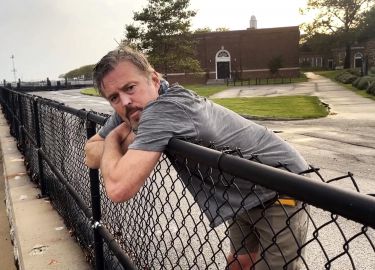
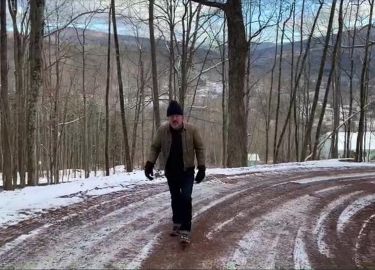
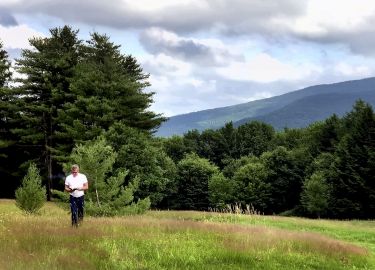
Nina Colosi
Founder and Creative Director of Streaming Museum, New York
Nina Colosi is the founder and creative director of NYC-based Streaming Museum, launched in 2008 as a collaborative public art experiment to produce and present programs of art, innovation and world affairs. Streaming Museum programs have been presented on 7 continents reaching millions in public spaces, at cultural and commercial centers and StreamingMuseum.org. Following her early career as an award-winning composer she began producing and curating new media exhibitions and public programs internationally, and in New York City for The Project Room for New Media and Performing Arts at Chelsea Art Museum, Digital Art @Google series at Google headquarters, and many other collaborations. In 2020 Colosi co-produced Centerpoint Now “Are we there yet”, the UN 75th anniversary issue of the publication of World Council of Peoples for the United Nations.
Picture: © Jacqueline C. Bates


Art for an inclusive Renaissance
Founder of the Creative Hub Incubator ZW Moto Republik, Harare
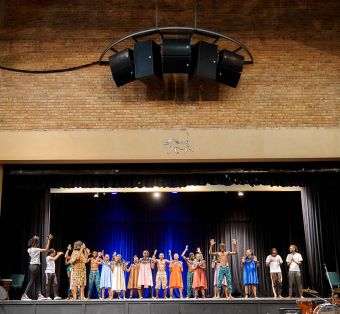
Art for an inclusive Renaissance: How Art can change narratives to include persons with disabilities
A podcast on the Nyakasikana Project in Zimbabwe
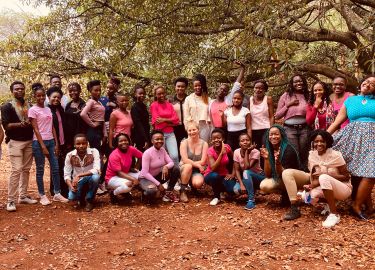
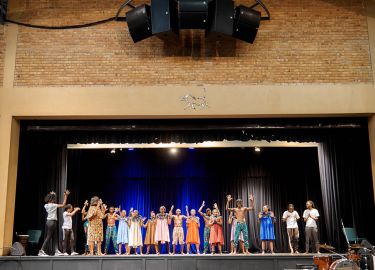
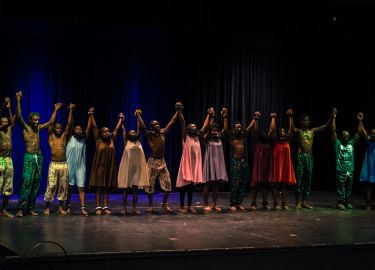
Vera Chisvo created a short podcast with the Tamba Africa Social Circus (TASC) on their NYAKASIKANA project, which is about using art to change the narratives of persons with disabilities in Zimbabwe.
»The Tamba Africa Social Circus (TASC) is a creative advocacy and inclusive arts initiative using intangible cultural heritage to address social issues affecting young people from marginalised communities. Their program NYAKASIKANA is a creative and inclusive culture action project for Gender Equality and the Empowerment of Women and Girls through women-centered leadership development. It seeks to equip girls and young women from marginalised communities (especially those with disabilities) with leadership, autonomy and other critical life and social skills through culture, inclusive arts and social circus tools. Social circus provides spaces for girls to freely explore their women-centered power, express themselves, build personal, functional and knowledge-based skills, and engage in gender artivism campaigns on issues that are important and real to them. NYAKASIKANA’s mission is ›Leadership for sustainable change and creation of creative spaces where gender justice goals can be realized‹.« (Quote by Tamba Africa Social Circus, Info Brochure)
More Info on the work of Tasc
Instagram: @TambaAfrica
Youtube: @TambaAfricaCircus
Facebook: @TambaAfricaSocialCircus
Twitter: @TambaAfrica
Sources
Header and Teaser picture left:
2019 CircAbility production ›Finding Your Feet – Raising Your Voice‹, Copyright: Siyano Media
First picture in gallery below:
International Day of the Girl Child 2020, Copyright: Halema Mekani
Vera Chisvo
Founder of the Creative Hub Incubator ZW Moto Republik, Harare
Maria Kudakwashe Chisvo has built a brand in music and is more popularly known as Vera. Vera has actively been in the music industry for 8 years. Her career has granted her the opportunity to travel both regionally and internationally. Vera has worked as an arts administrator for over 5 years from working accreditation at Harare’s biggest arts festival to managing the very first creative hub in Zimbabwe, Moto Republik. Throughout her career she has worked as a project officer at one of the longest running arts development organizations Pamberi Trust, and was responsible for running the Female Literary Arts and Music Enterprise that trained multiple female artists in Zimbabwe and has also worked as a project manager for Zimbabwe’s first hip hop dance festival Jibilika. Vera has also founded her own hub called Incubator ZW which focuses on creating art that inspires change and changes the narratives of minorities. She is also the founder and co-host of Her Hour Podcast which is a platform for young Zimbabweans to freely express themselves. Vera has over two years experience of working as a guest facilitator at LGBTQ+ trainings.
Picture: © Washington Njagu


Algae, Coffee and Plastic – materials the future is built on
Director of MIT Senseable City Lab & Founding Partner of the international design/innovation office Carlo Ratti Associati
Algae, Coffee and Plastic – materials the future is built on
Why Italy’s Pavilion at Expo Dubai 2020 was a stepping stone for the Next Renaissance
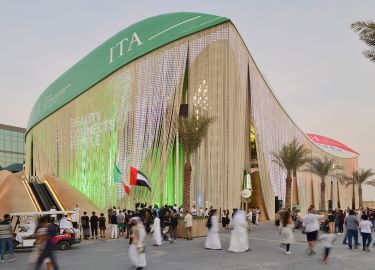
Italy’s Pavilion at Expo Dubai 2020 is an experiment into reconfigurable architecture and circularity. This piece explains the relevance of multidisciplinary innovations to build better—and thus to empower the green transition of cities, communities and economies to a Resilient Renaissance.
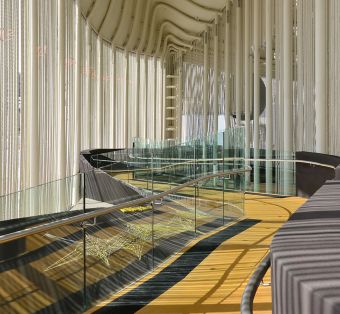
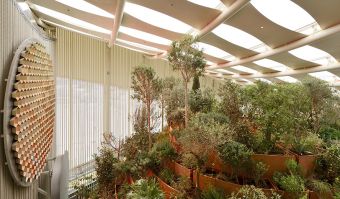
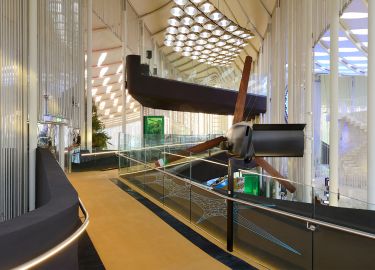
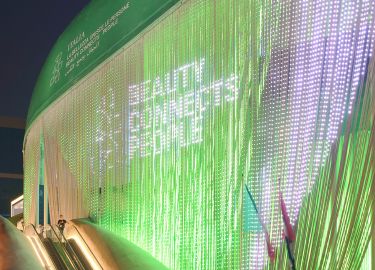
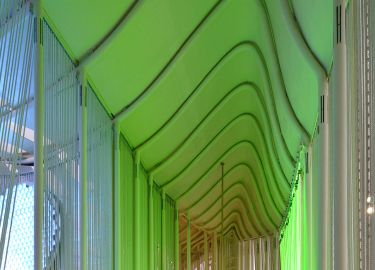
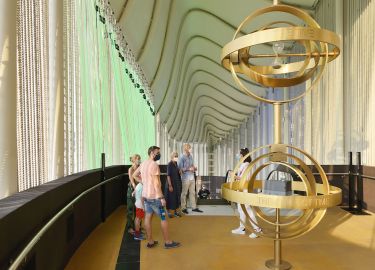
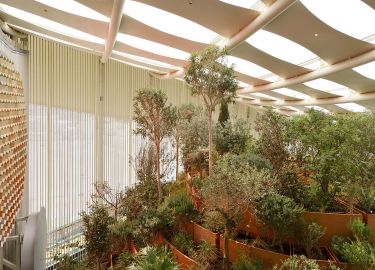
The project puts forward an all-encompassing vision for reconfigurable architecture and circular design involving some of Italy’s most innovative companies. The pavilion features a multimedia façade made with two million recycled plastic bottles, new types of building materials—from algae and coffee grounds to orange peels and sand—and an advanced system for climate mitigation that constitutes an alternative to air conditioning. Reusing is also fundamental to how the structure was conceived. The pavilion utilises three real-sized boat hulls, which could potentially set sail after the event, to create and shape the roof of the building.
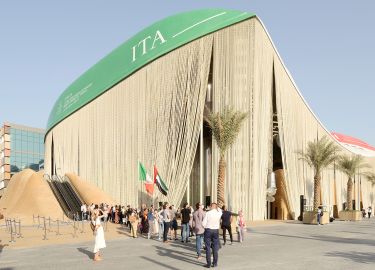
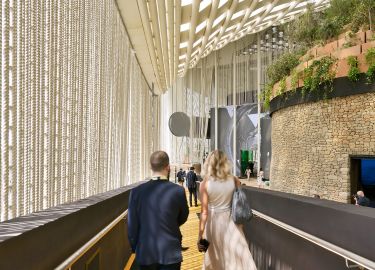
The Italian Pavilion building at Expo Dubai 2020, designed by CRA-Carlo Ratti Associati and Italo Rota Building Office, with Matteo Gatto and F&M Ingegneria, was officially unveiled on October 1st, 2021, as part of the first World Expo ever held in the Arab world. It envisions an architecture which challenges how buildings are usually developed for temporary events such as a World Expo, in which a lot of newly-built structures end up as landfill after just a few months. Contrary to that approach, the Italian Pavilion was conceived as an architecture that is able to transform itself through time, in a sustainable fashion.
Architecture that transforms itself
The roof —and its reuse
The three boat hulls that form the pavilion’s roof vary in length from 40 to 50 meters. They were produced with the contribution of Fincantieri, the largest shipbuilder group in Europe. The hulls are supported by more than 150 slender vertical steel pillars, each 27 meters high. In turn, they support a wave-shaped roof membrane made of ETFE pillows and a layer of perforated thin metal sheets that filter the sunlight. Seen from above, the hulls are coated in an innovative paint developed by paints and coatings company Gruppo Boero.
The wall—and its reuse
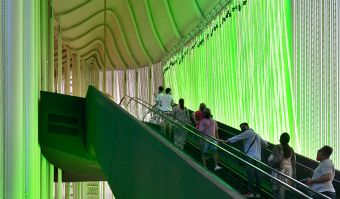
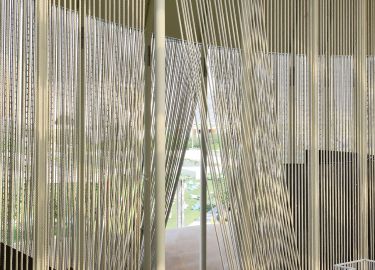
The pavilion has no conventional walls. Instead, a curtain facade made of nautical rope, which also incorporates LEDs that can be lit to transform the facade into a multimedia surface, delineates the exhibition space. The nautical ropes are produced in recycled plastic, using the equivalent of roughly two million bottles, and form an intricate vertical meshwork that stretches almost 70 kilometers (43,45 miles) in length. At the close of the Expo, they will be reused again, in accordance with the logic of the circular economy. The use of the nautical ropes and a localised cooling system integrated with misting allow for extensive shading, natural ventilation, and better thermal comfort. The project strives to showcase more sustainable ways to cool our buildings and cities in the future.
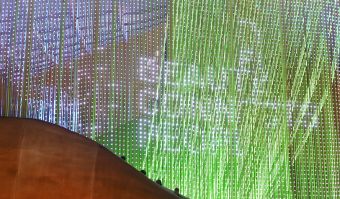
The Energy—and its resilience
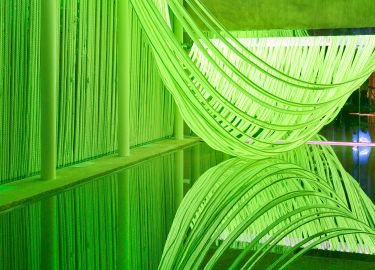
CRA and Italo Rota also designed an installation for global energy company Eni, titled “Braiding the Future”, which focuses on biofixation of carbon dioxide. It recreates a microalgae cultivation using a spectacular cascade of 20-meter-high technological liana vines. Within each of the luminescent lianas flow the microalgae: the see-through circuit becomes a spectacular interpretation of the production technology of these unicellular organisms, which produce high-value compounds through a natural photosynthesis process. The technology of intensified biofixation of carbon dioxide that inspired the installation was developed in Italy by Eni, Politecnico di Torino, and start-up Photo B-Otic. It allows the intensive cultivation of microalgae through photobioreactors, lit through LED technology optimized on specific wavelengths. Located at the entrance of the pavilion and suspended at full height over a body of water, the installation is a clear reference to Eni’s concrete commitment towards a sustainable future, including possible fixation and enhancement of carbon dioxide.
A Building as role model for purpose driven innovations
Hailed from the start as one of the most recognisable designs at Expo Dubai 2020, the Italian Pavilion has won the prize for the Best Entrepreneurial Project of the Year at the prestigious Construction Innovation Awards that are given every year in the country hosting the Exposition. The pavilion is an interdisciplinary construction, planned for deconstruction and re-use from the very start, built on innovations in several disciplines, empowered by an architect—or let us say, by a best-in-class innovation management and architectural team, enabled by a joint vision: This vision—and the people inhabiting it to make change happen—are also the “materials” the future is built on.
Sources:
The pavilion was designed by CRA-Carlo Ratti Associati and Italo Rota Building Office, with Matteo Gatto and F&M Ingegneria.
All pictures: © Michele Nastasi; Carlo Ratti Associati
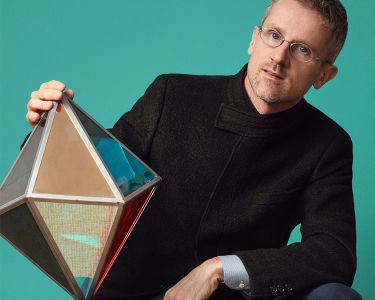
Prof. Carlo Ratti
Director of MIT Senseable City Lab and Founding Partner of the international design and innovation office Carlo Ratti Associati, Turin
An architect and engineer by training, Professor Carlo Ratti teaches at MIT, where he directs the Senseable City Laboratory, and is a founding partner of the international design and inno-vation office Carlo Ratti Associati. A leading voice in the debate on new technologies’ impact on urban life, his work has been exhibited in several venues worldwide, including the Venice Biennale, New York’s MoMA, London’s Science Museum, Barcelona’s Design Museum and Bi-City Biennale of Architecture and Urbanism. Three of his projects – the Digital Water Pavilion, the Copenhagen Wheel and Scribit– were hailed by Time Magazine as ‘Best Inventions of the Year’. He has been included in Wired Magazine’s ‘Smart List: 50 people who will change the world’. He is currently serving as co-chair of the World Economic Forum’s Global Future Council on Cities and Urbanization.
Picture: © Sara Magni

Artists and Ateliers in times of Exponential Change
Épica Foundation La Fura dels Baus
Artists and Ateliers in times of Exponential Change – What a multidisciplinary concept of art production could contribute today to a fair digital society?
Our world has been undergoing a spectacular evolutionary change. From the moment science and technology were aligned, the appearance of new advances became exponential, and these have become the new evolutionary driver, giving rise to a new era full of possibilities, as remote as if we were talking to a contemporary of Leonardo Da Vinci about a mobile phone or a tunnel boring machine. This piece analyses how art can continue under these circumstances to be able to anticipate these advances to society.
The Arts in crisis
The exponential advance of science and technology in recent years has become the driver of most of the major economic, social and even geopolitical changes at a global level.
Changes so far-reaching that they are modifying, and will increasingly modify, pillars such as social relations and our privacy, the labour market and our children’s education, health and its ethical implications. Changes so overwhelming for society that, far from being understood and accepted, they are being imposed before we are aware of them.
Art, which has always been one of the main means of expression of human beings, through which they express their ideas and feelings and the way they relate to the world, is being relegated to exclusively aesthetic expressions in this complex and rapid context, obviating its necessary contribution to understanding and critical capacity in society.
Is a new space for co-creation possible?
At the Fundación Épica la Fura dels Baus, we propose the concept of Anticipatory Arts as a new space for co-creation, knowledge transfer and mutual learning between art, science, technology and society.
A space of encounter and hybridisation where art becomes the driving force and catalyst of horizontal multidisciplinary processes. A space to create false but plausible realities, based on scientific-technological evidence, to be perceived as „real“ by society, and to be able to experience situations that may arrive in a nearer future than we imagine.
A space of real connection with society that allows, through knowledge, to maintain and amplify the critical thinking necessary for society to face the abrupt and accelerated changes that are about to come.
And at the same time, to help science and technology to anticipate the impact, the risks, but also the opportunities, that these advances will have in this new renaissance, where present and future are ever closer, and which will alter human relations in the next 500 years.
Picture Header: Copyright by By Fundación Épica La Fura dels Baus
Anticipatory Arts by Fundación Épica la Fura dels Baus
A selection of video documentations of a new concept of the arts in exponentially changing worlds:
European Performing Science Night 2021 (GA 101036143) – Performance: https://youtu.be/AMGq9Zg_S9U
Complex Systems 2019: https://youtube.com/playlist?list=PLQQ04W3CTIRYHr-R6f7NpuZ2av8ry91zB
About the institiution – the concept of an artist atelier as a Renaissance Laboratory:
Teaser Epica 2021: https://youtu.be/–0t8Stnhyw
More info at: https://lafura.com/en/
Pep Gatell
Artistic Director of La Fura dels Baus since 1980 and President of the Épica Foundation La Fura dels Baus
Pep Gatell (Barcelona, 1958) created over 250 different staging, integrating all kinds of technology such as synthesisers, CD-rom, web pages, dynamics between user-show 3D stereoscopic images, mobile phones App, etc., in the company’s shows. Always seeking to integrate new experiences for spectators, Gatell has had contacts with different multidisciplinary entities and research centers. Since 2012 he collaborates with the R&D team at Mugaritz, the third best restaurant in the world, with which he has directed the documentary Campo a través (Berlinale, 2016). Among his most recent and well-known works, in 2014, he premiered M.U.R.S., developing a new mobile platform for interaction with the audience, he co-directed the opening ceremony of the Olympic Games for Young People in the city of Nanjin and was responsible for the artistic direction of the opening of La Valetta, European cultural city of 2018. Since 2017, Gatell has focused its efforts on the Epica Foundation aiming to position the CCIs as relevant agents in the R+D+i processes necessary to face the global challenges of the 21st century.
Picture: © Fundación Epica La Fura dels Baus La Fura dels Baus
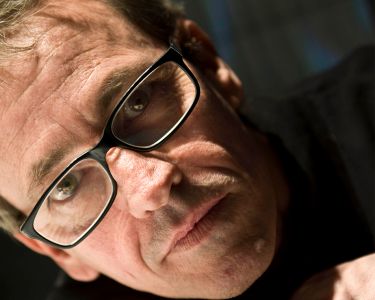
Fco. Javier Iglesias Gracia
General Manager of the Épica Foundation La Fura dels Baus & CEO, CFO, and co-founder of IGLOR Soluciones Audiovisuales Avanzadas S.L
Fco. Javier Iglesias Gracia’s (Barcelona, 1982) expertise as telecommunication engineering researcher began in 2004 with his staging in the IIS group of the Fraunhofer Institute. Iglesias has worked in recognized institutions as i2CAT Foundation or ESADE Business School where he even reached the Spanish secretariat of the ISO Sub-Group JTC1 SC6 dedicated to Future Networks. Iglesias has also dedicated half of his career to foster innovation ecosystems, especially those dedicated to merge science and technology with CCIs. He has been engaged in several national and international projects merging tech and art as, among others, Catalan „Anella Cultural“, the European “Creative Ring”, the „Anillo Latino Americano“, „GREC Innovación“ or „M.U.R.S.” by La Fura del Baus, led the city level innovation ecosystem in Barcelona through the Barcelona Lab project (2011-2015) on behalf of the Direction of Creativity and Innovation of the Institute of Culture, and the business mentoring and support for the Catalan Hub of the CREATIFI European Funded project, for boosting CCI with new technologies.
Picture: © Fundación Epica La Fura dels Baus La Fura dels Baus

Creating cities of greater resiliency
Group of Architects, Designers, Urbanists, Landscape Professionals, Interior & Product Designers, Researchers & Inventors

Creating cities of greater resilience: On the changes in architecture's paradigms for a Renaissance of life in cities for citizens
“Our cities and buildings are built on a paradigm of front of house and back of house. City infrastructure projects are utilitarian machines, isolated from the urban inhabitants they serve. You can find them on Google like cancerous tissue on a city map. The more specialized a utility becomes, the more reasons to separate it from the public to improve its efficiency and performance. We all know that a piece of infrastructure can have negative side effects, like the underside of an overpass, the shadow cast by a chimney, the noise of a highway, or the gaping wound of a parking lot. But we also know that once a piece of infrastructure shuts down, it can be reborn with positive programs. Trains become a park. A power plant becomes a museum. What if we could start by combining the utilitarian and the social? What if our urban infrastructures opened on day one with positive social and environmental side effects?
“Taking the profane and the elevated, we can create a city of higher complexity and greater resilience. If one use dissipates, the other consolidates. One is nocturnal, the other is diurnal. In fact, the more different two activities are, the more likely they are to produce the unprecedented. In architecture, as in love, opposites attract.” 1
The BIG U: Marrying physical resilience with social resilience
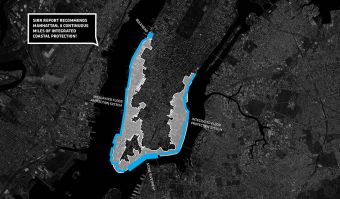
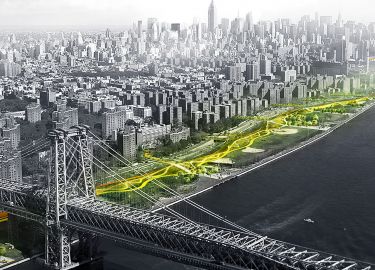
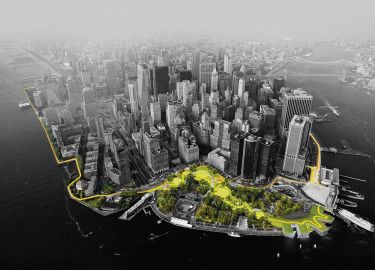
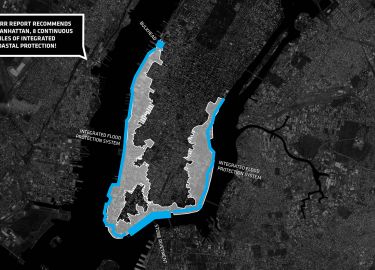
The 10 miles flood protection for Lower Manhattan stretches from West 57th street south to The Battery, and up to East 42nd street, and comprises low-lying geography with the incredibly dense and vibrant, yet vulnerable urban area. The BIG U rethinks infrastructure as a social amenity—what we call social infrastructure.
All pictures of BIG U: Copyright by Bjarke Ingels Group
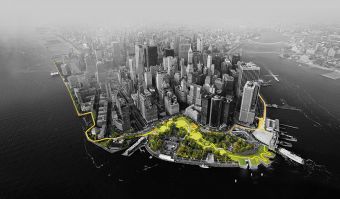
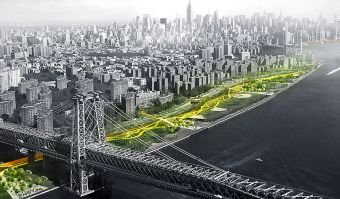
Infrastructure in the United States as it’s traditionally conceived has not been civic, accessible, or designed for interaction with the public in mind. Rather, it has been imposed upon our cities without engagement with community needs at a large scale, at times with terrible consequences for the urban experience. The BIG U combines the mandate to create large-scale protective infrastructure with a commitment to meaningful community engagement. The BIG U’s flood protection won’t look like a wall, and it won’t separate the community from the waterfront. Instead, the structures protecting us from the elements will become attractive recreational centres that enhance the city and lay a positive groundwork for its future public realm.
CopenHill – Amager Ressourcecenter (ARC): a destination economically, environmentally and socially profitable
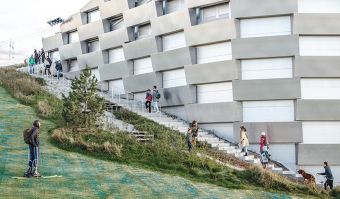
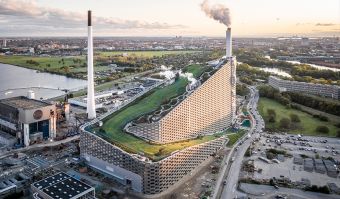
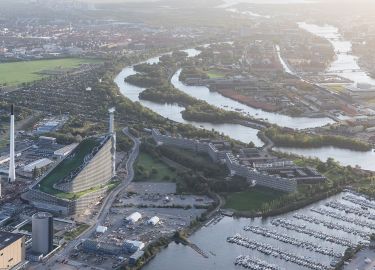
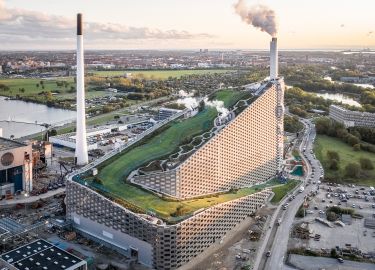
CopenHill, also known as Amager Bakke, opens as a new breed of waste-to-energy plant topped with a ski slope, hiking trail and climbing wall, while aligning with Copenhagen’s goal of becoming the world’s first carbon-neutral city by 2025..
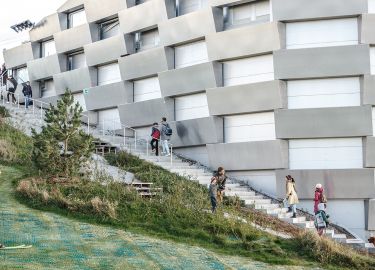
Replacing the adjacent 50-year-old waste-to-energy plant with Amager Ressourcecenter (ARC), CopenHill’s new waste incinerating facilities integrate the latest technologies in waste treatment and energy production. Due to its location on the industrial waterfront of Amager, where raw industrial facilities have become the site for extreme sports from wakeboarding to go-kart racing, the new power plant adds skiing, hiking and rock climbing to thrill-seekers’ wish lists. At its new top, experts can glide down the artificial ski slope or test the freestyle park while beginners and kids practice on the lower slopes. Recreation buffs and visitors reaching the summit of CopenHill feel the novelty of the highest viewing plateau in the city, enjoying its rooftop bar and the sensation of a mountain in an otherwise-flat country.
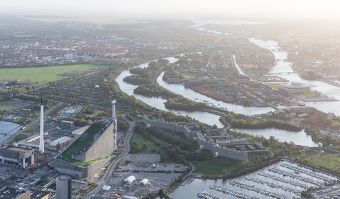
ARC is not an isolated architectural object but envelopes the local history and context while forming a destination. Formerly a piece of infrastructure in an industrial zone, CopenHill becomes the new destination for families, friends and celebration, one that is economically, environmentally and socially profitable.
ARC won World Building of the Year at the World Architecture Festival 2021.
Copyright Picture left: Laurian Ghinitoiuby & BIG – Bjarke Ingels Group
Copyright pictures below: Rasmus Hjortshoj & BIG – Bjarke Ingels Group
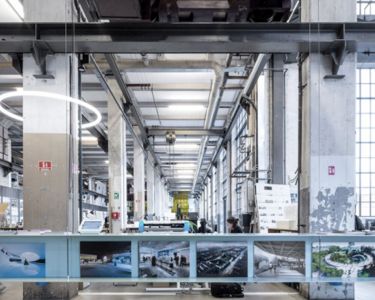
BIG – Bjarke Ingels Group
Copenhagen, New York, London, Barcelona and Shenzhen based group of architects, designers, urbanists, landscape professionals, interior and product designers, researchers and inventors
The BIG office is currently involved in a large number of projects throughout Europe, North America, Asia and the Middle East. BIG’s architecture emerges out of a careful analysis of how contemporary life constantly evolves and changes. Not least due to the influence from multicultural exchange, global economical flows and communication technologies, that all together require new ways of architectural and urban organization. We believe that in order to deal with today’s challenges, architecture can profitably move into a field that has been largely unexplored. A pragmatic utopian architecture that steers clear of the petrifying pragmatism of boring boxes and the naïve utopian ideas of digital formalism. Like a form of programmatic alchemy, we create architecture by mixing conventional ingredients such as living, leisure, working, parking and shopping. By hitting the fertile overlap between pragmatic and utopia, we architects once again find the freedom to change the surface of our planet, to better fit contemporary life forms.
Picture: © Rainer Tepper

New worlds emerge from old sounds
Artist, Music producer, Label owner and Co-Founder of Electronica & Techno label Kompakt, Cologne
New worlds emerge from old sounds: What we can learn from music about making new worlds when Man and Machine meet in new ways?
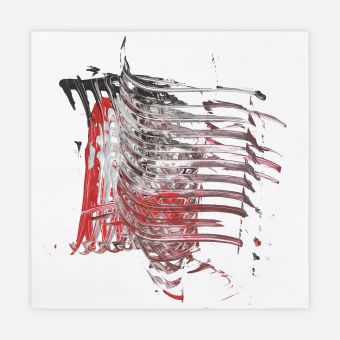
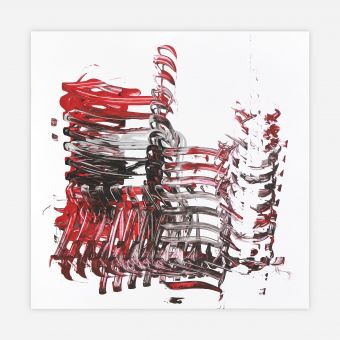
My work RÜCKVERZAUBERUNG 4 is an ambient trip of one hour through more than three centuries of musical history—and more. It resembles the Renaissance principle of constructing new worlds—in this case in music—with new scientific methods building on historical inspirations. Aligning Man and Machine in radically fresh, innovative ways is a method to create and make the new. My interpretation of this Renaissance method, applied in the 21st century, is “Looping”—in music and painting.
We hear the medieval sounds of lutes and flutes weaving into fragments of baroque falsetto singing, bells and bugles, creating abstract, amorphous sound constructs. Little spinet and harp loops gyrate intoxicatedly across beautifully feverish violin planes. Atonality and euphony flow into each other effortlessly and part again. New worlds emerge from old sounds.
In my musical and pictorial work I have mostly followed strictly conceptual principles, which I repeatedly refine and variegate. Besides a predominantly sample-based, sometimes abstract, sometimes gestural, sometimes figurative musical language, it is mainly the loop principle that has fascinated me all along. The static or varied replay of minimalistic, repetitive structures births certain patterns and shapes. This way of creating is influenced and structured by computer-based programs. And although, or maybe because of, the computer being my primary artistic medium in both disciplines—and I mainly considers myself a digital artist—I occasionally transpose my conceptual, mostly serial ideas to the „live“ instrument (Freiland Klaviermusik) and „real“ colour (machine painting).
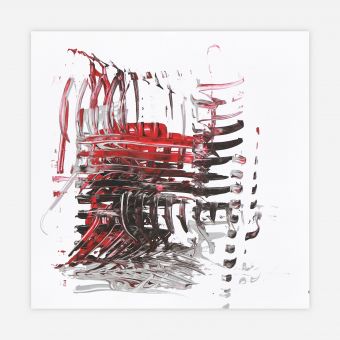
My work since 1990 can be understood in light of one of today’s most pressing questions: How are Man and Machine related? My work has been driven by the rapid development of Artificial Intelligence which is constantly changing our understanding of this relationship. The traditional balance of Man and Machine, of Artificial and Artistic Intelligence, formerly carved out in the Renaissance, is being changed in the 21st century by new emerging technologies. RÜCKVERZAUBERUNG 4 is an exploration of this change expressed in the musical and visual arts: The Loop as a Method.
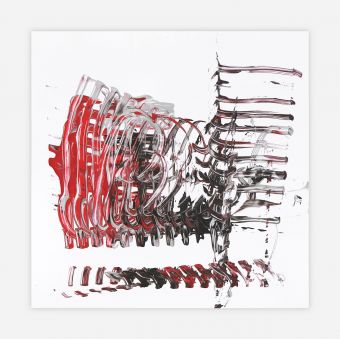
About the work of Wofgang Voigt:
The creative body of Wolfgang Voigt has always been characterised by complexity, boundlessness, unpredictability. The negation of the bounds of genre, style, and taste has been and still is today a crucial element of his body of work, just like the uptake, quotation and processing of external contents through universal sampling. Having been socialised in the pop culture of the 1970s and 80s, Voigt has since been creating his very own art-music cosmos influenced by glam rock and jazz, new wave and folk music, pop art, and digital expressionism. In the 1990s, Voigt, a founding member and influential part of the Cologne-based electronic label Kompakt, advanced in the wake of the globally booming techno movement, restlessly driven by his iconic straight bass drum, producing countless projects ranging from formally rigorous minimalism and expressive hardcore acid, to gabber and polka, to driving the conceptual techno made in Cologne (Sound of Cologne). His audiovisual project GAS, based on psychedelically-compressed classical sound sources in combination with ecstatically-focused forest photographs and films, has captured audiences far beyond electronic music and techno.
Listen to & Buy WOLFGANG VOIGT – RÜCKVERZAUBERUNG 4 10/2011 Profan CD11: https://kompakt.fm/releases/rueckverzauberung_4_digital_album
Wolfgang Voigt
Grown up and socialized in the pop sub-culture of the 1970s and 1980s, Voigt has developed his own art and sound that cross genres, mixing music styles such as glam rock, pop, jazz, classic, punk, and new wave, and art movements such as pop art and the Neue Wilde (the ‘New Wild Ones’). Inspired by the minimalist structures of this creative expressions, Voigt works around the most diverse facets of his own ideas of subversive concept art and music. Two fundamental approaches, through innumerable variations, characterize Voigt’s music and artwork. The first: the loop principle – the static or varying repetition of minimalist, repetitive structures which generate specific patterns. The structure of computer-based music production and associated software clearly and strongly influences this artistic concept, reflected in Voigt’s body of art and music. The second: the abstract deforming and condensing of external resources, i.e. the sampling of different sounds or images reduced to their original basic structure, their raw aesthetics, in a certain sense their (hypothetical) liberation, and transferred into a new context – a process that Voigt calls „Entdeutung“, i.e. de-signification.
Picture: © Unland