

Ten Hypotheses on Society-Centered Design
Professor at Graz & Kassel University, Culture & Design Consultant, Manager & Networker
1. A world in transformation
Our world is currently undergoing an enormous transformation. Above all, young people who are aware of the negative effects of today’s economic model are discussing new approaches to the world: The inequality between the first, second and third worlds meets with criticism and measures are demanded to stop the increasing destruction of our environment. A growing number of people are participating in social initiatives and working hard to make the world around them a better place.
2. Design and its great social responsibility
Design has played a crucial role in the developments of industrial societies over the past 150 years, thereby affecting man and his environment. Subsequently, designers are aware of their great responsibility in using creative means to resolve the problems we are faced with now and in the future.
3. User-centered design
Until about 30 years ago, the design process was neither interested in man nor environment; it was chiefly about achieving entrepreneurial success and profit maximization. However, from the turn of the millennium on, the idea gained popularity that the design process should take account of human needs and the capabilities and behavioral patterns of individual users. User-centered design came to be the new creed in the design scene.
4. Individual success versus long-term consequences
However, in a globalized, networked world, anything that could benefit one individual could harm another – not to mention our planet. The negative consequences of a creative method that focuses too much on the individual, at the same time ignoring the political and societal dimension of design, have now become evident.
5. A new paradigm?
As early as 1971, Papanek in his book “Design for the Real World” criticized the trend toward producing “useless, potentially harmful, irresponsible and questionable items of mass consumption” from an ecological point of view. He spoke out against irresponsible design and developed a radio for the third world based on an old tin can.
6. Society-centered design
50 years on, Papanek’s approaches are now gaining increasing approval. Many designers are no longer prepared to pander to wealthy clients in their search for aesthetic segregation, but are beginning to question their role in the context of the widening gap between rich and poor and in the light of environmental problems. They participate in social movements, support grassroots initiatives and try to contribute to improving the world as quietly and unobtrusively as possible.
7. Society-centered design from a holistic perspective
Designers must be aware that they are shaping ecosystems and not just individual applications. They need to look beyond the individual user and immediate financial success in order to develop the best possible solution for man, society and nature. “Society-centered design” is sourced precisely from that design context. It not only addresses users and business, but also society and environment and their various different interdependencies.
8. Society-centered design – a better business strategy
Enterprises, too, feel that it is time for a new approach in product development. Today’s consumers are more informed and critical, they check on the item’s production process and if employees are fairly treated, or on the attitude of companies and brands towards social questions. Many people want to contribute to community welfare and environmental protection. Accordingly, they seek businesses and designers that offer products and services in line with their own mindset. Consequently, society-centered design is no idealistic ideology, but rather a competitive advantage for entrepreneurs who wish to reach out to the public (and realize profit).
9. Society-centered design: a new mindset
In order to do justice to society-centered design, we not only need a new mindset, but also committed strategies and augmented methods. Instrumental to the concept would be to additionally integrate the needs of non-human stakeholders – such as animals and the environment – in the design process. To that end, we require knowledge and creative technologies from human-centered design and usability, as well as from the realm of ecology, environmental sciences, sociology and philosophy.
10. The future of design
Primarily, designers need to internalize holistic thinking and let it flow into their daily work, besides convincing businesses and clients of how essential that approach is. Society-centered design is not an idealistic bubble, but a real competitive advantage for enterprises. The key to success is to get together and develop a new design approach. And think ahead: it all depends on collaboration — between politics, science, the economy, designers, activists and citizens — in order to find solutions and achieve and implement this new idea of design in the near future.
Prof. Karl Stocker, PhD
Professor at Graz & Kassel University, Culture & Design Consultant, Manager & Networker
Karl Stocker, PhD., historian, exhibition director, information designer, chair of bachelor programme Information Design (2004-2021) and Master programme Exhibition Design (2006-2021), head of Institute Design and Communication at University of Applied Sciences Graz (till 2021), professor at the Graz University (since 1988) and Kassel University (1996/97), founder and director of Bisdato Exhibition & Museum Design (1990-2021), author/editor of books and scientific contributions, manager of scientific research projects, director of exhibitions, ambassador of Graz UNESCO City of Design.
Picture: © Lex Karelly

HOW WE LIVE TOGETHER
Founder and Creative Director of Streaming Museum, New York
HOW WE LIVE TOGETHER – Artistic ways of understanding community, individuality, spaces, and rhythms of life for possible futures.
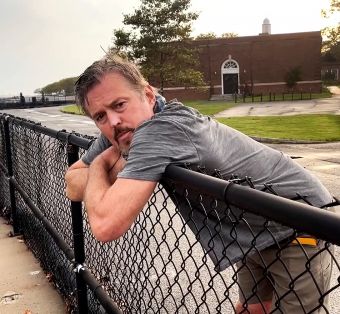
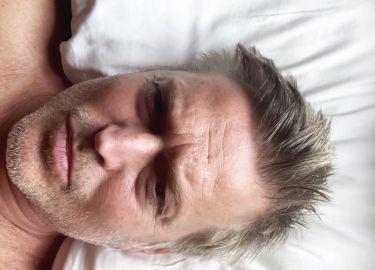
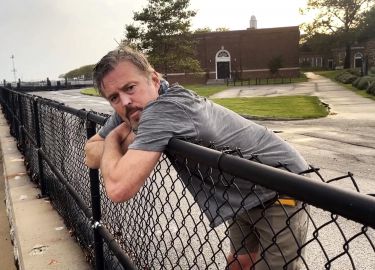
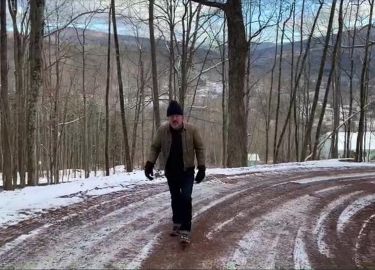
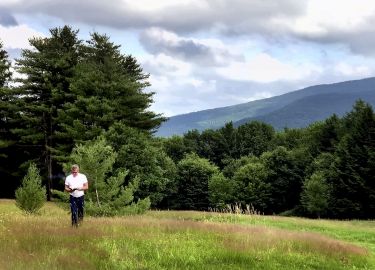
Four short films by Anne Katrine Senstad created in collaboration with Actor Bill Sage. 1
In a critical look at the human condition in current world affairs, filmmaker Anne Katrine Senstad suggests that a healthy value system has been disenfranchised and replaced by what the French philosopher Jean Baudrillard (1929-2008) called a simulacra—a postmodern imitation of reality, consumerism, and predatory systems. Senstad with actor Bill Sage express these theories in the films which were produced remotely along with sound producer JG Thirwell, within the confines of isolation during the pandemic. Senstad and Sage sharpen our understanding of today’s crisis to embark successfully to rebuild a better world.
Anne Katrine Senstad is a New York-based Norwegian artist. Her international practice lies in the intersections of installation art, photography and video, immersive installation art, and site specificity, with a focus on the phenomena of perception and ethics. Her sociopolitical projects engage in gender politics, community and critical philosophy through text and film.
Bill Sage is an American actor who has appeared in over 120 films, TV and stage productions. Throughout his career, Sage has been a champion for diversity and equality in the film industry. He has made a point of working with female Directors, Writers and Producers. Select film and TV performances include American Psycho, The Insider, Boardwalk Empire, and Hap & Leonard.
JG Thirlwell, is a sound producer and composer based in Brooklyn, NY. The state of the art sound for “How We Live Together” has been mastered by Thirlwell for an enhanced and dimensional experience of the actors performance. He has released over thirty albums and creates the musical score for the Emmy-winning FX show Archer, and the Adult Swim / Cartoon Network show The Venture Bros. foetus.org.

UTOPIE/UTOPIA (2020)
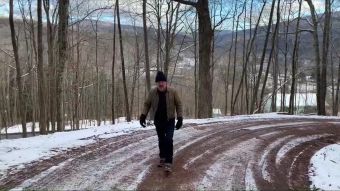
UTOPIE/UTOPIA (2020) theorises that tolerant co-habitation is a place of utopia, and reflects on ways of understanding community and individuality, societal and political systems, and solitude and the degree of contact necessary for individuals to exist and create at their own pace. Anne Katrine Senstad’s film explores the nuances of French philosopher Roland Barthes’ (1915-1980) term “idiorrhythmy”—a productive form of living together in which one is autonomous yet recognises and respects the individual rhythms of others.
In Senstad’s first film in the series of four, exploring Barthes text “UTOPIE/UTOPIA” from his 1977 book How To Live Together, acclaimed actor Bill Sage, in a personal and evocative monologue performance, assumes the character of Barthes in the creative process of preparation for his University lecture series of four decades ago. Set in the context of our contemporary world that is gripped by societal and political crises amplified by the 2020 pandemic, Sage’s character explores various forms of solitude through Barthes’ contemplations on history, psychology and societal structures. Barthes’ text concludes that our “Sovereign Good” is a form of tactful cohabitation and that an inner state—the state of tolerance—is a place of utopia.
MÔNOSIS/MONOSIS
Barthes contemplates the human monastic state—solitude, the isolated self, and seeks to identify the problem of separation, from community and from our internal unification as an aspect of iddiorhythmic Living-Together. Within societal structures, to be alone is construed as a punishment. However, in the place of utopic unity, the individual searches for a state of peaceful tolerance as distanced cohabitation.
MARGINALITÉS/MARGINALITIES
Those who live on the margins or who react to violence and oppression created by power are the source of intense social anxiety and considered dangerous—until they can be controlled and conform to society’s norms. The margins, however, are also a place of power, one which is untouchable and a form of a holy state. The isolated state on the margins is the creative space in which Barthes examines liberation.
XÉNITEIA/XENITEIA
The fourth chapter reflects on notions of exile and the displacement of peoples—politically, psychologically and due to climate change. The idea of being an outcast from ones home and not belonging o a community—to be ‘in the world but not of the world’. We are ultimately alone, exiled within the world and from ourselves. Barthes interweaves states of inner displacement and nostalgia—ultimately sentiments of isolation.
watch how we live together
An Exclusive Online Screening was presented October 31-November 15, 2021 at StreamingMuseum.org. The link below will lead to excerpts from each of the 4 short films by Anne Katrine Senstad, that were created during the pandemic in collaboration with acclaimed American actor Bill Sage and audio produced by JG Thirlwell.
Click here and enjoy watching: https://www.streamingmuseum.org/anne-senstad-how-we-live-together
Sources
1 This article is presented by Nina Colosi, founder of Streaming Museum and co-producer of the special UN 75th anniversary issue of the publication CENTERPOINT NOW, “Are we there yet?” A version of this article entitled „UTOPIE/UTOPIA“ appears in the publication. Copyright 2020, World Council of Peoples for the United Nations.
All pictures are film stills. Copyright by Anne Katrine Senstad & Bill Sage
Nina Colosi
Founder and Creative Director of Streaming Museum, New York
Nina Colosi is the founder and creative director of NYC-based Streaming Museum, launched in 2008 as a collaborative public art experiment to produce and present programs of art, innovation and world affairs. Streaming Museum programs have been presented on 7 continents reaching millions in public spaces, at cultural and commercial centers and StreamingMuseum.org. Following her early career as an award-winning composer she began producing and curating new media exhibitions and public programs internationally, and in New York City for The Project Room for New Media and Performing Arts at Chelsea Art Museum, Digital Art @Google series at Google headquarters, and many other collaborations. In 2020 Colosi co-produced Centerpoint Now “Are we there yet”, the UN 75th anniversary issue of the publication of World Council of Peoples for the United Nations.
Picture: © Jacqueline C. Bates


Plea for a European Renaissance from Below
Founders of Herr & Speer, Berlin
Plea for a European Renaissance from Below
Anyone looking at Europe today sees a continent struggling for its future. We have no doubt that the EU is no longer a stable house: Nationalist and populist movements are undermining Europe’s democracy, civil liberties and the rule of law are in danger, and many citizens‘ fears of decline and worries about the future are real. Instead of 28 states, there are now only 27 united under the umbrella of the European Union. And hanging over everything is the sword of Damocles of the climate crisis with its existential threat to future generations and to our fellow creatures. These and many other concerns are not easy to address and are even more difficult to solve.
But if you look at Europe today, you see not only shadows but also a lot of light. We see developments that give us courage and optimism. Civil society is resisting cuts to the rule of law, tens of thousands of young people are taking to the streets in support of better climate policy, and a new generation of politicians is taking up positions in parliaments and city councils with pro-European ideas and concrete commitment. At the same time, European entrepreneurs and cultural workers are developing solutions and offers that combine economy and socio-ecological responsibility, culture and politics. And all of this is increasingly happening across borders. Something is moving in Europe, a new spirit is blowing and the beginnings of a political, cultural and economic awakening can be seen—driven by the ideas and longing for the future of the young generation.
Rediscovering the Revolutionary Spirit of European Unification
In order for this tender seedling of European awakening, creativity, entrepreneurial spirit, political responsibility and the common good to develop, Europe will need the courage to try something new. Inspiration for this can also be found in the past. The European unification project itself shows with its development steps, which reconciled states and people and gave room to new ideas and methods, how it can be done. This spirit must be rediscovered, just as in the Renaissance, when people rediscovered what was once possible.
If we look at the history of European unification, it is nothing less than a revolution and one of the most successful ventures in history. European unification with its various stages of development—the Coal and Steel Community, the European Economic Community, the European Community up to today’s EU—has fundamentally changed the dynamics of European politics and its modus operandi from what was the continental custom for centuries: rivalry and war.
The result: never has there been a longer period of peace on the continent, never has economic and social progress been so comprehensive. Today, despite all the challenges, the EU is one of the most peaceful regions in the world, as the Global Peace Index shows. This idea would hardly have been conceivable in 1918 or 1945, or even between 1618 and 1871. In terms of peace, the revolution delivered what it promised. This was also due to the fact that this European Revolution was one of a special kind. Unlike many other revolutions with disruptive violent outbursts, political radicalisation and hasty throws, European unification was a process of careful steps, not too big, but mostly consistent.
Against the background of decades of enmity, especially between Germany and France who were central figures in the European project from the beginning, this mode is not surprising. But it has also been astonishingly successful. Traditional and nationally focused politics were not broken up and overthrown in one fell swoop, but reformed in small bites and introduced to a new Europe of cross-border cooperation. This was also due to the courage to come up with new and unusual ideas and proposals.
Ideas are the fuel
The EU embodies the courage to give new ideas a space and a chance, even and especially when the deceptive promise of settling down and staying put is at its greatest. This special spirit that can blow when we dare to do something new is described by Gerhard Brunn when the new Commission President Jacques Delors took office in 1985: „From the very first moment, he instilled new self-confidence into the demoralised, disoriented Commission and, with a handful of brilliant staff and a fireworks display of ideas, got it moving in such a way that some people lost their hearing and sight.“ Even if all these ideas (from Delors and many others) were not always implemented immediately, they often came to fruition via detours, and sometimes years later. Whether in the case of the common currency, the dismantling of border controls or a common security policy, a moment has always been found to take a further step toward integration.
In this way, revolutionary things were created through a gradual but constant evolution of political ideas. We call this modus operandi of the European Union and its predecessor organisations the European revolution of small steps. We think it is time to recall this revolutionary spirit, to revive it and to activate it, specifically for the future. While grand and long-term visions and castles of thought are important and can be beacons for the future, the immediate future of Europe is in the hands of those who understand and walk the fine line between too little and too much.
The EU thrives on constant development and movement forward. So pausing is not an option. At the same time, the history of European unification teaches us that taking too big a leap or doing too much in one fell swoop can be equally damaging and counterproductive. The United States of Europe, the European Federation or the European Republic may be inspiring goals, but the way to get there is through concrete, bold and feasible steps that directly and positively improve life in the EU.
Those who want to prepare the ground for a new European Renaissance do not always have to start at the top and with the big questions. We are convinced that change and progress always begin on a small scale. This makes the more than 450 million citizens important players. They help decide the direction in which Europe is heading. But far too often, obstacles are placed in the way of their ideas and their drive, or they are unable to realise their potential for financial reasons. If you want to think about the future, you have to be able to afford it. We have a proposal to change that and give more people the opportunity to drive social, cultural and economic innovation.
A start-up booster for all Europeans as a seedbed for innovation and progress
Europe is not a continent with a strong culture of entrepreneurship or innovation. This is particularly noticeable for young, creative and creative people with ideas. Anyone with an idea for a social innovation, an art project or a company is often confronted with skepticism, risk aversion and complicated access to financial support. Culturally and structurally, the European region tends to be geared more toward security and stability and less toward risk-taking and the ability to change. Anyone in the EU who has run a start-up into the ground or failed with a political idea or an ambitious art project rarely receives recognition or is encouraged to try again. Avoiding mistakes is more important than learning from them.
The European start-up scene is also underfunded. Nearly half of young European companies receive the all-important initial investment from outside the EU. „European investors are cautious and skeptical and want to see sales before they invest,“ writes journalist Grace Brennan. All of this puts the brakes on innovation. It’s no surprise, then, that in the top 10 rankings of the world’s most startup-friendly countries, with the exception of Germany in second place, EU states find themselves at the bottom of the list, in this order: Poland, Spain, Sweden and France. How many good ideas, groundbreaking works of art, smart products or innovative political approaches do not therefore see the light of day?
5,000 euros for all young people as a nationwide start-up booster
If Europe wants to put wind under the wings of the next generation with their ideas and see innovations take off, something has to change. While it takes time and perseverance to evolve cultural behaviours and thought patterns, it is possible to make direct changes in terms of funding and framework conditions.
We propose that every young person in the EU between the ages of 20 and 30 should have access to a so-called European innovation start-up credit. A minimum sum of 5,000 euros should be accessible to all those who want to start their own business with an entrepreneurial idea or a social, cultural or political innovation, or who want to continue their professional training. The sum would be provided by the EU budget from EU taxes and distributed by national and regional employment agencies and offices. Young people could register there or online with their business idea or educational project and thus receive their start-up credit with as little bureaucracy as possible. After a brief check, the funding amount of 5,000 euros would then transferred to the business account or directly to the respective educational institution. A one-time higher funding sum of up to 30,000 euros would also be possible if a convincing concept were presented and appropriate follow-up documentation ensured.
The start-up credit would pay particular attention to an aspect that is often neglected in the discussion about start-ups and innovations: the connection between a successful start-up and the socio-economic background of the founders.
Unfortunately, it is still disproportionately men who found companies. Around 93 percent of tech funding goes to all-male teams.1 So it’s not so much the individual’s dedication, sincerity or courage that determines entrepreneurial success in the early hours, but their financial and social background and gender.2
Those with a safety net can take greater risks. Those who are hyper-masculine take success home with them. The EU must counter this Anglo-Saxon and male-dominated logic and culture with something of its own and respond with an egalitarian, decentralised and diversity-oriented instrument. A European innovation starter credit will change hundreds of thousands of lives and make ideas fly in Europe.
Europe Bottom-Up as an Opportunity
What can happen when millions of people are given the opportunities to test or even implement their ideas and creativity can only be imagined. We are firmly convinced: Europe still has its best days ahead of it if we remember our strengths and values, carefully nurture our curiosity and ability to learn, and empower more people to be part of the path of progress. We, the citizens of Europe, have all the qualities and skills needed for this European path, this new European Renaissance.
Sources
1 Elizabeth Schulze, »93 % of funding for European tech start-ups goes to all male teams, new report finds«,
CNBC, 07.12.2018, https://www.cnbc.com/2018/12/07/ metoo-in-europe-93percent-of-tech-funding-goes-to-all-male-founders.html
2 Aimee Groth, »Entrepreneurs don’t have a special gene for risk – they come from families with money«,
Quartz, 17.07.2015, https://qz.com/455109/entrepreneurs- dont-have-a-special-gene-for-risk-they-come-from-families-with-money/
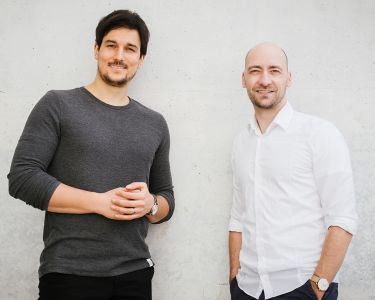
Vincent-Immanuel Herr & Martin Speer
Vincent-Immanuel Herr and Martin Speer are authors, speakers and consultants from Berlin. They are initiators of the EU mobility program DiscoverEU and are committed to a united Europe and gender equality. Their latest book „Europe For Future – 95 Theses that Save Europe“ was published by Droemer in 2021.
More info: www.herrundspeer.eu
Picture: © Phil Dera

Art for an inclusive Renaissance
Founder of the Creative Hub Incubator ZW Moto Republik, Harare
Art for an inclusive Renaissance: How Art can change narratives to include persons with disabilities
A podcast on the Nyakasikana Project in Zimbabwe
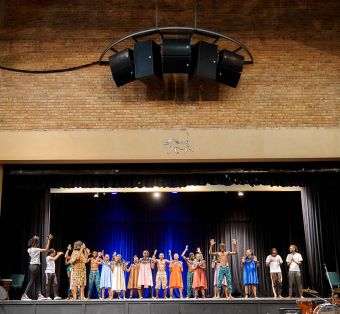
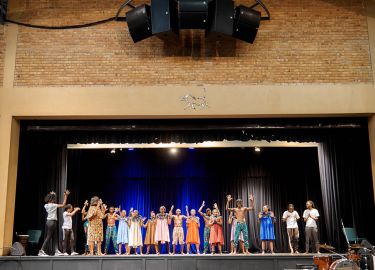
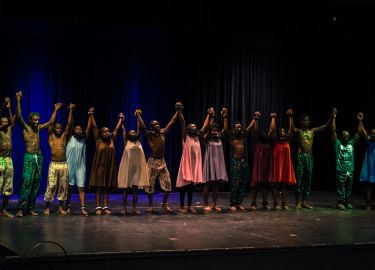
Vera Chisvo created a short podcast with the Tamba Africa Social Circus (TASC) on their NYAKASIKANA project, which is about using art to change the narratives of persons with disabilities in Zimbabwe.
»The Tamba Africa Social Circus (TASC) is a creative advocacy and inclusive arts initiative using intangible cultural heritage to address social issues affecting young people from marginalised communities. Their program NYAKASIKANA is a creative and inclusive culture action project for Gender Equality and the Empowerment of Women and Girls through women-centered leadership development. It seeks to equip girls and young women from marginalised communities (especially those with disabilities) with leadership, autonomy and other critical life and social skills through culture, inclusive arts and social circus tools. Social circus provides spaces for girls to freely explore their women-centered power, express themselves, build personal, functional and knowledge-based skills, and engage in gender artivism campaigns on issues that are important and real to them. NYAKASIKANA’s mission is ›Leadership for sustainable change and creation of creative spaces where gender justice goals can be realized‹.« (Quote by Tamba Africa Social Circus, Info Brochure)
More Info on the work of Tasc
Instagram: @TambaAfrica
Youtube: @TambaAfricaCircus
Facebook: @TambaAfricaSocialCircus
Twitter: @TambaAfrica
Sources
Header and Teaser picture left:
2019 CircAbility production ›Finding Your Feet – Raising Your Voice‹, Copyright: Siyano Media
First picture in gallery below:
International Day of the Girl Child 2020, Copyright: Halema Mekani
Vera Chisvo
Founder of the Creative Hub Incubator ZW Moto Republik, Harare
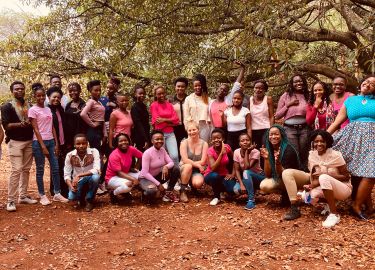
Maria Kudakwashe Chisvo has built a brand in music and is more popularly known as Vera. Vera has actively been in the music industry for 8 years. Her career has granted her the opportunity to travel both regionally and internationally. Vera has worked as an arts administrator for over 5 years from working accreditation at Harare’s biggest arts festival to managing the very first creative hub in Zimbabwe, Moto Republik. Throughout her career she has worked as a project officer at one of the longest running arts development organizations Pamberi Trust, and was responsible for running the Female Literary Arts and Music Enterprise that trained multiple female artists in Zimbabwe and has also worked as a project manager for Zimbabwe’s first hip hop dance festival Jibilika. Vera has also founded her own hub called Incubator ZW which focuses on creating art that inspires change and changes the narratives of minorities. She is also the founder and co-host of Her Hour Podcast which is a platform for young Zimbabweans to freely express themselves. Vera has over two years experience of working as a guest facilitator at LGBTQ+ trainings.
Picture: © Washington Njagu


Algae, Coffee and Plastic – materials the future is built on
Director of MIT Senseable City Lab & Founding Partner of the international design/innovation office Carlo Ratti Associati
Algae, Coffee and Plastic – materials the future is built on
Why Italy’s Pavilion at Expo Dubai 2020 was a stepping stone for the Next Renaissance
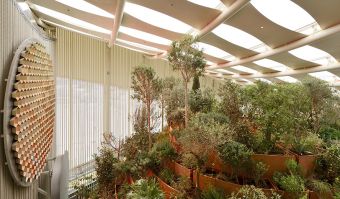
Italy’s Pavilion at Expo Dubai 2020 is an experiment into reconfigurable architecture and circularity. This piece explains the relevance of multidisciplinary innovations to build better—and thus to empower the green transition of cities, communities and economies to a Resilient Renaissance.
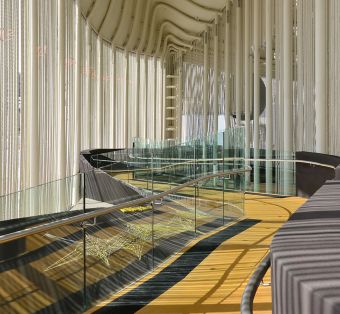
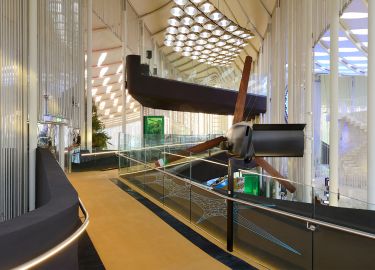
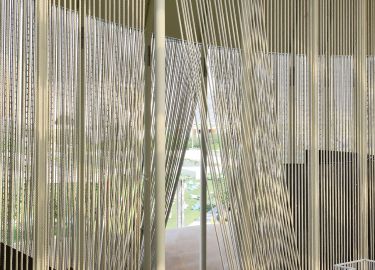
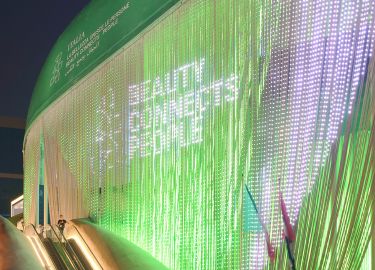
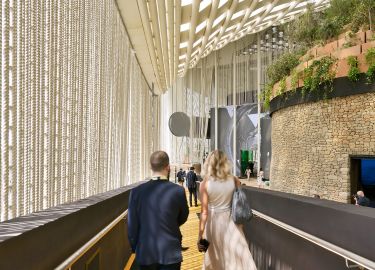
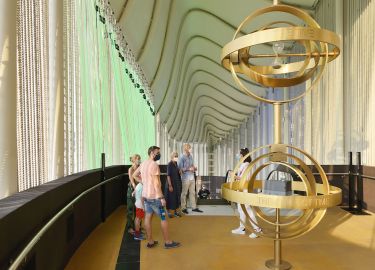
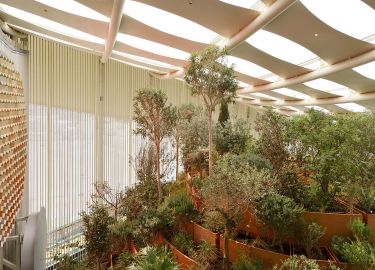
The project puts forward an all-encompassing vision for reconfigurable architecture and circular design involving some of Italy’s most innovative companies. The pavilion features a multimedia façade made with two million recycled plastic bottles, new types of building materials—from algae and coffee grounds to orange peels and sand—and an advanced system for climate mitigation that constitutes an alternative to air conditioning. Reusing is also fundamental to how the structure was conceived. The pavilion utilises three real-sized boat hulls, which could potentially set sail after the event, to create and shape the roof of the building.
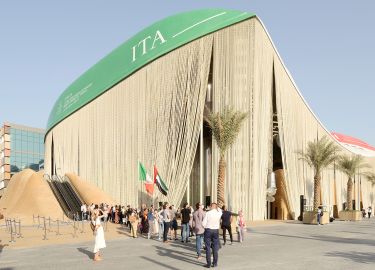
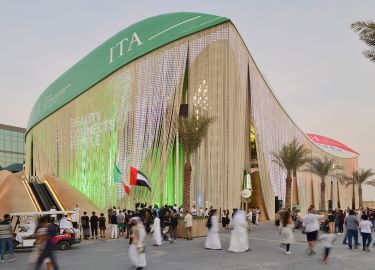
The Italian Pavilion building at Expo Dubai 2020, designed by CRA-Carlo Ratti Associati and Italo Rota Building Office, with Matteo Gatto and F&M Ingegneria, was officially unveiled on October 1st, 2021, as part of the first World Expo ever held in the Arab world. It envisions an architecture which challenges how buildings are usually developed for temporary events such as a World Expo, in which a lot of newly-built structures end up as landfill after just a few months. Contrary to that approach, the Italian Pavilion was conceived as an architecture that is able to transform itself through time, in a sustainable fashion.
Architecture that transforms itself
The roof —and its reuse
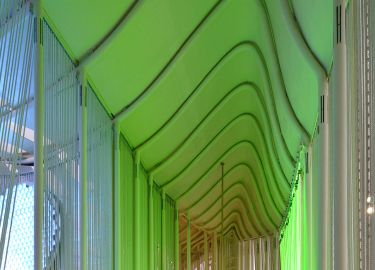
The three boat hulls that form the pavilion’s roof vary in length from 40 to 50 meters. They were produced with the contribution of Fincantieri, the largest shipbuilder group in Europe. The hulls are supported by more than 150 slender vertical steel pillars, each 27 meters high. In turn, they support a wave-shaped roof membrane made of ETFE pillows and a layer of perforated thin metal sheets that filter the sunlight. Seen from above, the hulls are coated in an innovative paint developed by paints and coatings company Gruppo Boero.
The wall—and its reuse
The pavilion has no conventional walls. Instead, a curtain facade made of nautical rope, which also incorporates LEDs that can be lit to transform the facade into a multimedia surface, delineates the exhibition space. The nautical ropes are produced in recycled plastic, using the equivalent of roughly two million bottles, and form an intricate vertical meshwork that stretches almost 70 kilometers (43,45 miles) in length. At the close of the Expo, they will be reused again, in accordance with the logic of the circular economy. The use of the nautical ropes and a localised cooling system integrated with misting allow for extensive shading, natural ventilation, and better thermal comfort. The project strives to showcase more sustainable ways to cool our buildings and cities in the future.
The Energy—and its resilience
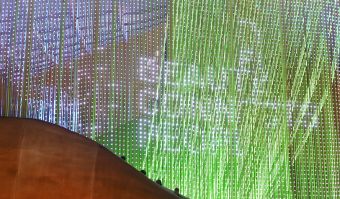
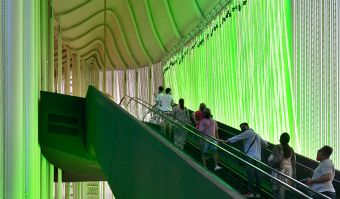
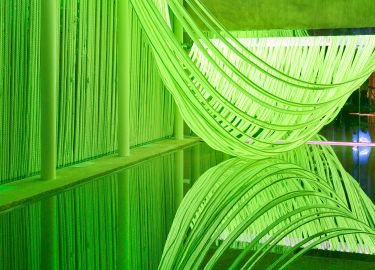
CRA and Italo Rota also designed an installation for global energy company Eni, titled “Braiding the Future”, which focuses on biofixation of carbon dioxide. It recreates a microalgae cultivation using a spectacular cascade of 20-meter-high technological liana vines. Within each of the luminescent lianas flow the microalgae: the see-through circuit becomes a spectacular interpretation of the production technology of these unicellular organisms, which produce high-value compounds through a natural photosynthesis process. The technology of intensified biofixation of carbon dioxide that inspired the installation was developed in Italy by Eni, Politecnico di Torino, and start-up Photo B-Otic. It allows the intensive cultivation of microalgae through photobioreactors, lit through LED technology optimized on specific wavelengths. Located at the entrance of the pavilion and suspended at full height over a body of water, the installation is a clear reference to Eni’s concrete commitment towards a sustainable future, including possible fixation and enhancement of carbon dioxide.
A Building as role model for purpose driven innovations
Hailed from the start as one of the most recognisable designs at Expo Dubai 2020, the Italian Pavilion has won the prize for the Best Entrepreneurial Project of the Year at the prestigious Construction Innovation Awards that are given every year in the country hosting the Exposition. The pavilion is an interdisciplinary construction, planned for deconstruction and re-use from the very start, built on innovations in several disciplines, empowered by an architect—or let us say, by a best-in-class innovation management and architectural team, enabled by a joint vision: This vision—and the people inhabiting it to make change happen—are also the “materials” the future is built on.
Sources:
The pavilion was designed by CRA-Carlo Ratti Associati and Italo Rota Building Office, with Matteo Gatto and F&M Ingegneria.
All pictures: © Michele Nastasi; Carlo Ratti Associati
Prof. Carlo Ratti
Director of MIT Senseable City Lab and Founding Partner of the international design and innovation office Carlo Ratti Associati, Turin
An architect and engineer by training, Professor Carlo Ratti teaches at MIT, where he directs the Senseable City Laboratory, and is a founding partner of the international design and inno-vation office Carlo Ratti Associati. A leading voice in the debate on new technologies’ impact on urban life, his work has been exhibited in several venues worldwide, including the Venice Biennale, New York’s MoMA, London’s Science Museum, Barcelona’s Design Museum and Bi-City Biennale of Architecture and Urbanism. Three of his projects – the Digital Water Pavilion, the Copenhagen Wheel and Scribit– were hailed by Time Magazine as ‘Best Inventions of the Year’. He has been included in Wired Magazine’s ‘Smart List: 50 people who will change the world’. He is currently serving as co-chair of the World Economic Forum’s Global Future Council on Cities and Urbanization.
Picture: © Sara Magni

The Game of our Life
Initiator of the GamesForest.Club, Founder and Chairman of GameInfluencer GmbH
THE GAME OF OUR LIFE – WHY GREENING THE PLANET NEEDS A CULTURAL REVOLUTION
The equivalent of about 30 football fields of rainforest is lost to the world every minute1. As forests absorb huge amounts of carbon, the planet is losing its biggest ally in the fight against climate change.
We have known about the phenomenon of climate change and its causes (greenhouse gases, especially carbon dioxide and methane) since the 1950s. Increasingly, since the 1970s, the huge impact that human activity on this planet has had on climate has been accepted as fact by the scientific community. The central role of forests as absorbers of carbon has been known even longer but education seems to lag behind this knowledge and is yet to compel us to protect forests. We are losing more forest than ever before. Deforestation in the Amazon was at a record high in 2020 and massive forest fires in recent years around the globe have intensified the effect. 2020 was the planet’s hottest year since records began.
Without putting a stop to deforestation, even transforming the biggest carbon releasing industries will be insufficient to prevent environmental catastrophe.
How to realise such transformations has been an ongoing concern for decades—in the scientific community as much as in the industries themselves. Industries have, for example, invested heavily in Smart Cities for Green Cities, in new battery technologies and ever more energy-efficient cars. Still, these transformations are stalling while a business-as-usual attitude in science, industry and policy is failing to deliver.
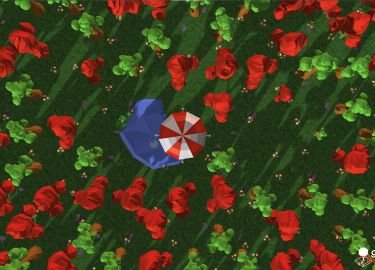
In order to break this deadlock it is high time for novel thinking beyond the mainstream and for new players to bring about transformative change. We propose looking at the climate crisis from the perspective of a global movement that, up to now, has been associated more with climate pollution than with solutions for that pollution: the global culture of some 3 billion gamers.


It is known that game mechanics—the elements that produce the gaming experience—can change behaviour. What if this potential were leveraged to support citizens in choosing carbon-neutral or -free products? What if this, in turn, motivated industries to follow new customer behaviour? And what if gamers themselves opted to invest attention, time and purchasing power—a market valued at $175.8bn2 in 2021—in forestation?!
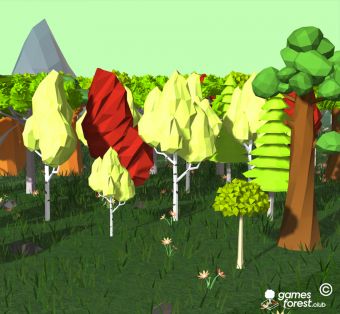
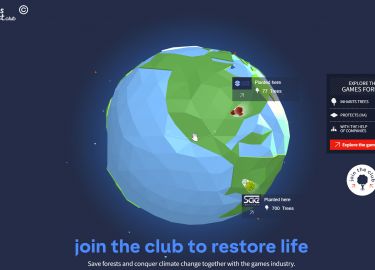
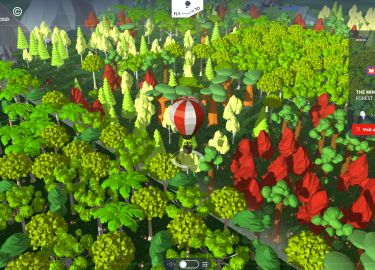
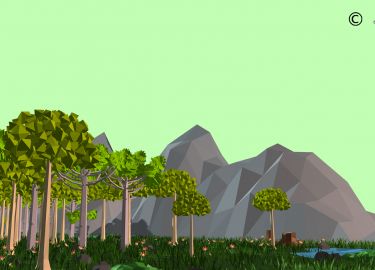
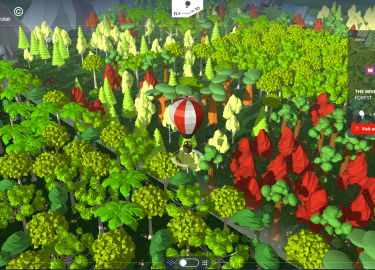
Specifically, we propose to measure and manage carbon footprint and show it in a playful way so as to make the challenge of climate change fun. That’s why we created the gamesforest as a digital twin to our analogue world.
Climate change is, of course, by far the biggest challenge Humankind has ever faced. By the same token, however, with the stakes no less than the survival of Humankind, the journey ahead of us promises to be heroic and full of potential. Luckily, gaming companies know best how to design massive challenges in a way that encourages players to rise to those challenges and to have fun with them.
We’ve already seen huge interest and engagement with the climate change challenge in the games industry. With GamesForest.Club we want to extend that engagement. All restoration activities in real life will therefore be shown simultaneously in gamesforest so we can all keep track of the efforts that the games industry is making to avert catastrophic climate change.
Save the planet playfully!
While saving the planet in playful way might sound like a strange proposition, we must give it a chance. After all, Humanity’s non-playful approach to saving the planet in the last 50 years, say, has not worked out well. Saving the planet playfully is no less than a cultural revolution: a culture of joyful, voluntary choices of the masses joining the cultures of science and policy-making in the service of saving the planet. As Albert Einstein once said, “No problem can be solved from the same level of consciousness that created it.”
Sources
1 Stubley, Peter. 25 April,2005. ‘Enough rainforest to fill 30 football pitches destroyed every minute last year.’
The Independent [Online]. [Accessed 28 January 2022]. Available from https://www.independent.co.uk/climate- change/news/tropical-rainforest-lost-destroyed-football-pitches-every-minute-a8886911.html
2 ‘Global Video Games Market’.
Ukiepedia. [Online]. [Accessed 28 January 2022]. Available from: https://ukiepedia.ukie.org.uk/index.php/Global_Video_Games_Market
All pictures: Copyright by GamesForestClub
Georg Broxtermann
Initiator of the GamesForest.Club, Founder and Chairman of GameInfluencer GmbH
Georg is an Entrepreneur and Business Angel based in Munich, Germany. He is the initiator of the GamesForest.Club, a non-profit company with the goal to protect nature with the power of gaming and together with the good hearts and minds of the games industry. Georg founded the Influencer Marketing and Talent Management Company GameInfluencer GmbH in 2016 and still acts as its chairman. Georg is an active Business Angel and Advisor in several Start-ups, among them Phoenix Games, ThankyouJane and others.
Picture: © Georg Broxtermann

Artists and Ateliers in times of Exponential Change
Épica Foundation La Fura dels Baus
Artists and Ateliers in times of Exponential Change – What a multidisciplinary concept of art production could contribute today to a fair digital society?
Our world has been undergoing a spectacular evolutionary change. From the moment science and technology were aligned, the appearance of new advances became exponential, and these have become the new evolutionary driver, giving rise to a new era full of possibilities, as remote as if we were talking to a contemporary of Leonardo Da Vinci about a mobile phone or a tunnel boring machine. This piece analyses how art can continue under these circumstances to be able to anticipate these advances to society.
The Arts in crisis
The exponential advance of science and technology in recent years has become the driver of most of the major economic, social and even geopolitical changes at a global level.
Changes so far-reaching that they are modifying, and will increasingly modify, pillars such as social relations and our privacy, the labour market and our children’s education, health and its ethical implications. Changes so overwhelming for society that, far from being understood and accepted, they are being imposed before we are aware of them.
Art, which has always been one of the main means of expression of human beings, through which they express their ideas and feelings and the way they relate to the world, is being relegated to exclusively aesthetic expressions in this complex and rapid context, obviating its necessary contribution to understanding and critical capacity in society.
Is a new space for co-creation possible?
At the Fundación Épica la Fura dels Baus, we propose the concept of Anticipatory Arts as a new space for co-creation, knowledge transfer and mutual learning between art, science, technology and society.
A space of encounter and hybridisation where art becomes the driving force and catalyst of horizontal multidisciplinary processes. A space to create false but plausible realities, based on scientific-technological evidence, to be perceived as „real“ by society, and to be able to experience situations that may arrive in a nearer future than we imagine.
A space of real connection with society that allows, through knowledge, to maintain and amplify the critical thinking necessary for society to face the abrupt and accelerated changes that are about to come.
And at the same time, to help science and technology to anticipate the impact, the risks, but also the opportunities, that these advances will have in this new renaissance, where present and future are ever closer, and which will alter human relations in the next 500 years.
Picture Header: Copyright by By Fundación Épica La Fura dels Baus
Anticipatory Arts by Fundación Épica la Fura dels Baus
A selection of video documentations of a new concept of the arts in exponentially changing worlds:
European Performing Science Night 2021 (GA 101036143) – Performance: https://youtu.be/AMGq9Zg_S9U
Complex Systems 2019: https://youtube.com/playlist?list=PLQQ04W3CTIRYHr-R6f7NpuZ2av8ry91zB
About the institiution – the concept of an artist atelier as a Renaissance Laboratory:
Teaser Epica 2021: https://youtu.be/–0t8Stnhyw
More info at: https://lafura.com/en/
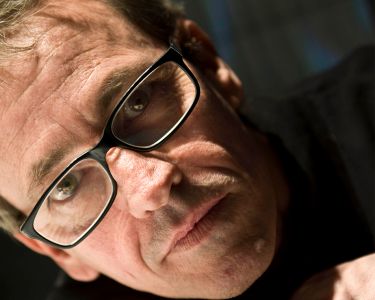
Pep Gatell
Artistic Director of La Fura dels Baus since 1980 and President of the Épica Foundation La Fura dels Baus
Pep Gatell (Barcelona, 1958) created over 250 different staging, integrating all kinds of technology such as synthesisers, CD-rom, web pages, dynamics between user-show 3D stereoscopic images, mobile phones App, etc., in the company’s shows. Always seeking to integrate new experiences for spectators, Gatell has had contacts with different multidisciplinary entities and research centers. Since 2012 he collaborates with the R&D team at Mugaritz, the third best restaurant in the world, with which he has directed the documentary Campo a través (Berlinale, 2016). Among his most recent and well-known works, in 2014, he premiered M.U.R.S., developing a new mobile platform for interaction with the audience, he co-directed the opening ceremony of the Olympic Games for Young People in the city of Nanjin and was responsible for the artistic direction of the opening of La Valetta, European cultural city of 2018. Since 2017, Gatell has focused its efforts on the Epica Foundation aiming to position the CCIs as relevant agents in the R+D+i processes necessary to face the global challenges of the 21st century.
Picture: © Fundación Epica La Fura dels Baus La Fura dels Baus
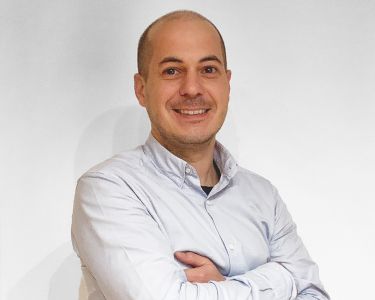
Fco. Javier Iglesias Gracia
General Manager of the Épica Foundation La Fura dels Baus & CEO, CFO, and co-founder of IGLOR Soluciones Audiovisuales Avanzadas S.L
Fco. Javier Iglesias Gracia’s (Barcelona, 1982) expertise as telecommunication engineering researcher began in 2004 with his staging in the IIS group of the Fraunhofer Institute. Iglesias has worked in recognized institutions as i2CAT Foundation or ESADE Business School where he even reached the Spanish secretariat of the ISO Sub-Group JTC1 SC6 dedicated to Future Networks. Iglesias has also dedicated half of his career to foster innovation ecosystems, especially those dedicated to merge science and technology with CCIs. He has been engaged in several national and international projects merging tech and art as, among others, Catalan „Anella Cultural“, the European “Creative Ring”, the „Anillo Latino Americano“, „GREC Innovación“ or „M.U.R.S.” by La Fura del Baus, led the city level innovation ecosystem in Barcelona through the Barcelona Lab project (2011-2015) on behalf of the Direction of Creativity and Innovation of the Institute of Culture, and the business mentoring and support for the Catalan Hub of the CREATIFI European Funded project, for boosting CCI with new technologies.
Picture: © Fundación Epica La Fura dels Baus La Fura dels Baus

It’s not about saving the world!
Cultural Manager, Creative Industries Expert and Design Aficionado
IT'S NOT ABOUT SAVING THE WORLD!
Renaissance is a word that you could associate with many things, on different levels and in various disciplines. If the concept of a “New European Renaissance in the Making” is to be discussed comprehensively at this point, then we should nevertheless keep in mind relevant historical landmarks and, to an even greater extent, the humanistic and social impact of the Renaissance, simply because we should be aware of the consequences. Accordingly, what could be subsumed under that term—despite all of its varied manifestations as Renaissance, Humanism or Reformation—is the concept of radical change, of a paradigm shift. We shall talk about that below when Creative Industries shift into the focus.
In recent decades, the need for change—you could also call it a restart or a reset—has become increasingly virulent and perceptible, especially in the creative sector and, above all, in the field of design. What had initially begun as a rather vague feeling of uneasiness is now becoming a visible constant in societal discourse. Behind it is the vast transformation of society and media which has caused radical change to our living and working environments. In order to present evidence for those transformations, you do not necessarily need to mention an epochal happening like a pandemic, although the pandemic has certainly sharpened our perspective on those upheavals. In that respect, then, there is no better time than now to address the “New European Renaissance in the Making”. And creativity will play a crucial role in it.
the human race will not survive without creativity
The idea is as simple as it is provocative: It’s not about saving the world because the planet will outlive the human race—but the human race will not survive without creativity. Now, at this point we could maintain that things have always been that way, and that is, of course, correct. There is, however, one fundamental difference: Today, in the 21st century, we are aware of the situation. It is no longer about mere inventions that could make something easier, faster or bigger, but rather about avoiding man’s extinction. That may sound somewhat pessimistic, but a glance at today’s state of the world (climate change, a migration crisis, and so on) seems to justify this dramatic momentum. In view of that, many people, above all younger people, are no longer prepared to uncritically perpetuate the quasi-natural mechanisms of life and work. Hence, the above-mentioned change can only happen through us and it will only succeed if we—which at first glance seems to be a paradox—do not put man, the individual person, at the centre of considerations.
To that end, we are in need of design, but the kind of design that can shoulder the current challenges. Over the past 150 years, design has taken on growing social responsibility as a key player in the developments of industrial society. If design had previously been perceived as a predominantly aesthetic and visual amenity serving the financial success and profit maximisation of big business, towards the end of the 20th century it started to become a tool for human needs that accounted for the capabilities and behaviour patterns of individual users. So-called user-centred design was suddenly in the limelight, triggering a process of unprecedented individualisation and commercialisation that completely disregarded the political and societal dimensions of design. However, that met with prompt criticism. As early as 1971, Victor Papanek in his book Design for the Real World criticised the trend towards producing “increasingly useless, potentially harmful, irresponsible and—from an ecological viewpoint—questionable items of mass consumption.” He spoke out against irresponsible design and developed a radio for the Third World based on an old tin can.
The answer to the question as to whether the time is ripe for revolution is, unequivocably, Yes
Fifty years on, Papanek’s approaches are meeting with increasing approval. Many designers are no longer prepared to pander to the demands of wealthy clients with aesthetically exalted tastes, but are instead beginning to question their role in the context of a widening schism between rich and poor and in the light of environmental problems. They participate in social movements, support grassroots initiatives and try to contribute to improving the world in a simple and quite unobtrusive way. This development marks a distinct turning point in the discourse on design, reflecting new standards that will determine how we shape our environment. A fundamentally different way of thinking is born: In place of nurturing individualism to the point of perversion, a genuine search has started for meaningful creative activities that focus on the bigger picture to deliver the best solution for man, society and nature. This approach to design will revolutionise future creativity and the future of creativity. It is about society-centred design that not only caters to users or to economic considerations, but above all to society and our environment.
The answer to the question as to whether the time is ripe for revolution is, unequivocably, Yes. It is high time and we can prove that by the fact that this attitude towards design has already arrived on the economic level. Businesses are experiencing a growing client demand for products and services that do not necessarily have to offer “more” (faster, further, bigger, more expensive), but should be fundamentally “different”. Those enterprises realise that they could have a competitive advantage if they pursue that strategy, which means that one of the toughest barriers for the widespread acceptance of society-centred design has been overcome.
Of course, that does not exempt us as representatives of Creative Industries—who often negotiate the topic on a highly theoretical level—from the responsibility of actively promoting this approach and introducing it with greater vehemence to enterprises. From the very start, we must rule out any suspicion that the matter could again end up in self-referencing ritualised academic discourse enriched with theoretical considerations on university level without, however, yielding any practical effects. The order of the day is, therefore, to act now and to implement the developed concepts at once. We know from experience that there is no lack of ideas, but rather a certain hesitance to implement them.
creativity as a maxim for future actions
Creativity and Creative Industries play a crucial part in that respect because they often allow unexpected solutions to unfold. Human creativity therefore makes the big difference, and again, it is not just about intelligence that could be made by a machine. There is no doubt that artificial intelligence will have an enormous impact on our future life. Creativity, however, is a profoundly human phenomenon that we should maintain at all costs. But precisely because is associated with a quantum of uncertainty, creativity—acting creatively—is rarely planable in a strict sense. We therefore have a dilemma. Creativity cannot be practiced to produce a solution, like an athlete training for a competition. For that reason, we are required not only to allow creativity to flourish on all levels, but also to actively promote it. Essentially, it is about augmenting the potential for creativity to a maximum and letting it permeate all areas right to the finest ramifications and niches of life. Maybe the solution for one of many challenges will originate from there. At the same time, it is a procedure of trial and error as well as creatio ex nihilo. The latter, i.e. creation out of nothing which is known from early Christian cosmogony, also found its way into modern physics: Stephen Hawking, too, argued that the Universe could have been created out of nothing—thus illustrating the principles of creative work. That would not only explain creativeness most aptly—it would also restore creativity to our lives as a maxim for future actions.
Eberhard Schrempf
Cultural Manager, Creative Industries Expert and Design Aficionado in Austria
Eberhard was vice-artistic director and managing director of the European Capital of Culture – GRAZ 2003 and is the director of the „Creative Industries Styria“ network since 2007. In this function, he developed the festival „Design Month Graz“ and was responsible for the successful application of the city of Graz to become a UNESCO City of Design, as well as developing many innovative projects and formats. Schrempf advises numerous companies and institutions in the areas of creativity, design and management. He is lecturing at the Institute for Design and Communication at the FH Joanneum, University for applied sciences, a lateral thinker and guest speaker at international conferences.
Picture: © Raneburger

Preparing Cities for the Future
What to learn from You Say Amsterdams‘ inclusive city strategy
Preparing Cities for the Future: What to learn from Amsterdams' inclusive city strategy?
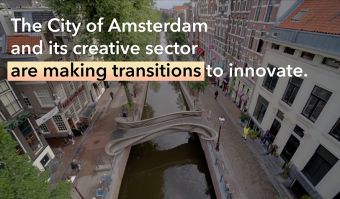
The City of Amsterdam and its creative sector are bouncing back from the Covid19 crisis through innovation. Maximizing resources already present, and strengthening the sector in years to come – aims cities in Europe share in the attempt to re-built better, especially if focusing carbon neutrality by 2050. In Europe around 80 cities are UNESCO Creative Cities focusing the cultural creative industries as driver for revitalizing the urban communities after the Covid-19 pandemic.
We, at the City of Amsterdam, want to prepare our city for the future by the focus on inclusive city strategies for a creative, diverse, fair and green community. But where do we start? And where do we want to go to concretely? In this piece we outline the major elements of our inclusive city strategy for the years to come and hope they are inspirational for all cities in finding their ways.
Where do we start?
When people think of Amsterdam, they often think of our rich cultural heritage and a thriving creative sector. From our museums to our cultural incubators, from festivals to the facades of centuries-old canal houses splashed with art projections. Arts and culture are present at every corner of this city. Even after sunset, in our lively club scene.
Home to some of the most forward thinking entrepreneurs and creatives, Amsterdam is a natural testbed for startups as well as a magnet to some of the world’s best-known creative brands. The region offers a strong support system and collaborative spirit that’s ideal for driving growth, while local connections between businesses, investors and universities are strengthened by its frequent community meet-ups.
The pandemic has had an immense impact on the creative sector of Amsterdam. It underscored existing urban problems such as inequality of opportunity and in representation. To top these challenges, we need to make the city future-proof in times of climate change, while finding answers for urban mobility- and privacy issues.
Elements for the inclusive city strategy
Digitalization
Due to lockdowns, digitalization and innovation got a head start. Inspiring makers and cultural institutions to discover new uses of digitalization and online business models. We want to use this momentum to make our cultural sector more future proof. Attracting broader audiences and extending the reach of culture and the arts.
Inclusion and diversity
Amsterdam’s unique character and culture have been shaped by its diversity. Already before the pandemic, our city’s cultural and creative sector emphasized inclusion, diversity and participation. Working on solidarity, strengthening intercultural connections by making diversity and our collective cultural heritage more visible and accessible.
Sustainability
We’re making museums and theaters future-proof in times of energy crisis and climate change. It’s a must. Particularly for those institutions housed in historical buildings. In general we are dedicated to making our cultural heritage more sustainable. And we’re supporting the Amsterdam festival scene to turn circular. The Amsterdam fashion industry is also committed to sustainability and innovation.
Education
Our ecosystem for interdisciplinary and multidisciplinary arts education is an unique breeding ground for creative students and talent. By supporting cultural education in schools Amsterdam encourages access to arts and culture for all young children
Tackling urban challenges with creativity
We invited creative minds to come up with innovative solutions and design methods for our city’s social challenges. Artists and other creatives contribute by using their vast imagination and unorthodox approaches.
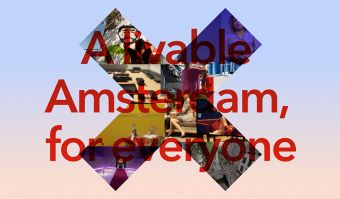
A livable and creative city for everyone
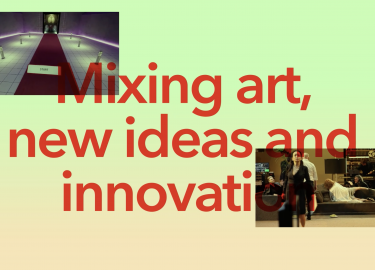
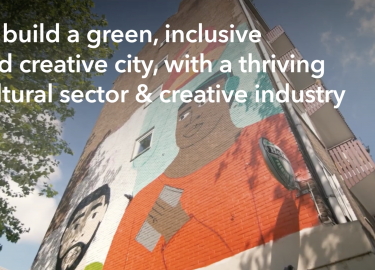
Together with citizens, visitors, education & knowledge institutes and businesses, we mix art, new ideas and innovation to a unique blend of new technology and creativity. Studying the impact of technology on our city and translating the latest developments into new policies and investments. Like a new 21th Renaissance. The 14th century Renaissance partially succeeded due to its embrace of the sciences and arts after recovering the plague. So in these equally unprecedented times, we might find insights to positively alter cities for generations to come. Together we strive for an open, green, creative and inclusive city. A livable city, for everyone.
Sources
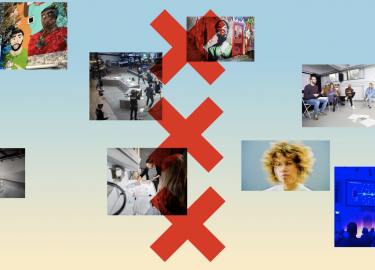
All pictures on this page are taken from the City of Amsterdam’s promotion video, which was especially prepared for the Next Renaissance Project. It can be downloaded below.
Copyright: City of Amsterdam
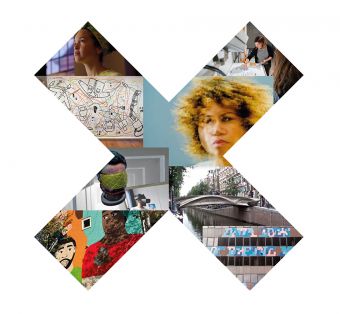
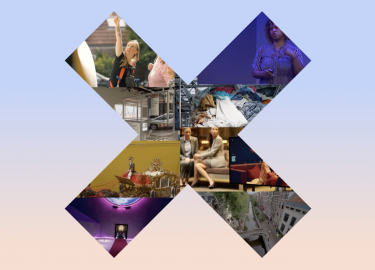
Captions & Sources of the pictures in the Cross Visual underneath the header above are as following:
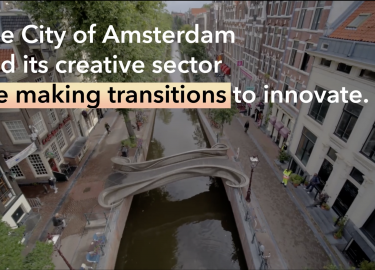
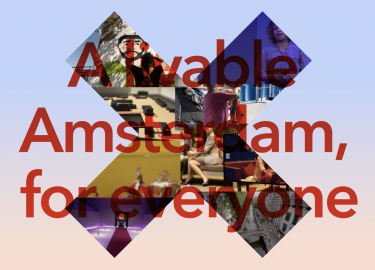
Expositions Gouden Koets & Refresh (artwork: Elisa van Joolen) at Amsterdam Museum; virtual reality artist Ali Eslami during ‘Digitale Daadkracht’; Privacy Project by Street Art Museum Amsterdam (SAMA) – artwork York One; Installation ‘Amsterdam Senses’ at NEMO’s studio developed by the Responsible Sensing Lab (credit DigiDaan); futurist Karen Palmer opening the festival ‘Me Myself & AI’ at cultural centre Felix Meritis; world-first 3D printed 12-meter long stainless steel pedestrian bridge crossing one of the Amsterdam’s canals designed by Joris Laarman and printed by MX3D; Privacy Project by Street Art Museum Amsterdam (SAMA) – artwork Oxenmystic.

City of Amsterdam
You Say Amsterdam, we say creativity & innovation
When people think of Amsterdam, they often think of our rich cultural heritage and a thriving creative sector. From our museums to our cultural incubators, from festivals to the facades of centuries-old canal houses splashed with art projections. Arts and culture are present at every corner of this city. Even after sunset, in our lively club scene.
Home to some of the most forwardthinking entrepreneurs and creatives, Amsterdam is a natural testbed for startups as well as a magnet to some of the world’s best-known creative brands. The region offers a strong support system and collaborative spirit that’s ideal for driving growth, while local connections between businesses, investors and universities are strengthened by its frequent community meet-ups.

Transformation & European-African cooperation- A podcast
Game-thinking, Gamification and Digital Transformation experts
A podcast about Transformation & European-African cooperation
Bethlehem Anteneh and Christoph Deeg got to know each other during a workshop on the transformation of cities through game mechanics in Addis Ababa. This was the beginning of an intensive, international cooperation and a special mutual transformation process. In this podcast the two talk about their common path, their view of transformation and whether the European-African cooperation means special opportunities for transformation processes. It’s a podcast about transformation, gamification, cooperation, learning, failure and life.
Bethlehem Anteneh
Game-thinking expert and Founder of BlueLeaf and PlayLab
Bethlehem Anteneh is a game-thinking expert with an architectural design background who uses games as tools to design environments, frameworks and processes that elevate human perception, experience and problem-solving-instinct. In this field, she has worked by managing various projects, conducting workshops, speaking/talks, and designing platforms with partners, organizations and universities internationally in 25+ countries around Africa and Europe being invited in happenings such as Gamescom Congress, AmazeBerlin, DeutscheWelle, Electronic Arts, ZKM-Karlsruhe, etc. After being the Game-Thinking Lead in 15 African countries on the project ‚EnterAfrica-Gamify Your City Future!‘ with the Goethe-Institut, she’s currently consulting the GIZ on learning experience design (LX) and curating the first of its kind gaming convention in Addis Abeba with the Goethe-Institut amongst other major projects such as ‚LUtopia: Rethinking the City of Ludwigshafen‘. She had co-founded an international and national play-based networks and companies such as ‚Chewata-Awaqi‘ and recently founded BlueLeaf & PlayLab; an entity bringing together GAME-Thinking, ART-thinking, and FUTURES-Thinking.

Christoph Deeg
Consultant and Speaker for the topics of Digital Transformation, Gamification & playful participation
Christoph Deeg describes himself as a “designer of the digital-analog living space”. He is a consultant and speaker for the topics of digital transformation, gamification and playful participation. In this context, he advises and supports national and international companies and organizations in the development of comprehensive and sustainable overall digital-analog strategies. He also deals with the strategic use of gamification, for example in the context of digital transformation processes, urban development or the development of digital-analog cultural strategies. Another focus of his work is the development of participation processes using analog and digital games or game models. The basic idea behind his work is the idea that digitization is not essentially about technologies, but about people with their individual digital-analog realities.
