Creating cities of greater resiliency
Group of Architects, Designers, Urbanists, Landscape Professionals, Interior & Product Designers, Researchers & Inventors
Creating cities of greater resilience: On the changes in architecture's paradigms for a Renaissance of life in cities for citizens
“Our cities and buildings are built on a paradigm of front of house and back of house. City infrastructure projects are utilitarian machines, isolated from the urban inhabitants they serve. You can find them on Google like cancerous tissue on a city map. The more specialized a utility becomes, the more reasons to separate it from the public to improve its efficiency and performance. We all know that a piece of infrastructure can have negative side effects, like the underside of an overpass, the shadow cast by a chimney, the noise of a highway, or the gaping wound of a parking lot. But we also know that once a piece of infrastructure shuts down, it can be reborn with positive programs. Trains become a park. A power plant becomes a museum. What if we could start by combining the utilitarian and the social? What if our urban infrastructures opened on day one with positive social and environmental side effects?
“Taking the profane and the elevated, we can create a city of higher complexity and greater resilience. If one use dissipates, the other consolidates. One is nocturnal, the other is diurnal. In fact, the more different two activities are, the more likely they are to produce the unprecedented. In architecture, as in love, opposites attract.” 1
The BIG U: Marrying physical resilience with social resilience
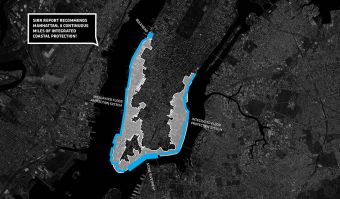
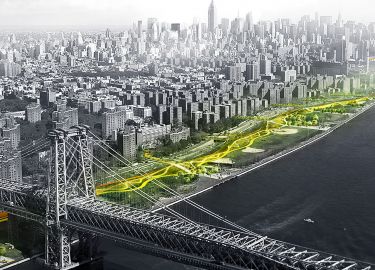
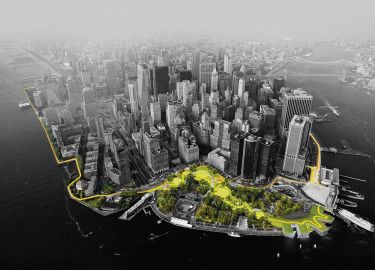
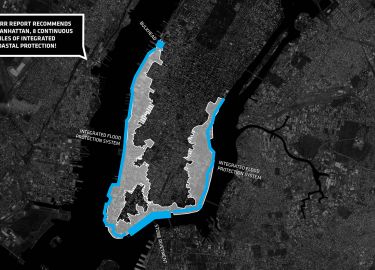
The 10 miles flood protection for Lower Manhattan stretches from West 57th street south to The Battery, and up to East 42nd street, and comprises low-lying geography with the incredibly dense and vibrant, yet vulnerable urban area. The BIG U rethinks infrastructure as a social amenity—what we call social infrastructure.
All pictures of BIG U: Copyright by Bjarke Ingels Group
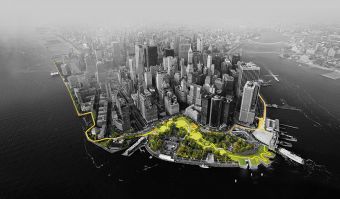
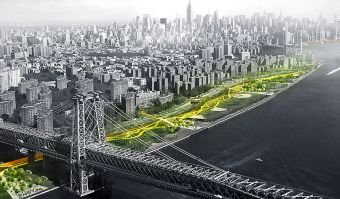
Infrastructure in the United States as it’s traditionally conceived has not been civic, accessible, or designed for interaction with the public in mind. Rather, it has been imposed upon our cities without engagement with community needs at a large scale, at times with terrible consequences for the urban experience. The BIG U combines the mandate to create large-scale protective infrastructure with a commitment to meaningful community engagement. The BIG U’s flood protection won’t look like a wall, and it won’t separate the community from the waterfront. Instead, the structures protecting us from the elements will become attractive recreational centres that enhance the city and lay a positive groundwork for its future public realm.
CopenHill – Amager Ressourcecenter (ARC): a destination economically, environmentally and socially profitable
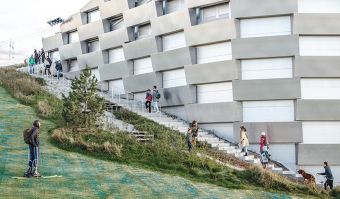
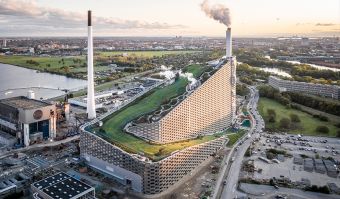
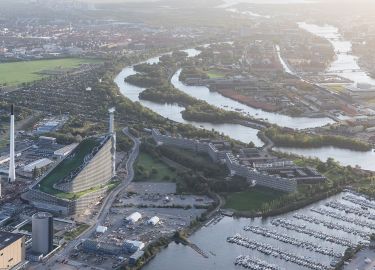
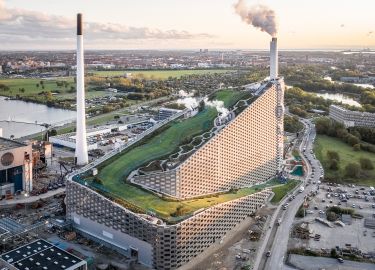
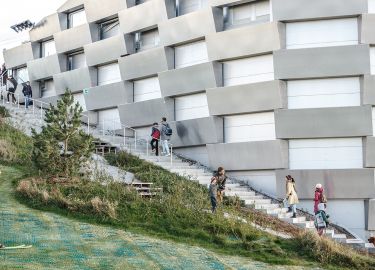
CopenHill, also known as Amager Bakke, opens as a new breed of waste-to-energy plant topped with a ski slope, hiking trail and climbing wall, while aligning with Copenhagen’s goal of becoming the world’s first carbon-neutral city by 2025..
Replacing the adjacent 50-year-old waste-to-energy plant with Amager Ressourcecenter (ARC), CopenHill’s new waste incinerating facilities integrate the latest technologies in waste treatment and energy production. Due to its location on the industrial waterfront of Amager, where raw industrial facilities have become the site for extreme sports from wakeboarding to go-kart racing, the new power plant adds skiing, hiking and rock climbing to thrill-seekers’ wish lists. At its new top, experts can glide down the artificial ski slope or test the freestyle park while beginners and kids practice on the lower slopes. Recreation buffs and visitors reaching the summit of CopenHill feel the novelty of the highest viewing plateau in the city, enjoying its rooftop bar and the sensation of a mountain in an otherwise-flat country.
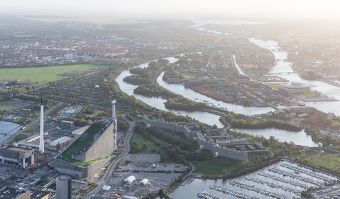
ARC is not an isolated architectural object but envelopes the local history and context while forming a destination. Formerly a piece of infrastructure in an industrial zone, CopenHill becomes the new destination for families, friends and celebration, one that is economically, environmentally and socially profitable.
ARC won World Building of the Year at the World Architecture Festival 2021.
Copyright Picture left: Laurian Ghinitoiuby & BIG – Bjarke Ingels Group
Copyright pictures below: Rasmus Hjortshoj & BIG – Bjarke Ingels Group
BIG – Bjarke Ingels Group
Copenhagen, New York, London, Barcelona and Shenzhen based group of architects, designers, urbanists, landscape professionals, interior and product designers, researchers and inventors
The BIG office is currently involved in a large number of projects throughout Europe, North America, Asia and the Middle East. BIG’s architecture emerges out of a careful analysis of how contemporary life constantly evolves and changes. Not least due to the influence from multicultural exchange, global economical flows and communication technologies, that all together require new ways of architectural and urban organization. We believe that in order to deal with today’s challenges, architecture can profitably move into a field that has been largely unexplored. A pragmatic utopian architecture that steers clear of the petrifying pragmatism of boring boxes and the naïve utopian ideas of digital formalism. Like a form of programmatic alchemy, we create architecture by mixing conventional ingredients such as living, leisure, working, parking and shopping. By hitting the fertile overlap between pragmatic and utopia, we architects once again find the freedom to change the surface of our planet, to better fit contemporary life forms.
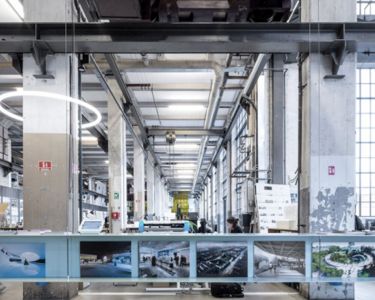
Picture: © Rainer Tepper

New worlds emerge from old sounds
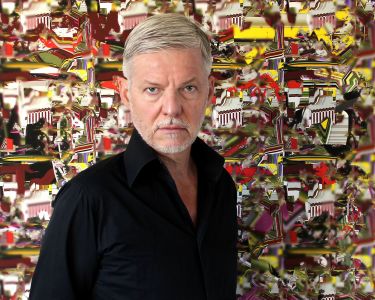
Artist, Music producer, Label owner and Co-Founder of Electronica & Techno label Kompakt, Cologne
New worlds emerge from old sounds: What we can learn from music about making new worlds when Man and Machine meet in new ways?
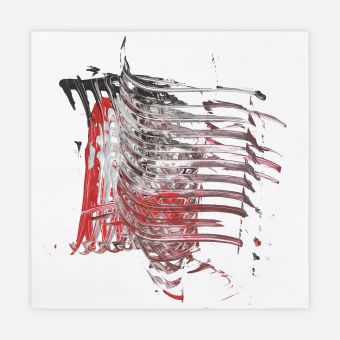
My work RÜCKVERZAUBERUNG 4 is an ambient trip of one hour through more than three centuries of musical history—and more. It resembles the Renaissance principle of constructing new worlds—in this case in music—with new scientific methods building on historical inspirations. Aligning Man and Machine in radically fresh, innovative ways is a method to create and make the new. My interpretation of this Renaissance method, applied in the 21st century, is “Looping”—in music and painting.
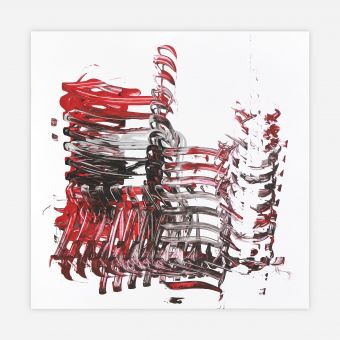
We hear the medieval sounds of lutes and flutes weaving into fragments of baroque falsetto singing, bells and bugles, creating abstract, amorphous sound constructs. Little spinet and harp loops gyrate intoxicatedly across beautifully feverish violin planes. Atonality and euphony flow into each other effortlessly and part again. New worlds emerge from old sounds.
In my musical and pictorial work I have mostly followed strictly conceptual principles, which I repeatedly refine and variegate. Besides a predominantly sample-based, sometimes abstract, sometimes gestural, sometimes figurative musical language, it is mainly the loop principle that has fascinated me all along. The static or varied replay of minimalistic, repetitive structures births certain patterns and shapes. This way of creating is influenced and structured by computer-based programs. And although, or maybe because of, the computer being my primary artistic medium in both disciplines—and I mainly considers myself a digital artist—I occasionally transpose my conceptual, mostly serial ideas to the „live“ instrument (Freiland Klaviermusik) and „real“ colour (machine painting).
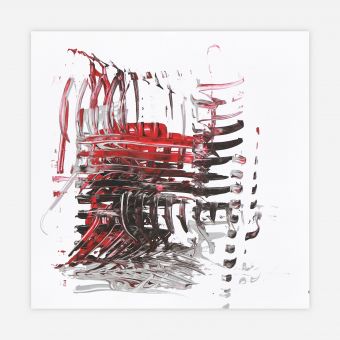
My work since 1990 can be understood in light of one of today’s most pressing questions: How are Man and Machine related? My work has been driven by the rapid development of Artificial Intelligence which is constantly changing our understanding of this relationship. The traditional balance of Man and Machine, of Artificial and Artistic Intelligence, formerly carved out in the Renaissance, is being changed in the 21st century by new emerging technologies. RÜCKVERZAUBERUNG 4 is an exploration of this change expressed in the musical and visual arts: The Loop as a Method.
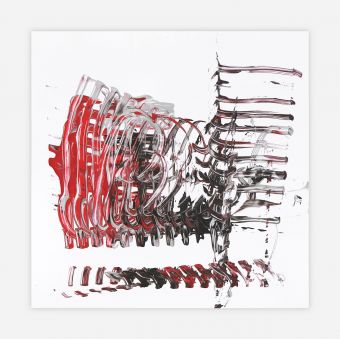
About the work of Wofgang Voigt:
The creative body of Wolfgang Voigt has always been characterised by complexity, boundlessness, unpredictability. The negation of the bounds of genre, style, and taste has been and still is today a crucial element of his body of work, just like the uptake, quotation and processing of external contents through universal sampling. Having been socialised in the pop culture of the 1970s and 80s, Voigt has since been creating his very own art-music cosmos influenced by glam rock and jazz, new wave and folk music, pop art, and digital expressionism. In the 1990s, Voigt, a founding member and influential part of the Cologne-based electronic label Kompakt, advanced in the wake of the globally booming techno movement, restlessly driven by his iconic straight bass drum, producing countless projects ranging from formally rigorous minimalism and expressive hardcore acid, to gabber and polka, to driving the conceptual techno made in Cologne (Sound of Cologne). His audiovisual project GAS, based on psychedelically-compressed classical sound sources in combination with ecstatically-focused forest photographs and films, has captured audiences far beyond electronic music and techno.
Listen to & Buy WOLFGANG VOIGT – RÜCKVERZAUBERUNG 4 10/2011 Profan CD11: https://kompakt.fm/releases/rueckverzauberung_4_digital_album
Wolfgang Voigt
Grown up and socialized in the pop sub-culture of the 1970s and 1980s, Voigt has developed his own art and sound that cross genres, mixing music styles such as glam rock, pop, jazz, classic, punk, and new wave, and art movements such as pop art and the Neue Wilde (the ‘New Wild Ones’). Inspired by the minimalist structures of this creative expressions, Voigt works around the most diverse facets of his own ideas of subversive concept art and music. Two fundamental approaches, through innumerable variations, characterize Voigt’s music and artwork. The first: the loop principle – the static or varying repetition of minimalist, repetitive structures which generate specific patterns. The structure of computer-based music production and associated software clearly and strongly influences this artistic concept, reflected in Voigt’s body of art and music. The second: the abstract deforming and condensing of external resources, i.e. the sampling of different sounds or images reduced to their original basic structure, their raw aesthetics, in a certain sense their (hypothetical) liberation, and transferred into a new context – a process that Voigt calls „Entdeutung“, i.e. de-signification.
Picture: © Unland