Climate and Culture united in crisis – or in the Next Renaissance?
Director of Julie´s Bicycle, London
Climate and Culture united in crisis – or in the Next Renaissance?
The Green and The Game changer
The COP26 global climate talks failed to commit to global temperature limits of 1.5 degrees warming, or to establish financial mechanisms to ensure climate justice is given the attention it richly deserves. Global climate governance has not yet succeeded in building consensus for rapid action in spite of the Paris Agreement.7 Perhaps the real challenge is found in root metaphors and their narratives—nature as machine, hostile, to extract, improve, sell, or sentimentalise. The story of climate change is in the buried histories of human and nature conquest, anchored in cultural values of human supremacy. The climate crisis as a cultural crisis, the consequence of myths and stories that permeate society in profoundly subtle ways.
The fragility of global economics has been exposed by the pandemic, illuminating the greater threat of climate change. Ambition to take action has surged across communities and business—the sheer volume of net zero commitments has potential to profoundly change our world —though only if the pendulum swings away from offsetting to absolute greenhouse gas reductions, especially in wealthy economies. And COP26 has bolstered net-zero targets by tightening governance for
carbon trading rules. Up until now cultural policy has, by and large, been oblivious to the encroaching climate crisis, rarely invoking ‘externalities’ from nature (i.e. clean air, green space, carbon profiles), or cultural rights, safety and social inclusion, profoundly affected by environmental conditions. This is true at every level, though city policy is more progressive than national policy, as are smaller institutional commitments. New ambition in the cultural sector is creating conditions for good climate governance.
The arts, like any other sector, have an ecological footprint and Julie’s Bicycle (JB), founded in 2007, began with a focus on the sector’s impacts, and ways to work within the ecological constraints of our planet. Unleashing the energy of the creative community and championing values that restore our sense of belonging within nature, was the real objective. Beyond the arts, the potential of the
creative industries to influence change—design, advertising, film, media, fashion—is huge. JB, which specialises in the arts, has translated the climate crisis into everyday currency with sector-specific expertise and resources that inspire words and action. Our premise is that doing empowers the arts to champion ambitious climate action across civil society. Working closely with the UK music industry, JB generated a methodology for greenhouse gas emissions analysis, carbon calculators for creative activities (buildings, tours, festivals, productions) that are used across the globe (5,000 current users of which about 2,000 are international).
Over the last decade, Julie’s Bicycle has expanded into performing and visual arts and museums, blending cultural and scientific knowledge for cultural practice to serve the planet.
Culture as an ecosystem: Arts Council England
Culture, just like any other sector, is an ecosystem: changes to one part are felt by all. Climate action needs to be tackled eco-systemically, including changes to policy and investment to align international frameworks. These goals are clear: net-zero carbon, green economy and climate justice. In 2012, Arts Council England (distributing £507million in 2019/20) embarked on the largest environmental literacy programme for culture anywhere in the world, making environmental requirements a funding condition. The backdrop was a bigger policy moment: the 2008 UK Climate Change Act. All Arts Council’s National Portfolio organisations (some 828 receiving core funds over multiple years) were asked to measure environmental impacts using JB’s Creative Green tools and have a policy and action plan. The data collection and policies formed a small part of a rich programme of research, resource development and knowledge-sharing evaluated annually. JB was initially
contracted for three years; by the time we complete the current contract (2023) the programme will be over a decade old. Results show an annual 4.5% reduction in energy use across 1,200 organisations, equivalent to over £16million in energy savings, with improved wellbeing and creative inspiration. Over time the partnership has got more demanding; 2018-2022 outputs include setting science-based targets for Arts Council’s largest energy users, 30 major institutions comprising 80 sites, which collectively reduced emissions by 18% in 2019-20.
A decade of data-gathering and collective cultural learning has generated credible and robust evidence, which makes a good case for scaling action. Starting from the basics—carbon footprints—the Arts Council’s deceptively simple policy is demonstrating how a sustainable cultural sector might work.
This vital perspective on culture, seen through the lens of our environment, has stimulated debate and passion, and catalysed a dialogue about the purpose of the arts more widely.
The International Perspective
Arts Council England’s intervention is only one, albeit effective, approach. Scotland and Wales, devolved nations with their own funding bodies, have established inspiring programmesthat combine accountability with exciting creative content. However, internationally, there is an urgent need to build environment into national arts policies. JB’s 2014 research partnership with the International Federation of Arts Council and Culture Agencies (IFACCA) recommended that national cultural policies explicitly reference environmental sustainability and build a global network to exchange ideas and resources with regional centres of excellence. The arts are hampered by a lack of data to underpin cultural policy, a gap which also prevents cultural activists from leading solutions and influencing major climate decision-makers. Climate Heritage Network has succeeded in getting cultural heritage represented at the UN—an important move in the right direction. In 2017, frustrated at the glacial pace of policy change, JB and World Cities Culture Forum, a network of global cities, developed a project for culture leads to connect to their environment counterparts in government and align goals. In many cities climate action is much more ambitious than national ambitions but there is patchy read-across of national cultural policies at this level, notwithstanding some inspirational examples.
Where are we now?
In the 6 months preceding COP 26 JB returned to national policy to understand progress aligning national culture policy with the Paris Agreement, as part of the British Council’s Climate Connection. Desk-based research, a survey to about 200 ministries, interviews and in-depth roundtables in Turkey, Indonesia, Nigeria, the UK, and Colombia, explored policy commitments and trends.We found that…
1. In spite of the Paris Agreement, requirements for climate action are still rare in national cultural policy. In the main, priorities are not yet reading explicitly across commitments to achieving global net-zero greenhouse gas emissions nor to environmental discourse on justice and just transition. There are some outstanding exceptions, notably Argentina where cultural policy reads explicitly across the national climate policy.
2. Many of the priorities of national cultural policies are environmental issues, especially relating to justice but framing and terminology does not, in the main, illuminate the commonalities. Cultural rights are often connected with environmental justice, and arts for transformation is connected with ‘just transition’. Translating cultural priorities into the vernacular of environmental policy and enriching environmental policy with cultural perspectives is a good starting point.
3. Broad sustainability issues are well represented in national cultural policy, especially as regards heritage, cultural rights and sustainable development. Connections to climate and environmental issues are often implicit. Policy dialogue with local and creative practitioners working from the ground up is urgently needed.
4. The huge potential of culture and creativity is not being leveraged systematically to address environmental issues in governance, i.e. to protect and preserve culture and heritage; to create safe places and strengthen and celebrate communities, circular design, new material use, innovative urban and city partnerships, new businesses, ideas and skills.
Art gives us different ways of knowing, and culture emerges from our many different ways of being; too often it feels like the creative community is showing up in spite of the lack of a presice place of action. While politics is debated in official halls, we work in the spaces between—sometimes being outside the system is exactly what’s needed. But what if we re-imagine a COP process shaped instead around culture?
The dominant cultural narratives must change and culture and creative endeavour should orient to this new purpose. The cultural sector—the arts, creative industries and heritage—can make a crucial
contribution to accelerating action. Culture is vital to national economies, contributing creative skills and innovation, and influencing lifestyles, tastes and consumption. But, most powerfully, art can change hearts and minds and it is intimately connected to place and to community. Artists can move us to reimagine our world and inspire societies to take climate action and contribute their best to the Next Renaissance.
Alison Tickell
Alison Tickell established Julie’s Bicycle in 2007 as a non-profit dedicated to mobilising action on the climate crisis, initially in the music industry and now across the arts internationally. Originally trained as a cellist, Alison worked with jazz improviser and teacher John Stevens, and community activist Dave O’Donnell at Community Music rethinking music education: what it’s for, what it values and who thrives, before setting up Julie’s Bicycle. She has also had many other roles (voluntary and paid).
Alison is an Ashoka Fellow.
Picture © James Allan

From crisis in systems to crisis of systems!
Edina Soldo, Full Professor at IMPGT-Aix-Marseille University School of Public Managment and Territorial Governance and Co-Leader of OTACC Chair; Djelloul Arezki, Senior Lecturer at IMPGT and Co-Leader ot OTAC Chair, Marseille
From crisis in systems to crisis of systems!
How can a new culture of research and research policy contribute to a post-covid world?
Since 2020 we witness not only multiple climatic, social, economic, and democratic crises, but a new interconnectedness of crises: We believe these individual crises are indicators of a more general systemic crisis. This piece debates and presents what an adaptation of the academic world in this system of crisis could look like, and what academic institutional innovation can contribute to overcome it. We believe organisational innovations are a prerequisite to re-build better and empower the makers of a possible Next Renaissance.
Picture above: Copyright: OTACC Chair
Interwined crises : telling points of a societal model system failure
„The climate, energy (and more generally natural resources), biodiversity, agricultural and food, demographic, social, financial, economic, democratic and governance crises… all indicate that our development model systemic crisis is now showing its limits… Could the Covid-19 crisis be the first one of a series of interconnected crises? (College of Societal Transitions1).
Because of their characteristics, the created problems and the generated effects, those intertwined crises deeply weaken our contemporary societies and are causes of worrying imbalances: social, demographic, economic, environmental, increasing inequalities, etc. These crises fundamentally question values and strategic priorities on which our societies’ development models are based. They also seriously challenge our capacity to lastingly
integrate populations with various backgrounds (social, ethnic, linguistic, cultural, religious, etc.).
Faced with the urgency of this situation, can stakeholders involved in public policies (researchers, public structures and organisations, experts and professionals) still work in nonintegrated way and vision? Are compartmentalised approaches still relevant and efficient?
Today these questions become even more acute because over the last few decades the normative, individualistic, and competitive approach, linked to the domination of a neoliberal capitalist development model, has largely delayed and slowed the emergence of collective utopian and pragmatic proposals and solutions.
To design a complex, holistic way of thinking, the challenge of a Renaissance is more urgent than it has ever been. “Building a live-together society” necessarily implies the emergence of an inclusive societal transition project.
Integrated solutions: How can a university achieve a collective utopia?
Society is in need of an inclusive ecosystem in the Cultural and Creative Sectors and Industries (CCSI) in order to promote societal transition. The Organisations and Territories of the Arts, Culture and Creation (OTACC) Chair, led by the Public Management and Territorial Governance School, is a Training and Research Unit of Aix-Marseille University and could be viewed like a sandbox for the academic world proposing novel organisational answers to this wicked systemic crisis. To do so the OTACC Chair is designed with the following mission and especially tailored components and features:A Creative Industries sector in order to promote societal transitions.
The OTACC Chair mission is to operate as a laboratory for thinking, experimenting, and disseminating innovative management systems for artistic, cultural and creative projects.
OTACC: A participatory science programme to foster inclusive societal transition projects
« O » Organisations and inclusion: OTACC Chair supports CCI organisations to address the challenges of the 21st century: digitisation, new users’ practices, ecological transition, citizen participation. An inclusive environment with a wide variety of stakeholders can help to ensure the success of innovative artistic, cultural, and creative projects. As such, CCI organisations perform as a driving force for innovation, becoming a model for other sectors which can lead to cross-sectoral collaborations.« T » Territories and inclusion: CCI projects are deeply connected with territorial actors and resources contributing to a sustainable and local development and foster collaborative work practices. CCI projects are a strong part of territorial attractiveness. Its connections in all social, societal and economic dimensions can assume a real impact from those CCI projects. They act as civic laboratories by experimenting new democratic governance practices, encouraging citizen involvement and creating collective innovative dynamics.
« A » Arts and inclusion: Based on various disciplines and aesthetics, CCI projects reflect major social and societal transformations and are fully developed and designed with a transdisciplinary approach. Artistic works address citizenship issues and encourage expression of a broad range identities. By putting also into question standard thinking habits, artists extend societal and technological limits.
« C » Culture and inclusion: Because the Chair conceives Culture as a whole concept in its civilisational sense, its analysis and studies move beyond a basic approach of “cultural production”. It deals with all the parts of CCI value chain: from the creative act to its distribution. And all forms of cultural expression are considered, from the so-called mainstream to so-called subcultures. A plural and inclusive approach to culture is strongly advocated.
« C » Creation and inclusion: OTACC Chair supports cultural, creative, social, and solidarity-based entrepreneurship. OTACC Chair guides projects emergence and development through participatory research. Academics, professionals and students are all gathered in order to promote shared solutions and vision to the main issues of the CCI sector.
OTACC: 3 axes to foster and support inclusive societal transition projects
Chair scientific project is focusing on 3 axes: Training, Research and Development, and Events organisation.
AXIS 1. TRAINING
6 services/ actions
– MDOMC Master degree leading: “Direction of Cultural Projects or Establishments” (DPEC) Master degree and “Management and Law of Cultural Organisations and Events” (MDOMC) Master degree both provide to OTACC Chair a strong pedagogical expertise. Founded in 1998 and awarded by Eduniversal, MDOMC Master runs work-linked training courses. Junior executives, enrolled as apprentices, offer their expertise to all OTACC Chair members. This master’s degree, the oldest of IMPGT, has a large Alumni network. They are working in all types of CCI companies (local, national, and international).
– Incubator function: OTACC Chair operates as a cultural and creative, social, and solidarity-based entrepreneurial incubator. OTACC Chair Master students, throughout two years training, implement their elaborated inclusive CCI project.
– Serious game: as a last course, the serious game is conceived to put students in real professional situations. They have to submit a project proposal in response to a cultural operator order.
– Short training courses: from 1 to 5 days and open to all types of public, those training courses focus on cultural and creative industries management.
– Off-site training courses: customised thematic training courses are designed on request to fulfil the CCI sector professional operators requirements.
– Career development: skills assessment and professional support for CCI managers.
AXIS 2. RESEARCH AND DEVELOPMENT
4 services/ actions
– Worldwide watch of best and innovative inclusive practices in CCI
– Resources:Free Access to all OTACC Chair members studies and research
– „Experimental labs “ Evaluation: Evaluation and audit by OTACC Chair experts and students
– Research projects Leading/Participation/Coordination: proposals in respond to collaborative research projects calls (National, European and International fundings).
AXIS 3. FORUM PLACE
By offering a discussion, sharing and meeting forum, OTACC Chair gives an opportunity to Members to increase and improve visibility and audience. The Chair network allows members to know each other and gives possibilities of exchanging projects and experiences. 3 types of events including a major one are yearly scheduled
– „Journées Organisations et Territoires des Arts de la Culture et de la Création“ (OTACC Days): professional event supported by OTACC Chair and co-organised in partnership with Master’s students, Chair members and partner organisations.
– Throughout the year, physical and/or online thematic micro-events are planned
– Chair experts attending events organised by Chair members/partners.
OTACC Chair project : Anti-discrimination strategies in Evaluation
Every year, the Chair pilots two studies on inclusion topic: a „macro“ study analysing ICCs sector inclusion practices and a „micro“ action-research focusing on innovative inclusion systems.
The 2021 „micro“ study focuses on the anti-discrimination strategies evaluation of ICCs organisations current music sector. The Chair students were dispatched into evaluation teams supervised by the Chair experts. The teams have collaborated with contemporary music sector key operators producing „experimental laboratories“.
Picture right: Copyright: OTACC Chair
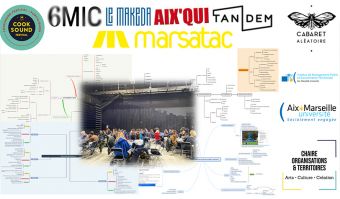
OTACC – a role model for a pluralistic fundamentally integrated organisation to teach innovative management to tackle crisis holistically.
Teaching management in a systemic crisis sounds on first sight like squaring the circle. We believe it is time that the academic world makes its own proposals to deal with uncertainty—for students in their future professional life or for courses and curricula of the academic world itself.
OTACC Chair, as a pluralistic fundamentally organisation and participatory science approach, brings together academic researchers, students, CCI sector professionals (public and private organisations representatives), artists, artists collectives, related sectors professionals (public and private organisations representatives) and offer them an non-linear learning environment with built-in cross-disciplinary surprises as well as the integrated skills for management in a world of multiple and continuing crisis.
References/Links
1 Collège des transitions sociétales: https://web.imt-atlantique.fr/x-de/cts-pdl/
OTACC presentation
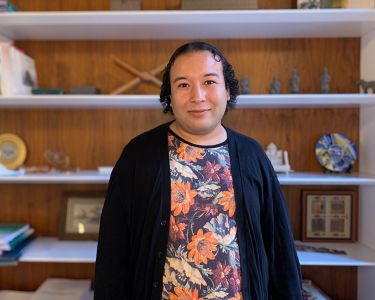
Edina Soldo
Edina Soldo is Full Professor at IMPGT (Public Management and Territorial Governance School)-Aix-Marseille University (AMU) and AMU Special Advisor on CCI. Djelloul Arezki is Senior Lecturer. They are both researchers at the CERGAM, AMU research center and head “Management and Law of Cultural Organisations and Events” Master’s degree at IMPGT.They have founded with three major universities and the Provence Alpes Côte d’Azur Region a regional hub: MIN4CI, Mediterranean Innovative Narratives Competence Center for Cultural and Creative Industries.
Edina´s research topics focus on innovation in CCIs. She analyses inclusive approaches in co-developed CCI territorial projects by using Public management and strategic territorial management concepts and theories.
Picture © Gapore Tan

Djelloul Arezki
Djelloul Arezki´s research topics focus on inclusive practices in co-developed CCI organisational projects. He analyses inclusion through strategic human resource management and queer theory. They co-lead the OTACC Chair.
Picture © Gapore Tan

Our Ode to Creativity
Dr. Matthias Röder, Managing Director of Karajan Institute, Co-Founder of Sonophilia Foundation; Seda Röder Founder of Sonophilia Foundation, Salzburg
Our Ode to Creativity
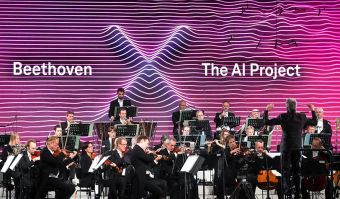
In 2019, Michael Schuld of Deutsche Telekom asked whether an AI could be built to finish Beethoven’s 10th Symphony—a revolutionary homage and a birthday gift to Beethoven by the Bonn-based company bringing together technology, arts and communications. In this piece we reflect on the aspirational benefits of a “creative AI” and the reactions of recipients from different milieus. Although general audiences embrace the endeavour, cultural conservatives argue to exclude AI from entering the genius-oriented realm of creativity. Fear seems to be omnipresent, oblivious to the fact that Beethoven AI is a tool—like printing in the 15th century. In this short essay we make the case of how to put AI-supported Art to use for a human-centric Renaissance.
Picture above: Copyright Deutsche Telekom / Norbert Ittermann
Finishing Beethoven’s 10th Symphony with AI support would be monumentally complex—we knew right away. This is for two reasons. First, there exist only a very small number of sketches for the symphony and they are for the most part in a fragmentary state. Therefore, understanding Beethoven’s intentions for this 10th symphony is difficult. Second, honouring what Beethoven had already written, but keeping in mind his incredible versatility in working with musical material, required a very flexible and unique kind of AI that did not yet exist. As we started the project, however, a third complexity emerged to outtrump all others. Beethoven was seen as one of the pinnacles of human creativity and we were receiving criticism even before one tone was played: How could we even dare to create music with an AI that could compare with Beethoven’s music?
Two years later, in October 2021, Beethoven X – The AI Project was premiered, at Deutsche Telekom’s headquarters in Bonn. Thousands of people around the world followed the live stream along with hundreds in the audience. Not one person in the crowd was able to tell where exactly the sketches of Beethoven ended and where the music of the AI took over. Standing ovations filled the hall for many minutes… Music aficionados, technology enthusiasts and distinguished media outlets such as CNN, BBC, BILD and many more from around the globe seemed to love the result, while the album entered the German pop charts.
Nonetheless, following the premiere, a heated discussion broke out.The conservative feuilletonists and hardcore traditionalists labeled Beethoven X as “sacrilege” and were particularly bitter in their judgement. Going over the music motif by motif, they discussed whether our AI matched Beethoven’s “genius” music, or whether it was just an unemotional imitation of the original—often confusing and criticising the original fragments with music produced by the AI. The discussion however showed striking similarities to the criticism that others have received for creating their completion of Beethoven’s 10th symphony. That’s when we realised that the whole debate was clearly not about the music itself nor about the capabilities of the technology—it was about excluding AI (and sometimes even humans) from entering the genius-oriented realm of creativity.
But Beethoven X heralds a future where there are no barriers of entry into the ivory tower of arts. It foreshadows a new kind of Renaissance that is all about democratising creativity for all rather than making it a privilege for a few. Most importantly, Beethoven X aspires to be part of a future where humans and machines interact productively so that more people can harness the benefits of technological tools to unleash creativity, to self-actualise and to contribute to humanity. Technologies are advancing rapidly. Therefore, unleashing their potential for the greater good is, quite frankly, a pressing matter. We should, perhaps, be maximising the creative potential in the world with much more urgency. Consider this: according to the numbers compiled by the Austrian Statistics Agency, only 0.02% of the entire world population is working in any innovation and creativity-related field—R&D, environment, food, societal innovation, arts… you name it!
But can it truly be that only one in 5,000 people are actually creative? Can it truly be that only one in 5,000 people can contribute to innovation or to arts? Of course not!
We live in a world obsessed with not wasting resources, yet when it comes to human potential, we seem somewhat complacent. Considering our world’s current situation, we need all the help we can get to start asking different kinds of questions and exploring new pathways where old ones are failing. That is precisely where the power of human-machine interaction lies.
Our Beethoven AI gave us options, options we could never have produced without it in such a timeframe. In so doing, it maximised our creativity. The options it so effortlessly produced were threefold. First, they expanded our horizons in that AI didn’t care about our conventions, taboos, or rules. Second, they gave us freedom, putting us in the driver’s seat with an amazing array of choices.
Finally, they saved us tons of time which we could spend focusing on and learning about things that really matter. All of that is indeed “human” music to our ears.
If an AI can help humans be more creative—more “human” even—the question remains: Why are we not employing this technology much more widely to address and solve other problems too?Perhaps the answer is that our age lacks courage. Business-as-usual mentality and fearing failure is omnipresent in our organisations. Many are reluctant to experiment with AI within the context of creativity. Or maybe the fear lies in the idea of a machine becoming a “more creative individual” than us, as if we were in competition.
Humans are not computers, nor should they be treated as such. Unfortunately, this is still the case: just look at your child’s homework sheet, and you’ll immediately know what we’re talking about. Our systems should be focusing more on raising first-class creative and collaborative thinkers, learners and inventors, rather than programming what are essentially second-class calculators.
Picture left: Copyright Deutsche Telekom / Norbert Ittermann
Let’s accept the reality: Humans are generally not very good at reproducing Knowledge 101. Our memory capabilities and speed of data-processing are simply flawed in comparison with machines. But we excel at other things, particularly at empathy and creativity. We are also extremely good at unleashing the potential of all sorts of tools around us: We invent tools to improve the lives of people we’ve never even met. We utilise tools all the time to inspire and connect with each other. Our Beethoven AI is one of them.
This is a turning point in history. Instead of asking whether someone is “allowed” to use AI in the creative process or to emulate the style
of a creative superstar, we should be instilling the right mindset and the joy of experimentation to awaken the creative superstar inherent in everyone. It is high time we stop putting people into boxes only to later instruct them to think outside of the box!
As the debates and reflections around our Beethoven experiment unfold, we must begin acting on that promise.
Our world is slowly coming out of the Industrial Age, but what’s next is not the age of technology, digitalisation, or transhumanism.
It’s the Age of Creativity!
Matthias Röder
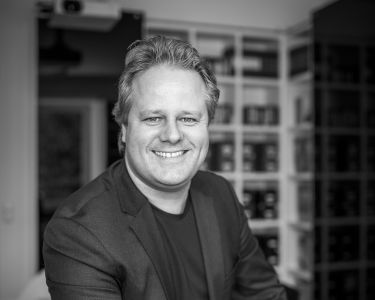
Dr. Matthias Röder is an award-winning music and technology strategist. He is Co-Founder and Managing Partner at The Mindshift, a consultancy on creative leadership and innovation strategy. Matthias currently serves as a board member of the Karajan Foundation and is the Managing Director of the Eliette and Herbert von Karajan Institute. He is also a member of the board of trustees of the Mozarteum Foundation. In 2017, Matthias founded the Karajan Music Tech Conference, a cross-industry event to promote breakthrough technologies in music, media and audio. He is also the founder of the Classical Music Hack Day series which he launched in 2013. Together with his wife, Seda Röder, Matthias co-founded the Sonophilia Foundation, a non-profit that promotes a scientific approach to creativity. Matthias has won numerous prizes and accolades for his work, including most recently, the “Game Changer” Award of the Chamber of Commerce Salzburg. He is a sought-after speaker and lecturer who has taught at Harvard University, the Change & Innovation Management Program at University of St. Gall, and Salzburg University. He holds a PhD in music from Harvard University and is an alumnus of the Mozarteum University Salzburg.
Picture © HUBERT AUER Salzburg
Seda Röder
Seda Röder, aka “the piano hacker”, is an author, entrepreneur and philanthropist devoted to cultivating creativity in society and organisations. She is a sought-after speaker, consultant to DAX listed companies and the founder of the Sonophilia Foundation; a non-profit organization dedicated to advancing the scientific research of creativity and critical thinking. Seda is Co-Founder and Managing Partner at The Mindshift, a consultancy on creative technologies and change leadership. Furthermore, Seda is a fellow and a member of the Salzburg Global Seminar Corporate Governance Forum, angel investor and network partner at the European startup accelerator Silicon Castles. In 2018 Seda received the Game Changer Award at the Austrian Chamber of Commerce for her business merits. Before relocating to Europe, Seda taught music performance, theory and history at Harvard University and Massachusetts Institute of Technology (MIT) as an Associate and Affiliated Artist.
Picture © Private Collection


physical-virtual-virtual-virtual-physical-physical-virtual-physical-physical-virtual-physical-virtual-virtual-physical-virtual-virtual
Alejandra Panighi, Strategic Consutant at Mediapro, Madrid
physical-virtual-virtual-virtual-physical-physical-virtual-physical-physical-virtual-physical-virtual-virtual-physical-virtual-virtual
In which metaverse do we want to live?
The Metaverse—A ubiquitous, synchronised universe where presence and sense of presence become indistinguishable.
For those of us who were born in the 20th century, the word „metaverse“ came to be associated with science fiction books and films of the 1990s which depict a dystopian future dominated by technology. In most of them, humanity is dominated by mega corporations, totalitarian governments or dehumanised scientists who use simulated worlds and robotic environments to subject people to situations of oppression, domination and injustice.
But for those who grew up with the online world as an integrated space within the physical world, the metaverse is simply a collection of all the virtual universes that coexist in the cloud and are necessarily shared, interactive, immersive and collaborative.
The metaverse is, for this generation, understood as an environment where the digital assets become an extension of the physical assets—precisely a moment when the blurring of this distinction simply happens.
It began perhaps with the mobile internet, and just accelerated with advances in the use of AR (Augmented Reality), VR (Virtual Reality) and AI (artificial intelligence) until becoming an increasingly present and ubiquitous mixed reality.
Creative industries, particularly video games, went deep into this concept of real-digital and digital-real, making immersive experiences a language of a generation who learned to live and enjoy these environments in which the physical person and its own digital extension coexist and converge.
It is now the same generation that expects to integrate into this metaverse all the other aspects of their lives: sports, social activities, academic life, travel, work and global economy.
For several years, the narrative about this metaverse, as something real outside of films and books, was captive of those who worked to revolutionise the actual rules of Internet, developing the virtual economy from different but close perspectives. It was almost a cryptic universe, accessible to those who could quickly understand the token economy and its fungible and non-fungible tokens and the rules of permissions and permissionless environments—among many other concepts—in which „old“ inventions like Napster would have been unstoppable.
That is until 2021, when Facebook divested itself of its original brand and became Meta by announcing multi-million-dollar investments in augmented and virtual reality, robotics, high-tech VR glasses and sophisticated software applications to make the old Facebook social media network an environment for communication, fun and work in the metaverse.
Other giants of the internet 2.0 era such as Google, Microsoft or Apple also unveiled their plans to develop virtual environments with huge investments. This sudden trust in the virtual economy became a fillip for hundreds of start-ups who could suddenly access a flood of money in projects that few months ago previously have been considered extremely risky. How quickly and how much further it might go is yet to be seen, but lots of ethical questions are raised when we think about a near future where both worlds, the Physical and the Virtual, get together and shape our lives in a constant physical-virtual-virtual-virtual-physical-physical-virtual-physical-physical-virtual-physical-virtual-virtual-physical-virtual-virtual dialectic.
There are at least two main visions of how this Metaverse should be…
One is inherited from the current model of society, led by closed platforms and Big Tech that are not necessarily the bad boys of so many dystopian novels. But there are indeed few and dominant players of the digital economy of the 21st century. They claim the central role such huge machines should be allowed to have, to make this Metaverse happen in an ordered and controlled way, far from actual wilderness of the internet sphere that includes the worst we can see from ourselves in the deep and dark web.
Another vision, in stark contrast, talks about an Open Metaverse created with open technology and open protocols that allow increasingly decentralised and accessible environments for almost anyone. This is the vision of those creators of—and believers in—Web 3.0, which has been evolving for at least 10 years. They advocate for an Open Metaverse based on principles of digital sovereignty and easy access to data and protocols for people to achieve a new world economic order, an order perhaps better, perhaps fairer, perhaps more promising for those who now lie at the bottom of the actual world’s economy.
A third vision, probably the most plausible one, is a coexistence of both centralised and decentralised visions, convergent and divergent environments in which any kind of ordering or regulation will be complex but might prove necessary.
In any case, during the next few years we will experience a true ethical, moral, ideological and economic revolution that is somehow reminiscent of the profound change in society that took place during the Renaissance.
In these times, we will see the scaling of this virtual-based economy, environmental challenges, not only those arising from the digital economy but also those inherited from the current economy, new jobs and the transition between the old jobs and the new ones, and so many other challenges and so many inconsistencies in the meantime.
We’ll need to go through a deep revision of the grounds of Internet, the deepest since it was born:
– the whole process of capture and control of data
– the cost of electricity or other renewable power sources
– accessibility to digital resources
– the conversion from actual sleeping goods in Cloud wallets to the commercial retail system
– the backend of the internet (hardware and software)
– the actual network and nation-based technical infrastructure
– operating systems.
… And so many other concepts raising from the revision of these basic ones.
But also, rethinking what identity means, what belonging means. What is a community? What is fandom? Or random? The possibility of
multiple identities for each person—physical and digital—and a possible total sovereignty for each opens up an unexplored universe.
The sovereignty of identity in the physical world, in the virtual world and in what emerges from the combination of both universes for future generations may completely change social relations in the decades to come.
Somehow, once again, as in Europe’s First Renaissance, the New Renaissance will be all about the convergence of Culture, Economy and Technology.
Alejandra Panighi
Born in Argentina, she started her career in TV in America as producer and journalist, but she was always attracted by all ways of storytelling in almost any written or visual formats too.So it was not a surprise when, in early 90’s, she joined the team that launched Yahoo and AOL portals in the American continent, when they were still a web directory of content curated by people. She experimented with live shows and live interviews with musicians, interacting also with those the few users who could access dial up connections for several minutes. Living in Europe for the last 20 years, she’s been focused in innovation of the film, series, live sport and eSports industries, looking for different business models and new ways of reaching audiences. She embraces technology as a driver for innovation and follows consumer’s behaviour with passion. From VR-XR to immersive experiences, from data management to AI and moving now in the arena of virtual economy her wide expertise on the evolution of the Audiovisual industry is an asset. Focused in EU policy for the last decade, she lives in Brussels and works as a strategic consultant for Mediapro Group, dealing directly with the Board of Directors.
Picture © Pepe Encinas (Barcelona, Spain)

Digital transformation as a second renaissance?
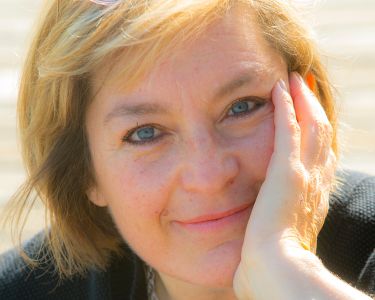
Prof. Dr. Dr. h. c. Julian Nida-Rümelin, Staatsminister a.D., Director of Bavarian Institute for Digital Transformation and Vice-Chair of German Ethics Council, Munich
Digital transformation as a second renaissance?
Towards digital humanism
The European Renaissance began first in Italy after a period of exhaustion by plagues, misery and wars. In the mid-14th century, the plague had plunged Europe into one of the worst catastrophes of mankind, an incurable disease that brought great pain to those afflicted and usually a quick death. Even before the plague, a long-lasting famine had taken hold, for which climate change in the form of significantly falling temperatures probably played a decisive role. The structures of social order eroded and everyday life became brutalised. The population declined markedly, with the paradoxical effect of a valorisation of human labour and an increase in productivity brought about by new technologies. The European Renaissance was preceded by a creeping decline in the authority of clerical and princely authorities, and was characterised by a return to ancient thought, especially that of the Greek Classical period and the Roman Empire. Aristotle was disposed of—prematurely—because the Thomasian worldview, unlike patristics, was based on his writings and had made them the authoritative source alongside the Holy Scriptures.
The young intellectual Pico della Mirandola (1463-1494), born into high wealth and highly gifted, published his writing De hominis dignitate (Rede über die Würde des Menschen EA: 1496) and ensured that it was discussed throughout Europe by intellectuals and eventually also by ecclesiastical authorities. At the centre was an image of God that endows man with artistic creativity, technical innovation, and scientific research; indeed, one might say that in this writing Pico della Mirandola anticipated the thesis of the analytical philosopher Roderick Chisholm that man, like God, is an unmoved mover (Die menschliche Freiheit und das Selbst (1964), S. 82). Human creative spirit completes the work of God. Humans as rational beings are authors of their own life. They are free and therefore bear responsibility for everything they do. Only Immanuel Kant thought the consequences to the end in his practical philosophy of autonomy.
The Renaissance was an epoch of impressive innovation. And like other innovative periods in human history, it was characterized by the breaking up of schools and conventions, by interdisciplinarity, and by the fluid transition of philosophy, science, technology, and art. Education was no longer the learning of preconceived patterns of thought and practice, but self-education with the goal of life-authorship. Leonardo da Vinci did not know whether to see himself as a scientist, technician or artist. The Renaissance cities became documents of impressive design in the combination of technology, craftsmanship, art and science.Are we on the threshold of an era of comparably far-reaching innovations, shaped by the potential of digital technology? To be able to assess this, we first have to face a sobering fact. The third wave of digitisation has not yet made a significant contribution to either labour-hour or resource
productivity. The platformisation of the economy has reshaped it to some extent and created large tech giants, but it has not stimulated growth, or at least not noticeably. In a ranking by the World Economy Forum a few years ago, Germany landed in first place among the most innovative countries in the world—probably to the surprise of the authors—while at the same time being one of the most digitally backward. Working hour productivity in Germany is almost a third higher than the EU average while almost all European countries are outstripping Germany in terms of digital transformation. The productivity of the German economy is just behind Norway and Switzerland, but well ahead of France, Canada, the U.S. and Japan (which leads the East Asian countries). The productivity boost that digitisation triggered with the introduction of personal computers and the use of the Internet in the 1990s has not been repeated in the third wave. At the same time, however, the world is in dire need of a technologically-driven increase in productivity in the face of resource scarcity, ecological depletion and climate change.
All the inadequate efforts to cut CO2 since the 1990s have been far outweighed in Europe by the additional CO2 emissions of the Chinese economy. Meanwhile, the Chinese economy is polluting the atmosphere with climate gases at a higher rate than the US and Europe combined—even though China’s economic output ranks only third after the US and after the EU. If other current and future boom regions such as India or sub-Saharan Africa follow the development path of China, the climate catastrophe in large parts of the world cannot be stopped. The digital transformation must enable other development paths and use human and natural resources far more sparingly without stifling economic momentum in a development phase where the demographic dividend pays off in the global South.
Inventiveness, interdisciplinarity and creativity—the human ambition to master the existing challenges and not to be driven by apocalyptic fears into helpless protest or resentment-laden apathy—are required. A rapid changeover to climate-neutral and ecologically sustainable economic activity, first and foremost in the highly industrialised countries, the treading of new technological, economic and social development paths in fair cooperation between the world’s regions and the mobilisation of human resources in order to overcome the major challenges facing humanity will only be possible with the massive use of digital technologies.
Not data thriftiness, but protection of personal rights and use of data for humane progress in medicine, natural science and education, in state administrations, small and medium-sized enterprises, the efficient and effective organisation of social cohesion, are indispensable for this. The humanistic ideal of human authorship, self-education and creative power must experience a renaissance under digital auspices.
Responsibility remains solely with human actors. Software systems, highly developed so-called „autonomous“ ones as well as those which are called „artificial intelligence“ (AI), are not actors, not people. Man does not become God, who creates other individuals in his image to use them at will for himself. They are merely technical, albeit highly sophisticated, tools that we should use individually and collectively, legally framed and politically shaped, for the good of humanity. This is the central message of Digital Humanism: machines are not people and people are not machines. The currently fashionable AI animism is unscientific mumbo jumbo, a projection of a familiar type that animates the unsouled and gives satisfaction to the swashbucklers. And man is not a machine, not an algorithm-controlled software system, but a freely responsible actor of his actions. Digital technologies will not relieve him of this responsibility, but neither will they take away his freedom to individually and collectively shape life and its conditions.
The renaissance of digital transformation is based on the empowerment of human authorship, on the development of human creativity, on the targeted, intelligent and measured use of new technologies for human purposes. It aims to humanise the world of work through sustainable production and the establishment of fair practices in the global economy, while the current development path has established monopoly structures in the form of large tech giants, shifted greater parts of economic value creation to platforms and made a successful business model out of the skimming of user data from digital service offerings for marketing purposes. This humanistic form of digital transformation will not be feasible without a state framework in the form of digital infrastructures, without an independent European path of „human centred AI“ and transparent uses while safeguarding informational self-determination rights, without a European legal framework of digital dynamics. But the chances are good that the humanistic form will ultimately prevail over the commercial model of Silicon Valley and the state control model of China and other autocratic and totalitarian states.
Prof. Dr. Dr. h. c. Julian Nida-Rümelin, Staatsminister a. D.
Julian Nida-Rümelin teaches philosophy and political theory at Ludwig Maximilian University in Munich.JNR was a member of the first Schröder cabinet as Minister of State for Culture and Media. He is a member of the Academy of Sciences in Berlin and the European Academy of Sciences, director at the Bavarian Institute for Digital Transformation (bidt). In 2016, the Bavarian state government awarded him the medal for special services to Bavaria in a United Europe. In 2019, he received the Bavarian Order of Merit. Since May 2020, he has been a member (as deputy chairman) of the German Ethics Council. In 2016, Humanistische Reflexionen (Humanistic Reflexions) was published by Suhrkamp. In the fall of 2018, he published a monograph on Digitaler Humanismus: Eine Ethik für das Zeitalter der künstlichen Intelligenz (Digital Humanism: An Ethics for the Age of Artificial Intelligence) (Piper Verlag), for which he received the Bruno Kreisky Prize in Austria for the best political book of the year. In spring 2020, edition Körber published Die gefährdete Rationalität der Demokratie (The Endangered Rationality of Democracy) and DeGruyter Eine Theorie praktischer Vernunft (A Theory of Practical Reason). Picture © Diane von Schoen

Design is an attitude
Forbes Top 50 Women in Tech, Strategy Advisor to European Commision and Parliament and Founder of ElectroCouture, ThePowerHouse and FNDMT, Brussels
Design is an attitude
The renaissance of an interdisciplinary mindset
This article pays homage to the legacy of artist and Bauhaus professor László Moholy-Nagy and calls for a renaissance of his mindset, a mindset that incorporated new and revolutionary ideas about technology, education and attitude.László’s mindset is perhaps best encapsulated in maxims that abound in his prolific writing and which are pithy, catchy and easy to adopt as principles of design. Design is an attitude. Everyone is talented. László’s ideas about design were—and still are— democratic and inclusive. Everyone who can get involved in the design process should be involved—and that’s especially true when confronting the complex issues we face today such as sustainability. László was relentlessly experimental, but he was also very practical and his ideas very practicable. He documented his work fastidiously and he wrote prolifically, meaning his ideas, his guidance could be put into practice.
What is design?
So, what is design? Wow, we could talk for 10 hours—for 10 years!— about this. But what we can say for certain is that design is always an opportunity to improve. And for the designer, opportunities abound—it’s just a matter of seeing them. Looking, for instance, at discussions around sustainability, we need to find new solutions and new ways to tackle problems in order to build a better world. We need to solve problems created by old systems. (Though imagine that we had actually tried to avoid the problems before they had turned into the big issues they are now…)The sort of design I’m interested in is inspired by the Bauhaus. The Bauhaus was not just a school of design—it was away of working, of living, of being. One of my favourite aspects of the Bauhaus, a school of which László founded in Chicago, is the training that all of the students had to go through. Every student needed to know all of the machines in the workshops—not only how to use them, but also how to maintain them and how to repair them. Isn’t that wonderful? When you know how things are made, how machines work, it gives you power and freedom at the same time.
"Everyone is talented"
Back then it was the sewing machine. Today it’s the computer. Both have generated an impact beyond their intended purposes. I call this potentially extended impact #reprogramthemachines, because every machine can do more than the purpose it was originally designed for. It’s the same with our brains. We can do so much more than what we’ve been trained for before. And everyone is talented. László argued that, so long as they are interested in and dedicated to their work, people can tap into their natural creative energies. That means everyone can get involved. And in the case of the complex issue of sustainability, everyone—every possible angle—should be involved.We also need to look in from the outside. The fashion industry, for example, is an industry which was siloed for a very long time, relatively protected from outside opinion and criticism. A t-shirt requires around 25,000 litres of water in order to it. There is something very wrong with this picture but sometimes it takes an outside view to see this wrong.
Looking at other industries which have been disrupted in the last 10, 15 years—transportation, music, movies—the startups that disrupted them didn’t emerge from the traditional industry. Spotify, for instance, didn’t emerge from traditional radio. Instead, these companies were founded by people who were frustrated with the status quo and who dared to question it, asking, Why don’t we try things differently? They used tools to fix the problem, digital tools, and involved people from across disciplines. When everybody is talented, everyone can get involved. No elite, no club, just an equal playing field.
"Designing is not a profession but an attitude”
I love the emphasis on attitude in the Bauhaus. Everybody can have an attitude, it’s a totally level playing field. It’s about lifestyle, it’s about seeing opportunities everywhere. Everyone should and can have the attitude to change and to design. And everybody can and should have the opportunity and attitude to be sustainable.
That means it is the designer with the right attitude who brings everything together.
The problems we have to solve now—and the problems we need to avoid in the future—are very complex and very diverse. They’ve been created because industries have been trapped in silos with no communication between them. So, for me, it’s the designer with attitude who can bring everything together—and we are all designers. We are bridge-makers, traversing industries, silos, technologies and mindsets to bring everything into a coherent and intelligible picture.
"The illiterate of the future will be the person ignorant of the use of the camera as well as the pen”
Remember László’s telephone pictures? Those pictures started a whole new discussion: What if, all of a sudden, a designer uses technology to create art? Is he still an artist?. Back then, photography was a new technology and László completely embraced it. But let’s not forget the pen which was, at some stage in history, a new, super smart piece of technology. The camera is to us now what the pen was for László. For us, the camera is a standard, familiar tool, like the pen. Perhaps new technologies like algorithms and artificial intelligence perhaps have a similar novelty for us that the camera had for László. The question is how we work together to use these tools. So, ladies and gentlemen, how do we do this?
Work. Go and travel. Go and talk with other people if you’re an architect or builder, in the loosest sense of those words. Or if you’re a writer, a musician, a content creator. Explore space, explore our oceans. Have you ever talked with a programmer, a software engineer or a data architect? I highly recommend it because a great piece of code can be as exciting as a novel and as impactful as a symphony. So, wherever you go, whatever you do, do something different. Talk with other people. Make things better, together.
Lisa Lang
Lisa Lang has gained recognition as one of Forbes Europe’s Top 50 Women in Tech, and has been listed as one of the 50 most important women for innovation & startups in the EU.She founded highly recognized companies like ElektroCouture, ThePowerHouse and FNDMT who are dedicated to push innovation within the creative and innovative industry eco systems. Lisa Lang is a direct adviser for creative industries, digitalisation and entrepreneurship for the European Commission on several high-level advisory boards, including Pact for Skills, Industrial Forum and the US/EU Trade & Technology Council.
Lisa Lang is on the advisory board to the Zurich university of arts as well as a policy advisor for Fashion Innovation Centre Sweden. She regularly teaches business and innovation strategies at the Porto Business School and has been given guest lectures at TEDx Athens, KryptoLabs Abu Dhabi and Oxford University.
Picture © VOGUE Greece

New Stages for Collective Imagination
Annette Mees, Artistic Director of Audience Labs, King’s College London and Creative Fellow at WIRED, London
New Stages for Collective Imagination
The show must go on
Cultural institutions the world over collectively seek out new ways to connect meaningfully to local, global and diverse audiences—To co-produce and programme new kinds of experiences created with new kinds of creative teams and new kinds of partners offers exciting opportunities. Audiences are eager to connect with both big ideas and one another and have challenging and new experiences ahead. Audience Labs is an artist-led initiative looking at the intersection of Performance, Innovation and Social Change and was born at the Royal Opera House in London’s Covent Garden, a location with a centuries-old tradition of performance. Introducing the creative practices of opera and ballet to immersive technologies provided a unique opportunity to look at bringing human emotion and collective experiences together. We want to look at what is possible but always continue to ask what is desirable and in what way technology enriches our life in the wider societal shifts and upheavals of the digital and green transformations taking place before our eyes.
I’m a theatremaker not a technologist. I work in the arts because it has a public function—it’s a space to collectively reflect and imagine, a space that can help us explore what it means to be human in a future society and what it can contribute towards a next Renaissance. I’m interested in the artistic potential of technology and the role art and culture can play in shaping our relationship to the world, to each other and to the technologies we use in that process.
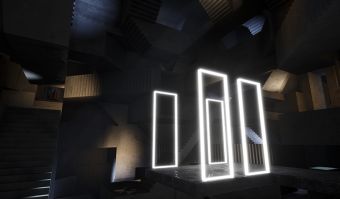
Picture above: Current, Rising CGI Production Shot House of Subconscious, Copyright: Joanna Scotcher & Figment Productions
Current, Rising: an opera in hyper-reality
One of the projects Audience Labs presented in 2021 was Current, Rising. Described as the world’s first ‘hyperreal’ opera experience, it invites audiences to step into an atmospheric virtual world and take centre stage in the performance.
When I joined the Royal Opera House I was inspired by the ‘epicness’ of opera, the way the storytelling was driven by music first, narrative is secondary, the events are there to support the ideas and emotions. So many of them are about heightened emotions, to let you feel all the feels, so to speak, everything is bold and big. In opera the word Gesamtkunstwerk is used, or „all-embracing art form“.
Hyperreality combines Virtual Reality with a physical set and visceral effects like wind, heat, touch and movement to create a multi-sensory, immersive experience. It uses tracking to create a shared experience—the audience can see each other in the virtual space. It felt like an inherently operatic medium, which could enable audiences to step into an imaginative universe and to be the lead characters in it.
We wanted to do a project like this because it allowed us to use the possibilities of hyperreality to expand the idea of what an opera can be, both in the process of creation and in the audience experience. We set out to challenge the traditional hierarchies of opera and searched for different approaches to creating a 21st-century version of a Gesamtkunstwerk: A challenge and change of hierarchy to be found in many sectors, markets and communities now on their way to invent new sustainable and green ways of living and working. For us Current, Rising puts the opera as an institution right in the middle of these transformational debates about possible futures in Europe.
Fellow Travellers
Our starting point for projects is always identifying the most interesting questions—often that is a ‘What If’ question. The immediate second step is casting the right people to explore those questions with. Exploration and innovation is not something one does on one’s own. We believe that the power of creativity and innovation grows exponentially with the diversity and multiplicity present within a team. It is most powerful when based on a shared vision, shared vocabulary. When we visited Figment Productions, their technology and creative team felt like a perfect match. They had a radically different background from us, making work for theme parks and big live events, but they shared our enthusiasm for radical new ways of working, deepening the audience experience and doing everything with imagination. They, like us, were curious about the potential of a hyperreal opera and equally important brought a real sense of technological poetry to the table.
We brought together a highly-experienced and diverse creative opera team. We facilitated a series of sessions where we explored opera and hyperreality, finding directions of travel that might unlock something exciting. I call this establishing the artistic nucleus. Since we were not only inventing what a hyperreal opera might but also how we make it, we needed a space to develop a vocabulary before going into production. We gave makers time to develop attitudes and taste before landing on what they wanted to say on that particular stage; we enabled technologists to find artists that inspired and pushed them in new directions. It was the equivalent of making rough sketches before you decide what the painting looks like.
Picture right:
Iterate
Audience Labs embraced iterative working as a way to try out new ideas, and to de-risk investment and learning. When trying to create something both artistically valuable and highly innovative, you need time to fail and learn, reassess, make changes and try a different approach. Many projects start with an inkling of the possible but need time to gather the right ideas and the right team to work towards something that has meaning and value to an audience. Although an overemphasis on efficiency stifles innovation, iteration is simultaneously the most efficient way to look after your money. Innovation is inherently risky and unpredictable. But by working in stages, starting small and slowly scaling up to full production, you de-risk investment that is necessary for large-scale productions.
Current, Rising used techniques from theatre, technology and design to create a process that allowed the artistic and technological developments to iterate together towards a meaningful piece of work.
We started on paper, trying ideas and concepts out by making simple sketches, storyboards and mock ups. Some of the places we borrowed from included:Theatrical rehearsal and devising techniques
– Game design
– VR production pipeline
– Double diamond model
– Experience design
We shared work often and openly between the team until we knew we had the right story, technology, aesthetic and approach for the project to soar. Only then did we go into the full expensive production period. This approach allowed us to adapt to the complexities as the project grew and deliver an extraordinary project on a tight budget.
The show
The show that emerged from this process was Current, Rising. Inspired by the liberation of Ariel at the end of Shakespeare’s Tempest, Current, Rising takes four people at a time on a journey through the six phases of the night. Participants are empowered to collectively explore a series of imaginary dreamscapes, travelling from twilight to dawn as they encounter ideas of isolation, connection and re-imagination. It explores freedom as a process within our control, rather than as a state in which we exist, and asks how we might harness personal responsibility to join with others to re-think the future.
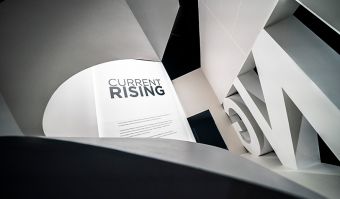
The audience enter a real life theatre set wearing VR headsets and go on a dreamlike journey carried musically by a poem layered in song. It takes the epic, music-driven and poetic qualities of opera and combines it with the possibility of VR to create any possible landscape, defying all natural laws, pushing beyond what is possible on the stage. In Current, Rising music, the visual world and the physical experience are completely enmeshed, changing the relationships between the creators, the usual sequence of creation, and the relationship of the audience to the work. Here the audience members are the protagonists: they are inside the work, and their physical experience is a part of the work itself.
The audience and the response
An audience research conducted by Royal Holloway discovered fascinating results.It brought new audiences to opera: 31% had not been to the Royal Opera House before and 68% of these new audiences were under 35.It also brought new audiences to the technology: 32% had not experienced virtual reality before. A lot of those were regular opera goers.
Many reported on a potent emotional experience, with uniformly high enjoyment ratings (an average of 4.6 out of 5) with an equally high rating in the seasoned opera goers and VR users and first timers. That cross-pollination of different audiences is really exciting—people who wouldn’t meet each other under different circumstances shared an experience in this show.
An audience research conducted by Royal Holloway discovered fascinating results.It brought new audiences to opera: 31% had not been to the Royal Opera House before and 68% of these new audiences were under 35.It also brought new audiences to the technology: 32% had not experienced virtual reality before. A lot of those were regular opera goers.
Many reported on a potent emotional experience, with uniformly high enjoyment ratings (an average of 4.6 out of 5) with an equally high rating in the seasoned opera goers and VR users and first timers. That cross-pollination of different audiences is really exciting—people who wouldn’t meet each other under different circumstances shared an experience in this show.
Possible futures through art
Current, Rising is one of many projects we developed at the Royal Opera House. In our three-and-a-half years there we worked with 22 partners and 44 artists spread over 14 countries. We explored a range of technologies including game engines, motion capture, animation, augmented reality and virtual reality and worked with artists working in opera and ballet, visual art, music, design, digital art, make-up and filmmaking. This convergence of perspectives, practises and ideas provided an incredibly fertile ground on which to create new ways of thinking about art and new possibilities for creative expression.
Art can make a world worth living in. After shelter, equality, equity and a healthy planet, there is art. Audience Labs explores possible futures through art—we aim to construct shared experiences and transformative moments that enrich people’s lives.At a time when we’re all struggling with what the future holds, we wanted to bring makers and audiences together to imagine a shared future, reflecting collectively on: Where shall we go? How do we want to feel? What do we want the world to look like? We are interested in expanding where culture takes place, and broadening who it is for, who gets to make it and how it interacts with other agents of connection and change in the world in the Next Renaissance
As Audience Labs is starting its time at King’s College London, we will be working with a network of industry experts, collaborators and experts to focus on critical questions surrounding the future of performance.
Picture left: Current, Rising CGI Production Shot House of Subconscious, Copyright: Joanna Scotcher & Figment Productions
The work will focus on four strands:
1. Artistic Futures—how do we make good and meaningful art that both explores new opportunities for connection and rising to the challenges of an uncertain world? This includes inclusive international collaboration, remote creative processes, audience and community engagement, and new partnerships.
2. Cultural Metaverses—exploration of technical infrastructures needed to create and deliver a distributed cultural experience, including distribution models, and digital dissemination, expansive audience engagement and business models.
3. Ethics, Audiences, Diversity and Inclusion. As we move towards new possible futures for art and culture in a hybrid age, we need to support work that promotes a more equitable ethical world for all.
4. Towards a Net Zero Profile. We will explore the use of digital and physical green innovations that promote reduced travel and touring, and will support the development of low/no impact stages, and the green venues of the future.
Initially, in this new context at King’s, we will take the opportunity to convene a wider ecosystem of artists and cultural organisations, technology partners, researchers and students to explore these questions and lay out possible methodologies and projects to start that journey. A practical plan on how we work together to innovate and make great art with ethics, equity and inclusion at the heart.
We don’t have all the answers yet. I see the role of Audience Labs as a place that combines conversations with practical artistic production—an intersection that a Next Renaissance cannot do without. Audience Labs might well be understood as a Renaissance sandbox in exploring and R&D-ing how culture can help understand the ethical side of technology, how culture can push the envelope.
Innovation is constant iteration, a form of continuous thinking, trying and pushing. Artists and arts institutions need partners that share their civic values to enable innovation. Only in value-based and wide-ranging partnerships can the arts create value, change and equity for audiences and communities everywhere: a societal Gesamtkunstwerk or in other words, social cohesion in the transformations ahead of us.
Picture right: Current Rising – set design by Jo Scotcher, Copyright: Johan Persson
Annette Mees
Annette Mees is an award-winning immersive theatre director known for her innovative, interdisciplinary, experiential work that allows audiences to explore big ideas and meaningful change. She is the Artistic Director of Audience Labs; a hub for imagination exploring new forms of theatre and technology to dream up sustainable, diverse and equitable futures. It connects artists, technologists, researchers, experts, communities to spark new thinking. We use centuries of stage craft and the possibilities of cutting-edge technologies to create spaces for radical imagination, emotional connections and collective experiences. Audience Labs started at the Royal Opera House and recently moved to King’s College London to explore the underlying questions emerging around these new forms. We want encourage work by interdisciplinary, diverse and inclusive partnerships that is driven by imagination and equity, works towards net-zero and uses technological possibilities ethically. Next to that she works as an innovation strategist, artistic advisor and dramaturg for a range of organisations and projects. Currently she is the chair of FutureEverything, a co-host of global conversation around the future of culture supported by Arup and Therme, an artist mentor for CPH:DOX and developing a strategic R&D project with Substrakt.
Picture © Annette Mees

Renaissance, the world and Europe
Sir Geoff Mulgan, Professor of Collective Intelligence, Public Policy & Social Innovation at University College London and Fellow at The New Institute, Hamburg, and Demos Helsinki
Renaissance, the world and Europe
Beyond the obvious
In the middle of the 20th century Europe was ravaged by world war. But it continued to dominate the world. The empires of Britain and France remained vast. Europe accounted for over a fifth of the world’s population and most of its largest economies.By the middle of the 21st century that will all have changed dramatically. Europe’s share of world population will be closer to a twelfth; its economies will have been overtaken not just by China and India but possibly by others such as Brazil and Nigeria. Its military might will be modest compared to the superpowers.
Moreover, many of the things that might have once seemed uniquely European no longer do. There are many examples of healthy democracies and many examples of the rule of law. Science is more generously funded in countries like South Korea or Israel than most of the EU.
To the extent that people across the world talk about European values, they talk as much about slavery, exploitation and genocide as they do about human rights.
So, any discussion of renaissance has to be tempered by humility. Too much European self-love feels ever less appropriate to the times.
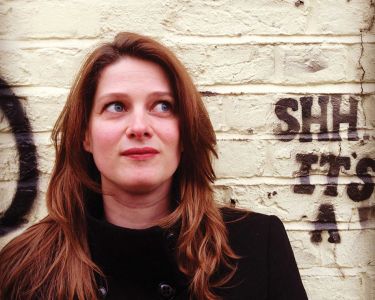
Picture above: Geoff Mulgan, Copyright: NESTA
What Europe has however sustained is a unique mix of features that remain attractive to the rest of the world. We remain good at combining security, prosperity, democracy and ecology. In the developing world people speak of “getting to Denmark” as the typical objective for most of the world’s poorer countries.
And part of that mix is being at ease with creativity, exploration and discovery. That hunger for challenge is not only still missing in many places but is also in retreat—squeezed in Xi’s China, blunted in Erdogan’s Turkey, frozen out in Putin’s Russia, ideologically constrained in Modi’s India.
This makes it all the more important that Europe continues to try to imagine, to fuel creative imagination. To me the heart of this is to imagine not just how the world could get to Denmark, or how to assert our values, but rather to think forward to a plausible and desirable picture of what societies could be like a generation or more from now.
What might a truly zero-waste and zero-carbon society look like? How could democracy evolve to make the most of collective intelligence? How can we live with hugely powerful artificial intelligence in ways that help us thrive? How will we live with far more free time, the result of shrinking working hours and rising life expectancy?
This is the imaginative space that is so badly needed now and at the heart of any plausible renaissance. But at the moment, in Europe as elsewhere, the thinking is weak and constrained.
The universities have largely given up on their role in exploration of the future (something I have written about, with suggested remedies, for the New Institute in Hamburg). Political parties and think tanks
are much more trapped in the present. A few governments have small teams looking into the distant future—for example in Singapore and Finland. But in general, although there is heavy investment in technological imagination and futures—much of it in Silicon Valley—there is far less on social possibilities. This is one reason why so much of Europe’s public now fear the future and expect their children to be worse off than them.
I’m interested in the role the arts can play. Claims that the arts can be prophets of the future, trailblazers of a future society, are quite wrong, and based on misunderstanding—though commonly articulated over the last two centuries by everyone from Percy Bysshe Shelley (who called poets the “unacknowledged legislators of the world”) to Joseph Beuys (who claimed that “only art is capable of dismantling the repressive effects of a senile social system that continues to totter along the death-line”). I can think of no work of art of the last 50 years that described or defined a better future for our society.
But what the arts are uniquely well placed to do is other essential work. I believe that some of the methods of creativity and design need to be integrated with the social sciences and the work of policy design. Remarkably little of this happens now—yet that cross-pollination was precisely what fuelled previous renaissances.
The arts can bear witness and warn—as so many are doing in relation to climate change. They can transform our perceptions. They can explore possibilities, both good and bad, as so many are doing with AI and data. And they can help large numbers to take part in the work of social exploration. Here are three examples.
Bearing witness: climate change
Climate change is now the most visible big crisis, prompting an extraordinary range of artistic responses. Most try to bear witness to what’s happening. Olafur Eliasson’s blocks of ice melting in city squares vividly make people think about climate change as a reality, not an abstraction. A similar effect is achieved by Andri Snær Magnason’s plaque to commemorate a lost glacier in Iceland or the World Meteorological Organization’s short videos presenting fictional weather reports from different countries in the year 2050: “WMO Weather Reports 2050.” Others turn the medium into the message, re-using waste materials to signal the emergence of a more circular economy.Literature is also grappling with climate change. What one author called ‘socio-climatic imaginaries’ can be found in novels such as Paolo Bacigalupi’s The Water Knife and Kim Stanley Robinson’s Green Earth (both from 2015) which go beyond the eco-apocalypse to examine the multiple interactions between nature and social organisation. Kim Stanley Robinson has spoken of science fiction as “a kind of future-scenarios modelling, in which some course of history is pursued as a thought experiment, starting from now and moving some distance off into the future” and makes a good case that literature is better placed to do this than anything else. As the warning signs of crisis intensify we should expect all the arts to respond in creative ways, both warning and bearing witness but also pointing to how we might collectively solve our shared problems.
Investigating complex challenges
The second big crisis—in the sense of being both a threat and opportunity—comes from algorithms and a connected world. Here the role of the arts seems to be more about investigating complex challenges and dilemmas. Many fear that technology will destroy jobs, corrode our humanity and our ethics. So it’s not surprising that we’re seeing an extraordinary upsurge of art works both using and playing with the potential of artificial intelligence. For some artists AI is primarily interesting as a tool—with GPT3 writing fiction; Google Tiltbrush and Daydream in VR; or the growing use of AI by musicians and composers. There are many wonderful examples of emerging art forms (like Quantum Memories at the National Gallery of Victoria in Melbourne). But others are trying to dig deeper to help us make sense of the good and the bad of what lies ahead. Look, for example, at the work of Soh Yeong Roh and the Nabi Center in South Korea exploring ‘Neotopias’ of all kinds and how data may reinvent or dismantle our humanity. LuYang’s brilliant ‘Delusional Mandala’ investigates the brain, imagination and AI, connecting neuroscience and religious experience to our new-found powers to generate strange avatars.
AI’s capacity to generate increasingly plausible works of visual art and music is of course a direct threat to artists, and perhaps encourages a
hostile or at least sceptical response in works like Hito Steyerl’s projects exploring surveillance and robotics (like HellYeahWeFuckDie); Trevor Paglen playing with mass surveillance and AI; or Sun Yuan and Peng Yu’s ‘Can’t Help Myself’, on out of control robots. Others are more ambiguous. Ian Cheng’s Emissaries series imagined a post-apocalyptic world of AI fauna, while Sarah Newman’s work, such as the Moral Labyrinth, explores in a physical space how robots might mirror our moral choices, giving a flavour of a future where algorithms guide our behaviours.
Andreas Refsgaard’s work is playful in a similar vein, like the algorithm assessing whether people are trustworthy enough to be allowed to ask questions. Shu Lea Cheang’s work 3x3x6 references the standards for modern prisons with 3×3 square meter cells monitored continuously by six cameras, using this to open up questions about surveillance and sousveillance, and the use of facial recognition technologies to judge sexuality (including in parts of the world where it’s illegal to be gay). Kate Crawford’s fascinating project on the Amazon Echo (now at MOMA) is another good, didactic example, revealing the material and data flows that lie behind AI.
Each of these brings to the surface the opaque new systems of power and decision that surround us and the hugely complex problems of ethical judgement that come with powerful artificial intelligence.
Advocating for change
The third, slow-burning crisis concerns inequality in all its forms, at a time when power and wealth have been even more concentrated than ever in the hands of a tiny minority. The arts have always played a central role in advocating for greater equality, from the feminist utopias of the 18th century to the revolutionary films and murals of the 20th. They have also, of course, been bound up with wealth and power, dependent on kings and patrons, and today on the super-rich. The world of arts is now inescapably bound up with the many battles underway over gender, race, sexuality, and the responsibilities of institutions—sometimes bearing witness, sometimes investigating, but often acting as advocate. A striking example is the way around the world the Black Lives Matter movement sparked an extraordinary rethink. An interesting recent example is the transformation of the public statue of Robert E Lee in Richmond, Virginia, now covered with a growing forest of slogans and the names of victims of police violence. Many arts institutions are now being held to account for their treatment of historical memory, their links to slavery (like the Tate Gallery in the UK), and the connections of the arts establishment to the more malign features of contemporary capitalism. A good example is the work of Forensic Architecture challenging the role of the then vice-chair of the Witney Museum over his company’s role in making tear gas, a rare example of challenging elite power in the art market.
The top end of the arts market is now entwined with the world of fashion and the lives of the ultra-rich—a symptom more than a solution of what’s gone wrong with the world. High-end art generally favours forms of art that are abstract or ambiguous, paying lip service to equality but avoiding anything too specific, and now plays with new financial devices like NFT to commoditise art as a luxury good.
But a radically different energy is now coming from the bottom up, with a demand for the arts to be more engaged and more accountable. My sense is that this is fast becoming a generational divide, with an older generation reasserting the artist’s autonomy and freedom from accountability, and taking for granted a world of patrons and galleries not so different from a few centuries ago, and a younger generation no longer convinced that this is right for our era.
So art can thrive on crisis and can help foster a much needed renaissance. It can bear witness, explain and provoke. Many sense that a period of relative stability may be coming to an end. The first half of the 20th century brought world wars, and revolutions from Russia to China. Europe had far too much history! But history then slowed down—in good ways for much of the world. The Cold War froze
international affairs, and the period after its end brought far fewer big wars and fewer revolutions, even as parts of the world descended into civil war.
The 21st century by contrast appears set to see history accelerate again, with a looming confrontation between the US and China, the rising pressures of climate instability and the fragility of a world more dependent on networks and machine intelligence.
That may or may not be good for the arts. Harry Lime’s comment on Switzerland doesn’t quite fit today’s world, where the countries producing the most successful artists are generally stable and prosperous (Germany, the US…) rather than steeped in crisis and civil war (Congo, Afghanistan…).
But perhaps a little discomfort is good for the arts, and may better help them to help us make sense of the crises around us and to sensitise us to what’s not obvious. That may also prompt them to work harder to be part of the solutions rather than part of the problem and to help us to be actors not just observers.
Geoff Mulgan
Sir Geoff Mulgan is Professor of Collective Intelligence, Public Policy & Social Innovation at University College London (UCL). He was CEO of Nesta, the UK’s innovation foundation from 2011-2019. From 1997-2004 Geoff had roles in UK government including director of the Government’s Strategy Unit and head of policy in the Prime Minister’s office. Geoff advises many governments, foundations and businesses around the world. He has been a reporter on BBC TV and radio and was the founder/cofounder of many organisations, including Demos, Uprising, the Social Innovation Exchange and Action for Happiness. He has a PhD in telecommunications and has been visiting professor at LSE and Melbourne University, and senior visiting scholar at Harvard University. Past books include ‘The Art of Public Strategy’ (OUP), ‘Good and Bad Power’ (Penguin), ‘Big Mind: how collective intelligence can change our world’ (Princeton UP) and ‘Social innovation’ (Policy Press).
Picture © NESTA
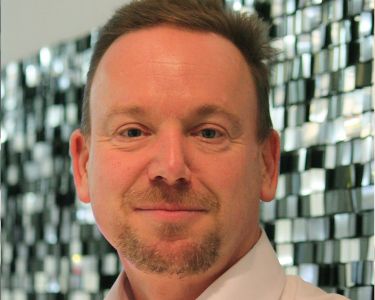

Connecting people and places
Susa Pop, co-founding director of Public Art Lab and Connecting Cities Network; Martijn de Waal, professor at the research group Civic Interaction Design at Amsterdam University of Applied Sciences, Berlin
Connecting people and places
Why Cultural Led Urban Developments are necessary for Resilient Cities
Placemaking is a global civic trend in urbanism. However, a novel combination of arts, technology development and processes of urban governance empowers placemaking to be responsive and forms an essential contribution to a next renaissance of global cities. Not necessarily by making them less global as the following case studies show, but by bringing in a perspective of interconnected local publics and public values to urban policy, from the design of public spaces to the organisation of urban resource management and carbon-neutral cities.
Picture above: Digital Calligraffiti 2017-21 commissioned by Public Art Lab in cooperation with the artists Michael Ang, Don Karl and Hamza Abu Ayyash, Copyright by Michael Ang and Public Art Lab
Responsive Placemaking
Our cities take shape through the overlap of various ‘scapes’: spheres of the circulation of people, resources, ethnoscapes, mediascapes, financescapes, ideoscapes and technoscapes.1 The rise of new technologies and their accompanying practices in the past quarter of a century—from budget airlines to the internet—has intensified the flows in these various scapes and between them. Today we witness interlinked geographies of these scapes across the globe, making the world’s cities ever more interconnected. Hence, from the mid-1990s onwards, scientists, policy makers and mayors around the world increasingly started to think of our cities as part of networks of global cities, immersed in a space of flows, facilitating a worldwide creative class. However, as has become clear, these global cities did not only produce economic growth and innovations—from tech to finance—but also huge inequalities, both between and within cities, both economically and in terms of cultural and political equity.
To address the tensions and inequalities that have arisen from the emergence of global cities, new approaches are needed that combine top-down urban policy with bottom-up ‘citymaking’ and centre around public values. Such an approach should not so much deny the interconnectedness of cities, the rise of digital networks, or the dynamic interaction between the various scapes. Rather, these should be embraced from a different perspective: a perspective that foregrounds civic relations and public values. In the past decade or so, digital and responsive placemaking has emerged as an approach that does exactly that. Digital and responsive placemakers understand our cities as ‘hybrid spaces’, simultaneously produced by their physical design as well as through their manifestations in virtual networks. The experience of a city is not just that of its buildings and monuments, its materialised institutions like city halls and local libraries and locally embedded cultural practices from weekly markets to critical mass bike rides. Increasingly, the ways in which the city is made up also include mediated versions of these experiences, through urban sensor data, social network practices and the search algorithms of digital map services, all reinforcing each other.
Responsive placemaking integrates this perspective with former ideas about placemaking that go back to Jane Jacobs and William W. Whyte and their groundbreaking visions and methodologies in the field of urban planning and architecture of the 1960s and 1970s. Revolutionary for their time, they brought out the importance of the seemingly trivial practices and rituals of everyday life for the success of cities, focussing on the street as a site in which social relations, trust and urban society could take shape. “The street is the river of life of the city, the place where we come together, the pathway to the center.”2
Responsive placemaking enhances such a perspective with new modes of representing and experiencing the city and the built environment and, more generally, time and space.
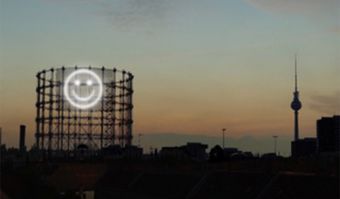
Picture above: Public Face I @Mood Gasometer, Berlin Schoeneberg, comissioned by Public Art Lab for the Media Facades Festival, Copyright by Julius von Bismarck and Public Art Lab
New Practices
Responsive placemaking can take various forms, and we’d like to highlight three of these here as examples of projects in which we have been involved ourselves.First, through projects of representation, responsive placemaking highlights the connections between people and places, and contributes to the construction of local publics. They can aid bringing out a ‘sense of place’ as well as a layered, variegated ‘sense of us’.
Second, as collaborative management and governance, responsive placemaking aims at providing these local publics with tools to organise themselves as collectives, addressing civic engagement and social inclusion. It seeks to set up alliances and coalitions of citizens, government representatives and professionals to organise around issues of communal concern, and the collaborative and inclusive management of local resources, from reusable energy communities to commons-based housing cooperatives.
And third, illustrating practices of translocal exchange and mutual learning, responsive placemaking does not approach local initiatives as isolated communities, set in their own time and place. Through the various scapes they are often part of various translocal movements and communities that enable mutual learning.
New Relevance of Translocal Communities and Mutual Learning
As such, in times of global pandemic, responsive placemaking becomes relevant in the context of border closures, spatial isolation, loss of mobility within and between cities, social distancing and quarantine measures. Although the pandemic has had devastating effects for individuals and societies globally, it is also an opportunity to rethink the ways we engage in intercultural dialogue and responsive placemaking in sustainable and equitable formats. As stated by Michele Acuto, director of Connected Cities Lab and professor of global urban politics in the School of Design at the University of Melbourne, “empowerment and community-building need to be at the heart of the digital lessons we are learning from COVID-19.“3 Although we are not travelling, we must work to understand better new types of transnational mobility. According to Federico Parolotto, in post-pandemic landscapes, hyper-mobility may be less feasible and therefore “digital connectivity will emerge as the most prominent transport technologies.”4 Although we are social beings, and most of us crave physical connectedness with others, the pandemic has revealed that we can and must continue to develop effective, inclusive and meaningful ways to connect digitally—novel forms of mobility.
Public Face: How does Berlin feel today?
Public Face5 is a showcase of responsive placemaking contributing to the representation of publics. It transformed a gigantic screen at the Gasometer in Berlin Schoeneberg into a ‘Mood Gasometer’ representing the emotions of the citizens in Berlin. It was developed for the Media Facades Festival6 in 2010 as a realtime data visualisation. The artist team Julius von Bismarck, Benjamin Maus and Richard Wilhelmer recorded and filtered the faces of the citizens with the newly developed software of facial recognition and transmitted the data of the dominating emotions of the group in the form of a emoji in real time on the big screen of the Gasometer with the question, „How does Berlin feel today?” By gathering data in public space, and by scraping social networks, these installations display collective ambiences and moods, communal spatial use patterns, and shared concerns back into public space through media installations. At the same time, and more critically, Public Face also establishes a critical public around the issue of urban surveillance.
Circulate
The Amsterdam-based project Circulate contributes to the design of local management and governance tools for urban publics, and in particular for resource communities. Increasingly, in the Netherlands and other parts of the world, citizens have started to organise themselves around sets of shared resources.7 Their motivation to do so is that they want to find alternatives to the extractive and unsustainable modes of production and organisation of many economic models, from housing to energy. Instead, they are looking for ways to share resources in a pro-social way, based on the principles of the commons, and to contribute to the production of renewable energy or the circular economy. New technologies such as urban sensors and database technologies such as distributed ledgers and smart contracts promise new ways to administer and govern these communities. Yet, the design of such digital platforms posts various questions that need to be resolved: To what extent is it a good idea to trade off privacy against transparency? To what private, collective or public goals should the set-up of a system be algorithmically tuned? For responsive placemaking to succeed, experimental designs of urbanism have only just begun.
Picture above: Circulate. For the project Circulate. Designing Digital Platforms for Resource Communities, Design researcher Tara Karpinski made the Ener-geyser – a data fountain visualizing the energy use on a local grid in real time, as a conversation piece to discuss the values at stake in the algorithms that optimize energy exchange. Copyright by Tara Karpinsk and Public Art Lab
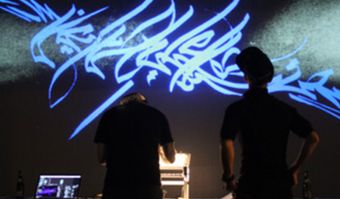
Picture above: Digital Calligraffiti 2017-21 commissioned by Public Art Lab in cooperation with the artists Michael Ang, Don Karl and Hamza Abu Ayyash, Copyright by Michael Ang and Public Art Lab
CONNECTING CITIES: Urban Screens mediate togetherness of distant publics
The European Lighthouse project CONNECTING CITIES8 explores translocal exchange through artistic practices, the networked infrastructure of urban screens, media facades and projection walls worldwide. Its goal is to engage citizens from distant places in new creative forms of togetherness and exchange. Under the guiding principle ‚Urban Screens are our Walls’, the CONNECTING CITIES NETWORK transforms these digital infrastructures into platforms and visualisation zones which provide new opportunities for communication, community building and translocal dialogue and telepresent scenarios in the public space by overlapping layers of virtual reality, augmented reality and networked society. For example, DIGITAL CALLIGRAFFITI9 allows all social groups to freely share their messages, wishes and visions on burning issues of our society. It combines the traditional cultural technique of calligraphy and graffiti with the possibilities of urban media art and new technologies. DIGITAL CALLIGRAFFITI transforms walls and digital screens into a canvas of civic expression to build bridges of intercultural understanding and promoting diversities as the medium to bring us closer.
A Vision for a Responsible Citizen-based Renaissance
The use of urban media technologies such as sensing and interaction technologies, social media, virtual and augmented reality tools and streaming solutions can strengthen community building and civic engagement in novel placemaking practices—such “responsive placemaking” promotes the democratisation of public space, facilitates public awareness about the urgencies of climate change with potential worldly resonance and enables the togetherness of people in dispersed and diverse locations. This multidimensional responsiveness of placemaking inserts citizen bottom up process in urban development of newly emerging resilient cities—such as the 100 Carbon-Neutral Cities in Europe til 2030—and will be part and parcel of Responsible Next Renaissance, responsive and responsible to its citizen-driven novel arts and technologies.
References
1 Appadurai, A. (1996). Modernity al large: cultural dimensions of globalization, volume 1. U of Minnesota Press.
2 William H. Whyte in City: Rediscovering the Center (1988)
3 Acuto, M. 2020, ‘Will COVID-19 Make Us Think of Cities Differently?’: https://newcities.org/the-big-picture-will-covid-19-make-us-think-cities-differently/
4 Federico Parolotto, F. 2020, ‘Mobility in the Age of Coronavirus’: https://newcities.org/the-big-picture-mobility-in-the-age-of-coronavirus/
5 Public Face is commissioned by Public Art for the Media Facades Festival 2010 http://connectingcities.net/project/mood-gasometer
6 Media Facades Festival 2010 is initiated by Mirjam Struppek and Susa Pop, Public Art Lab http://mediafacades.eu
8 The Connecting Cities Network is co-funded by the European Union / Culture Programme 2007-2013 and initiated by Public Art Lab http://connectingcities.net/
9 Digital Calligraffiti initiated by Public Art Lab in cooperation with Don Karl, Michael Ang and Hamza Abu Ayash
Susa Pop
Susa Pop is co-founding director of the platforms Public Art Lab and the Connecting Cities Network which contribute to creative citymaking, citizen science and translocal dialogue that empower social interactions and citizens‘ engagement. Susa Pop is an expert in investigating, curating, and producing artistic projects in the urban public sphere at the intersection of media arts, urban planning and digital naturalism. Best showcases include Mobile Studios, Media Facades Festivals, Urban Screens Innovation Forum, Connecting Cities, Future DiverCities, Digital Calligraffiti, Renewable Energy Avantgarde, Augmented Europe, Connecting Cinemas in Rural Areas. She holds lectures worldwide and gives seminars at the Bauhaus University Weimar / Media Architecture. She is co-editor of Urban Media Art Cultures (avedition, 2012) and What Urban Media Art Can Do – Why, When, Where, and How? (av edition, 2016). In 2017 she co-initiated the globally networked Urban Media Art Academy together with Tana Toft Ag in cooperation with the Goethe-Institut Thailand.
Picture © Ruthe Zuntz
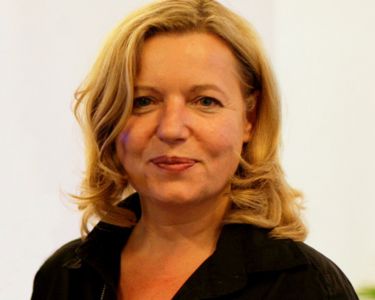
Martijn de Waal
Martijn de Waal is a professor at the research group Civic Interaction Design at the Amsterdam University of Applied Sciences. His work focuses on the experience of public spaces in a networked society and investigates the design of digital technologies from a perspective of public values. Recent research projects include The Hackable City on practices of collaborative citymaking; Circulate on the design of digital platforms for commons-based research communities and From Prevention to Resilience on the role of public space design in making neighborhoods more resilient in the aftermath of the Covid-crisis. He was the general chair for the Media Architecture Biennale 20. Key publications include The Platform Society. Public Values in a Connective World (Oxford University Press, with José van Dijck and Thomas Poell), The City as Interface. How New Media Are Changing the City (Nai010 Uitgevers) and The Hackable City. Digital Media and Collaborative City-Making in the Network Society (edited together with Michiel de Lange).
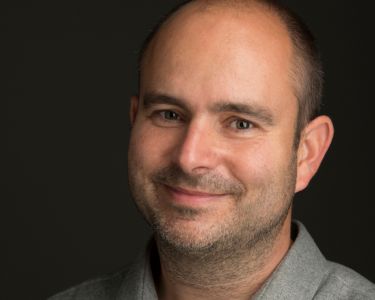

Poetics in the Remaking of Europe
Writer, cultural activist and Emeritus Professor of Literature at University of East Anglia
Poetics in the Remaking of Europe
In 1951 the German philosopher, Theodor Adorno, published an essay called ‘Cultural Criticism and Society’. One remark in it, often taken out of context, made the essay famous: “After Auschwitz to write a poem is barbaric.” Whatever controversies it provoked, and however much Adorno subsequently changed his thinking about the relation between poetry and society, his comment remains emblematic of an important intuition. Language, and its expressive potentials, are not immune from historical events. Language has a distinctive life and social being, a life which can be enhanced, damaged or, in some of its forms, made obsolete. Violence threatens the life of language as it threatens other forms of life.
It is worth recalling the context that provoked Adorno’s remark. The holocaust remains at its dark centre, but, between 1939 and 1945, 36 million Europeans lost their lives in war related deaths. Many of the dead were civilians. The loss of life amongst Russians was greatest and more people died in eastern than in western Europe. But, however you analyse the numbers, what happened was probably the greatest act of human self-slaughter in history.
We may live in ignorance of these numbers and their implications. Or we may know about them and choose to ignore them. Or we may remember them in terms of certain images that we think are very much of the past: ruined cities, vast numbers of refugees, the dead and the scarcely living bodies of the Holocaust. That was Europe then and we live in a different place now. Wasn’t the post-war European renaissance precisely to do with the construction of a political order expressly designed to keep the peace? Hasn’t this been its most durable achievement?
We can answer those questions in different ways. One response might acknowledge that Europe had to come close to annihilation in order for that peace to be constructed at all. The memory of violence had to stay vivid for political energy and ambition to be directed towards the creation of a peaceful order. Now that memory has diminished, an important question for the next European renaissance is how the impetus for peace-making will be maintained. Another response, amongst the many causes of the violence that led to the slaughter of 1939-45, was a way of talking about the world that emphasised a wounded nationalism, that identified threats in alien others, and sought solutions in authoritarian leaders. Different media and different contexts were involved from films to newspaper articles to informal conversations.
These diverse means of communication created a multiplier effect. Xenophobia, racism and authoritarianism became the focal points of a collective imagination. Whatever else may have changed since this period, the thought that these ways of talking have been overcome in a new peaceful Europe is clearly false. If anything, they are on the rise, but in a way that still seems oddly oblivious to their possible consequences. A new European renaissance needs to take account of this fact: the way we talk to each other is consequential. It’s one of the many ways that we make the world we live in.
Some commentators at the time of the European conflagration were sensitive to this linguistic dimension. The English writer, George Orwell, was one. He saw that the totalitarian regimes that caused such havoc needed to control language and, by their control, to gaslight whole populations in order to maintain power. Albert Camus, Hannah Arendt, and Ceslaw Milosz all shared a similar sense of the importance of the way we talked to each other and our capacity to treat each other humanely as ends in themselves and not just means to an end.
Adorno was concerned with the violence that could be done to language, Orwell with the violence (and control) that certain kinds of language enable. For both, this heightened their sense of the conditions in which language might live or become dead and
deadening. Orwell valued a plain clear style as the condition of language’s vitality. Adorno valued the dialectical potential of a language that could put in question what it was saying and how it was saying it. Both opposed the use of jargon and the tendency of language to congeal into fixed vocabularies and routine gestures. All large organisations, the EU included, have a tendency to speak in ways that Adorno and Orwell opposed. The corporate speech of the early 21st century unconsciously echoes the language world of Orwell’s 1984 in its repetitiveness, its tendency to settle into slogans, and its closing down of thought in the name of consensus. But how might we find alternatives? This will importantly depend upon our own inventiveness with language and a willingness to give up on certain forms of ‘authoritative speaking’ that seem increasingly threadbare to those on their receiving end of them. Our own inventiveness can draw on many resources as we imagine how we might speak to each other in ways that are both democratic and expressive. Europe invents itself through many languages and not just one. In this repeat it is a little like another multilingual society, India. How we respond to this reality not as a deficit or a problem, but as a source of cultural enrichment and opportunity is one challenge for the next European renaissance.
For Merleau Ponty le langage parlant is a creative state, but it also affirms and recreates a social bond. It becomes what he describes as a “gesture of renewal and recovery which unites me with myself and others.” While he finds examples of this kind of language in literature it is by no means confined to a specialised form of creativity. The experience of “renewal and recovery” occurs for the speaker and the listener, for the individual and the collective. To utter le langage parlant is a potential in all of us, but one that circumstance can easily damage or restrict. It also marks the moment when language comes alive.
The first European renaissance marked a great transition in language in its affirmation of the expressive power and the literary dignity of different vernacular languages that were destined for a while to become the different national languages of Europe. The next renaissance will perhaps move in another direction, one that has been described as a colonial phenomenon, creolisation, where different languages and cultures mix and mingle. How we talk to each other and in what language or languages will become of ever greater importance. A ‘poetics for Europe’ will foster the conditions for a langage parlant made out of the interaction between different languages and cultures. One of its hallmarks will be the understanding that in saying something we are always doing something and that one of the things we are doing is recreating or dissolving the conviviality that can connect us one to another.
Jon Cook
Jon Cook is a writer, cultural activist and Emeritus Professor of Literature at the University of East Anglia. He was educated at Cambridge University and the University of East Anglia. He has published a number of books and essays that, in different ways, focus on the question of what makes language creative. From 2008-2017 he was on the governing body of the Arts Council for England. He has taught at universities in the US, Europe and India and is currently involved in a project to create an arts and humanities curriculum for the 21st century. In 2021 he was appointed an Honorary Fellow of the Royal Society of Literature. He currently lives near Stroud in Gloucestershire and hopes it will not be too long before the UK rejoins the EU.