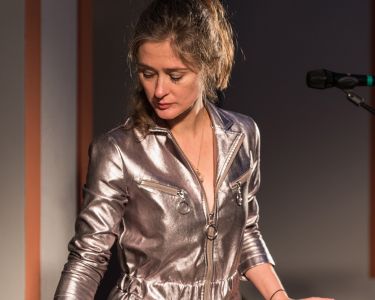
Riding the rapids of the great transformation
Charles Landry, inventor of Creative City concept and Co-Founder Creative Bureaucracy Festival, Berlin
Riding the rapids of the great transformation
The place to be
Periods of history involving mass transformation, like the Enlightenment, the Industrial Revolution or the technological revolution of the past fifty years are cultural shifts. They involve major adjustments in attitudes, ways of being and mindset. They can produce confusion yet also a sense of liberation and a mindshift combined with a feeling of being swept along by events. There were delights and dilemmas as they unfolded. Now, by contrast, the temper of the age, the Zeitgeist, is one of uncertainty, foreboding, vulnerability and lack of control over overweening global forces—especially our urgency to avert climate collapse or to avoid the polarising narratives that poison civilised conversation.
It is hard to see a way to a golden age, especially since we know we need to shift our economic order and a way of life that is materially expansive, socially divisive and environmentally hostile. And doing that cannot be grasped by a business-as-usual approach as it takes a while for new ethical stances and new ways of operating to take root and to establish a new and coherent world view.
Is there light at the end of the horizon in facing those challenges, even though some feel Europe is at the edge of exhaustion and without the energy or motivation to think, plan and act afresh and with vigour? Is that really so?
Will-o'-the-wisps?
Our crises, often dark and gloomy, weigh heavily and can push us into passivity and resignation. Yet crises can be opportunities and provide a gateway from one world to the next. Take a helicopter view of the vast range of initiatives happening, large and small, across Europe and beyond to address the solutions to create a more human- and nature-centred world and you see some positive patterns. Still, for the moment, fragmented and without sufficient power and traction, big agendas are coming together in unprecedented ways and driving this change are many: activists, civil society, politicians, researchers, inventors, artists, entrepreneurs, business, writers and more. There is a mood and a movement emerging. We are seeing the possibility of creating a different world driven on other principles. There is a Planet B in sight, even though to get there we must get Planet A right.
It is a compelling story. Think how eco-principles are beginning to shape our mindset and how that provides the frame and therefore
courage to move towards a green transition where the circular economy notion plays a crucial part. Think too how newer concepts like resilience help us work through the tasks ahead or how co-creation and the participatory imperative helps harness the collective imagination (since transformation is a collective endeavour). Think here too of the notion that the world is our commons. And not to forget a digitising world that allows, in particular, the cultural creative economy to run through systems like electricity in its inventiveness and with its immersive capacities. Sometimes the speed of the possibilities are dizzying and we always must be alert that we, rather than the technologies, are in control.
There is convergence and it is happening at escalating speed. From the beginning of the 21st century we finally saw a rapprochement between the two great ways of exploration, discovery and knowing: Art and Science. That rapprochement began to break down the widespread mutual incomprehension between the arts and sciences. The premise is that the most fruitful
developments in human thinking frequently take place at those points where different lines of creativity meet. By sharing their creativities, ways of knowing and the knowledge it enables, scientists and artists enrich and maximise each other’s potential and so encourage innovation. The transdisciplinary perspective is powerful when boundaries erode and as the methods of exploration and problem-solving can combine the linear, analytical and logical as well as the visual, kinaesthetic, spatial and musical. Allied to technologies that help shift ideas into reality, these synergies promote new forms of creativity which can result in ideas that can be turned successfully into products, services and solutions. This is the radical technological and cultural revolution underway. It has great opportunities. Together it is all transformative.
Incessantly, however, a bigger question remains ever-present and it needs to be answered: How do you make people feel viscerally that they must transform and change their minds—even while people realise that the world stands at the cusp of a crucial moment? Time is short in which to make the big difference towards one-planet living and we need to harness and share our collective talents, will, energy, intelligence and resources.
The year 2020 glitch
2020 was a year of radical reckoning. It was a time to think afresh. Did it make us finally listen and etch itself into our consciousness as we saw, momentarily, the skies clear and heard the birds sing again? This forced experiment of reducing carbon emissions gave us a glimpse of a possible other world. It reminded us that the world of ‘more and more’ cannot go on even though many still think of the old normal as our desirable and exotic destination. Crises like the pandemic provoke a dramatic reordering of priorities, deep reflection and rethinking and focused us—or at least should have—on what really matters: the common good and public interest. We saw too that, as Tom Burke put it, “civilisation is the thin film of order around the chaos of events.”
The pandemic was a wake-up call which triggered a dawning of humility as our collective hubris was humbled and old certainties crumbled. The pandemic created both clarity and confusion as in the eye of the storm it is difficult to see “where next” and how to get there. There seems to be no blueprint for how to move forward, yet we do have them.
We have an image of what could be: a zero-carbon society, a gender-equal society, a world where the dividends rather than the threats of diversity are promoted. The solutions are there but we think too often that technology will sort it out and that we can continue to just act as before. Technology takes on the responsibility and authority. We abnegate, we feel less answerable to what is happening. Shifting our mindset and how we think, plan and act—our behaviour—is the far bigger task.
Taking an eagle-eye view of the world in motion demands we unscramble the nested complexities and look at existing trends in order to assess their depth or superficiality, their characteristics and the nature of their impacts.
A good analogy is to think of change like an ocean. Ripples on the surface are less important than waves of increasing significance, which are themselves formed by tides, currents, climatic changes and
geological events which shape the movement and dynamics of the whole—and which might produce the occasional tsunami. It is that tsunami we need to avert.
We know the direction of travel if we do not act and it is the deep trends—think climate change—that we need to address. The challenge for all of us is to distinguish between the important, the less significant and the trivial: to understand the difference between a trend and a fad. And some trends are as persistent as they are predictable—just consider that when I was born the world population was about 2 ½ billion and when I die it will be more than 8 billion people. Not surprisingly, nature is suffering. Think water shortages, deforestation and animal extinctions. All are inextricably interwoven. In addition to this we are still operating largely with the same institutional structures made for a different age.
Variation of the mind
To make the rebirth—perhaps a Renaissance—a reality requires us to shift our mindset dramatically. That mindset should see things as an integrated whole. But this is not to downgrade the specialist—it is simply that we need to grasp the interconnections. Is it crisis, danger, the fear of impending doom, awareness, knowledge or is it a thoughtful, inclusive mind that shifts our thinking? This means understanding mindsets, mindflows and mindshifts. It implies reassessing how we think and learn, what we learn, the intelligences harnessed, the types of information used and disregarded. It demands new criteria to discriminate, judge and filter and a broader perspective which embodies a more inclusive sense of possible resources that are more free-flowing, lateral and creative. A changed mindset, rethought principles, new ways of understanding and generating ideas are the cornerstones of change.
A mindset is the order within which people structure their worlds and how they make choices, both practical and idealistic, based on values, philosophy, traditions, experience and aspirations. Mindset is our accustomed, convenient way of thinking and guide to decision-making. It not only determines how we act in our small local world, but also how we think and act on an ever-encompassing stage. Mindset is the settled summary of our prejudices and priorities and the rationalisations we give them. A changed mindset is a re-rationalisation of a person’s behaviour and is difficult as people like their behaviour to be coherent—at least to themselves.
Mindflow is the mind in operation. The mind is locked into certain patterns for good reason. To cope with the world we focus on the familiar, whether thought processes, attitudes, concepts and interpretations. The environment or context determines what is seen and what meaning is given. It operates below the level of conscious awareness. We cannot be completely open 24/7 although our default position must be a willingness to re-assess. Most of us will look at the world or a problem in a learnt way and have vested interests in perpetuating our current practices. An open focus can be seen as threatening, especially for discipline specialists as this might challenge the authority of their profession.
A mindshift is the process of dramatically reassessing core ideas. But how can you relax when there are pressures around you? Changing a mindset is unsettling and potentially frightening. Transformative effects happen in differing degrees: direct experience, seeing things work and fail and through conceptual knowledge. The most powerful means is the direct experience of having to change behaviour. This is where crisis comes in. By living through and understanding a crisis directly a person internalises learning and is able to repeat this learning in different contexts—it thus becomes replicable.
The challenge here Is that we travel with a weight of history attuned to bipolar thinking, operating in silos and are often sceptical of integrated, 360-degree perspectives and transdisciplinary thinking. Yet that cannot generate the solutions the future requires. The greater the number of perspectives applied to a problem, the more
imaginatively will it be approached. This is not to deny the value of our existing specialist knowledge. We cannot all simultaneously have the skills of an engineer, a biochemist or environmentalist, but we can understand their essence and so merge them with other skills or insights to make them more effective. This integration with other skills—especially in the human and social sciences, such as history, anthropology, sociology and psychology—has too often been lost in most affairs. For instance, a traffic issue is never only about cars and land use. If transport planners had understood psychology or culture better or the ideas of mental geography, they would have been more careful about building urban motorways that scorch their route through communities.
So, how can youthink small and with less when we are used to thinking big and with more? This transformation is a cultural project, the biggest of our times, as it is about values, mindset, attitudes and hearts, minds and skills. Seeing things culturally is powerful as culture is who we are. Creativity helps shape what we can become.
There are various ways to change behaviour and mindset: to coerce through force or regulation; to induce through payment or incentives; to convince through argument; to con, fool or trick people; to seduce (an odd combination of the voluntary and involuntary); and finally to create and publicise aspirational models. It is the latter we need to
focus on and it is not as straightforward as it sounds. It is likely to be a combination of all persuasive devices that takes into account immediate, short- and long-term impacts. At times the slowest way of changing a mindset can be by rational argument; yet while longer, it is the most effective, especially when evidence based.
This is where storytelling comes in and understanding the distinction between forms of communication—especially the narrative and iconic. Narrative communication is concerned with creating arguments; it takes time and promotes reflection and is linked to critical thinking; we build understanding piece by piece. Iconic communication by contrast seeks to ‘squash meaning’ and to crisply encapsulate an essence in order to create high impact and to show that what is being said feels significant. Our challenge is to embed narrative qualities and deeper, principled understandings within projects which have iconic power. This is where the talents embedded within the creative economy are so significant. They can create the messaging, the products, the experiences that are emblematic and which can leapfrog learning and avoid lengthy explanatory narratives through the force of their ideas, their projects and the symbolism they engender. The iconic project says it in one go and as you reflect, you understand what it is about.
How artists and those in the creative economy can help
What exactly is it about the process and act of singing, writing, dancing, acting, performing music, sculpting, painting, designing or drawing that is so special? Participating in these activities arguably harnesses the imaginary realm to a degree that other disciplines such as sports or much of science, which are more rule-bound and precise, do not. The latter tend to be ends in themselves, they do not change the way you perceive society; they tend to teach you something specific. This process of imagining has the benefit of forcing us to reflect, to develop original thought, to confront challenges and, crucially, to imagine that Planet B, which is where we need to get to. Nursing us through a green transition is a creative act where involvement with the arts can help.
Engagement with the creative activities combines both stretching oneself and focusing; feeling the senses and expressing emotion. Art, for instance, can broaden horizons and convey meaning with immediacy as well as depth; it can facilitate immediate and profound communication; symbolise complex ideas and emotions or encapsulate previously scattered thoughts; anchor identity and enhance communal bonds or, conversely, stun and shock for social, moral, or thought-provoking ends. Art can criticise or create joy, entertain, be beautiful and even soothe the soul and promote popular morale. More broadly, expression through the arts is a way of passing ideas and concepts on to later generations in a (somewhat) universal language.
What art does is not a linear process. Humans are largely driven by their sensory and emotional landscape in spite of centuries of developing scientific knowledge and logical, analytical, abstract and technical thought. We are not rational in a scientific sense, but we are a-rational rather than irrational. This is why all cultures develop arts.
What are the elements that help transformation along the way? We see here a combination of urgency, perhaps a crisis, and increasing evidence that the old ways do not work. Then a new concept comes in that encapsulates a way forward, as when the notion of sustainability emerged especially after the Club of Rome report in 1972. That in turn can drive an intent, a vision, a mission. Missions act as calls to action and as gathering devices to bring interests together towards a common aim. Crucially, we need real-life projects that embed the intent as it is only the lived experience of, say, a sustainability
initiative in action that makes an abstract concept real. Think here of the 15-minute city idea popularised by Paris and its focus on the city of proximity where walking, ease of access and most facilities are nearby and local. Here what might have seemed invisible becomes visible.
This reminds us that the new thinking needs to impact at three levels—the conceptual, the discipline-based and the implementational. It involves, additionally, reviewing the detailed mechanisms to make things happen, such as financial arrangements or planning codes to encourage and direct development into certain directions.
New thinking can generate a rebirth—a Renaissance. This Renaissance could unleash a process of re-enchantment that speaks to our deepest yearnings, our soul and our sense of wanting to become whole again where we and the world around us have the right balance.
Great placemaking is an art not a formula, but strong principles can help us along the way. For a long time I pondered, What are great places beyond their need to provide the means of survival and shelter and to be environmentally responsible? Five core themes came to mind: “places of anchorage and distinctiveness”, “places of connection and communication”, “places of opportunity and ambition”, “places of nurture and nourishment” and “places of inspiration and imagination”.
A place of anchorage and distinctiveness
This place feels like home. It generates a sense of the known, it is familiar and comforting, it feels safe and this is a place where I am sheltered and that creates a sense of belonging. It is distinctively itself. It celebrates where it comes from. It acknowledges its past, its heritage, its traditions and core assumptions about who it is. Its multiple identities, its ideas, its visions are etched into its way of life and this is what makes it special and unique. This place explains to itself where it comes from by its history, built fabric and urban design, its rituals, behaviours and activities. The routines of daily life and their predictability seem ordinary, but this ordinariness makes people feel rooted. Ironically, feeling at ease about itself gives this place confidence about where it is going and more relaxed about any changes that may unfold—so it dares to be innovative.
A place of connection and communication
This is a place of relationships, from the incidental to the casual to the deeply profound. You connect and communicate face to face with neighbours, work colleagues, friends, acquaintances and those different from you. You link to the wider world physically and digitally as well as with your past and potential futures.This place is locally bonded. It is at ease with itself and with the wider world. It reaches out. It is relaxed about meshing its diversities. There is seamless connectivity enabled by high quality urban design, good gathering places and possibilities for chance encounter. Its walkability and varied transport modes—internally- and externally-focused—connect beyond the city confines. Its digital infrastructures reach out to virtual worlds stretching out far and wide. It is the hub from which your transactions with the world flow—both those near to you and those afar.
A place of opportunity and ambition
This place fosters open-mindedness. It encourages a culture of curiosity, it provides choices, options and possibilities in our differing phases of life. It has a ‘can do’ attitude. There is an experimental culture and this keeps it flexible and adaptive to emerging circumstances and changes.Some places provide opportunities and others less so, yet this is a place in which to have ambition, ideals and aspiration. It sparks in you the desire to give free rein to your exploratory instinct and to open out. The raw materials of the city create the potential and are embodied in peoples’ creativity, skills and talents as well as its material resources. These are “things” like buildings and also symbols, activities and the repertoire of local products in crafts, manufacturing and services. They are our historical, industrial and artistic assets including architecture, urban landscapes and landmarks as well as our indigenous traditions of public life, festivals, rituals and stories, hobbies, enthusiasms and amateur cultural activities. This draws attention to the distinctive, unique and the special in any place. These resources are all potential opportunities. Acknowledging this can engender a spirit of generosity. It can create the desire to give back to your city. This helps generate civic pride, loyalty and trust.
A place of nurture and nourishment
In this place people can flourish and there are many opportunities to self-improve from the formal to the informal. This is a lifelong learning environment and a place where a culture of discussion is vibrant. This place cares about every aspect of your life. Here you can grow personally and professionally and the city helps you in this endeavour. It reinforces your necessary ladders of opportunity to move forward. It provides accessibility and enables mobility and helps move away constraints. It enables you to be more fulfilled and to widen your horizons. You are fed by these broadening perspectives and so learn and reflect. This can help citizens become more competent and confident and thus willing to participate in helping to shape, make and co-create their evolving city. To make this happen requires preconditions and these include good facilities, be they in education and research, health care, social provision, affordable housing, parks, good retailing and cultural facilities from the large-scale to the intimate. It will provide anything that makes it more liveable. Overriding everything there is a spirit of generosity and of giving back and this in turn inspires citizens to aspire to give of their better self and to become the best they can be.
A place of inspiration and imagination
This place has a visionary feel. It lifts you up from the day-to-day. You feel at one with yourself and your city. It provides a heightened level of experience by its beauty, and what that is remains ever debatable—and so it is also a place of possibility and excitement. It allows you to envision what could be. Here, aspiration and good intent is made visible in both the built fabric and through the vitality of its culture and urban programming. Each reinforces the other and this creates a virtuous spiral. This visionary dimension reflects the ideals and ethics that the city wishes to project to its citizens and to the wider world. These greater purposes beyond self-interest change over time.
In bringing about a New Renaissance, three foci are important. First, we need to heal the division between the city and nature in a changing climate; second, we need to be imaginative in working through how we live together with our differences; and third, we need to unleash the creative potential in each one of us.
Many in Europe understand this and they have the commitment and energy to make it happen. Europe is not exhausted – it is alive as never before!
Charles Landry
Charles Landry works with cities around the world to help them make the most of their potential. He is widely acclaimed as a speaker, author, innovator and he facilitates complex urban change projects.His aim is to connect the triad culture, creativity and city making. An international authority on using imagination in creating self-sustaining urban change Charles has advised cities or given talks in over 60 countries. He helps shift how we harness possibilities and resources in reinventing our cities and his Creative City concept has become a global movement. His book The Art of City Making was voted the 2nd best book on cities ever written by the planning website: http://www.planetizen.com/node/66462. His most recent books are The Civic City in a Nomadic World and The Creative Bureaucracy with Margie Caust. The latter has become a movement with an annual festival taking place in autumn every year in Berlin. The 2021 Festival had over 18000 visitors. Other books cover the measurement of urban creativity, the digitized city, urban fragility and risk, the sensory experience cities and interculturalism. For further information: www.charleslandry.com
Picture © Lukas & Joe

The New Relevance of Heritage
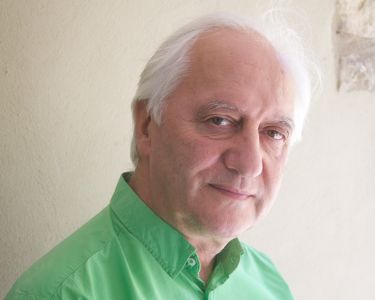
Professor of Sociology of Law since 1986, is Rector of the Suor Orsola Benincasa University of Naples, Vice President of the CNR (National Research Council)
Renaissance 1.0
Case study: The Pignatelli Chapel, Naples: How bringing past Renaissance alive with digital tech opens new civic and economic spaces
The chapel or small family church of Santa Maria dei Pignatelli, located in the heart of Naples, in Piazzetta Nilo, has 14th-century origins and was first renovated from as early as the last decades of the 15th century at the behest of Ettore Pignatelli, Duke of Monteleone and Borrello and future viceroy of Sicily. The works lasted until 1515 and included the construction of the two important funerary complexes that make the chapel one of the jewels of Neapolitan art of the mature Renaissance: the tomb of Carlo Pignatelli, on the left wall, the work of Tommaso Malvito’s workshop around 1506-07; and the small chapel of Caterina Pignatelli, the work of the great Spanish sculptor Diego de Silóe around 1513-14, rich in decorations taken from Antiquity and close to the culture of the Papal Rome of Raphael, Michelangelo and Sansovino. From 1736 the chapel was restored and assumed baroque forms. It was provided with a new altar in polychrome marble designed by Gaetano Buonocore and realised by Gennaro Di Martino, with rich marble decorations on the walls; a floor in inlaid marble was also added, realised by the same Di Martino and by Antonio Di Lucca on a drawing by Ferdinando Fuga (1761). A bowl-shaped dome was frescoed in 1772—as well as the drum, pendentives and sails of the adjacent vault—by Fedele Fischetti.
This phase was soon followed by a long period in which this extraordinary Renaissance masterpiece was neglected and fell into a state of abandonment, neglect and ruin. In the 1990s, the Pignatelli family decided to donate the chapel to the Suor Orsola Benincasa University which immediately carried out a vast program of works that, between 1999 and 2007, provided for the restoration of the structure and the arrangement of the annexed rooms. Then, from 2013 to 2015, the works of art preserved in the chapel were restored through the Great Project for the Historic Center of Naples, enhancement of the UNESCO World Heritage site. Finally, between 2016 and 2017, important sculptures by Diego de Silóe pertaining to the chapel of Caterina Pignatelli were brought back and relocated on new supports in the original site which had been devastated by thefts in the 1970s.
The Pignatelli Chapel thus became once again a „splendid“ Renaissance window on the historic centre of Naples.

Renaissance 2.0
But the above is only the first stage of an important process of recovery and enhancement of this masterpiece. In recent years, with a project that was completed in 2020, the University Suor Orsola has designed and developed a project to enhance the space through the integration of digital technologies organised in five interactive and multimodal visit experiences.
In the first, available to the visitor as soon as they enter the Chapel, spatialised sound tracks have been created, with a story about the place and its protagonists, which can be enjoyed through wireless headphones while moving freely.
A second experience allows the visitor to immerse themselves in a video that reproduces the space in its entirety, explorable in 360 degrees with the technique of cinematic virtual reality. Through immersive visors, the user can watch a story unfold within the walls of this building. That story, furthermore, is connected to another story, set instead at the Suor Orsola University a few kilometres away. where another space equipped with an immersive visor allows for a complementary experience. Thus, in either space the visitor is engaged in a virtual and remote dialogue, united by virtual reality and
by the crossing of glances, given that the two spaces are visible to each other.
Continuing on towards the balustrade in front of the chapel, a third experience provides the visitor with augmented reality applications that, by means of a special device, allow them to observe the details of the dome that otherwise would not be visible. By directing the devices in certain areas, moreover, the user can have precise and contextual information of the details. With this technological solution, physical boundaries can be overcome and the observation of space can be enriched with informative details.In the next experience, in a room on the upper floor, the visitor can interact with gestures and explore three-dimensional models of some of the works present in the Chapel.
The last experience projects the visitor towards the city, in a space that allows the visitor to follow cultural itineraries created for the project, referring to a wide range of themes, eras and works that show the many stories that make Naples extraordinary. The routes are depicted on a large interactive touch table and along the walls, on which appear images and maps linked to the chosen routes to be explored.

Our video recounts not only the recovery of an asset of such extraordinary value, returned to the city, but also how this reunification with the city context is enhanced by the crucial role of digital technologies. It is therefore an exemplary journey: from the Renaissance as a material and cultural heritage to be preserved, to the New Renaissance with the potentialities opened up by new technologies for cultural and creative industries.
Sources pictures: All pictures are screenshots from the Video below, Curtesy of Università Degli Studi Suor Orsola Benincasa.
Case study: The Pignatelli Chapel, Naples
Lucio d’Alessandro
Lucio d’Alessandro, Full Professor of Sociology of Law since 1986, is Rector of the Suor Orsola Benincasa University of Naples, Vice President of the CNR (National Research Council) and President of the TICHE Foundation, the management body of the National Cluster of Technologies for Cultural Heritage. He is also President of the Alumni Association of the Italian Institute of Historical Studies founded by Benedetto Croce. His research focuses mainly on Moral Utilitarianism between the eighteenth and nineteenth centuries (Utilitarismo morale e scienza della legislazione, 1993), on the genealogy of the social in the thought of Michel Foucault (Pouvoir, savoir, su Michel Foucault, 1981), on the relationship between society and law (Decisione del legislatore e interpretazione del giudice, 2009; Diritto e società: per un immaginario della cultura giuridica, 2018), on the modern concept of the University, starting from the thought of Humboldt and Schleiermacher (Universitas, exodus, communitas, 2011; Università quarta dimensione, 2016). With Il dono di nozze. Romanzo epistolare involontario sui Reali d’Italia scritto nel 1896 da Gabriele D’Annunzio e altri personaggi d’alto affare (Mondadori, 2015) he won the 2016 President’s Viareggio Prize.
Picture © Suor Orsola Benincasa University of Naples


The next renaissance will be globalised
Johannes Ebert, Secretary General/ Chairman of the Board of Goethe-Institut; Nico Degenkolb, advisor for Cultural and Creative Industries projects at Goethe-Institut Head Office, Munich
The Next Renaissance Will Be Globalised
Shaping the past, changing the future?
Renaissance, Reformation, Enlightenment, Modernity: these terms for epochs of progress and awakening continue to shape the collective identity of Europe and of the Western world to this day. Their achievements are rightly pointed out and their pioneers and representatives remembered.
However, what has increasingly entered public discourse and thus collective consciousness in recent years is a fundamental ambivalence that characterises Europe’s history of progress in the modern era—on the one hand, a claim to values shaped by humanism, and on the other, a lived practice that all too often contradicts the ideals formulated.
This contradictoriness comes to light especially in Europe’s relationship to non-Europe. On the one hand, the great Enlightenment philosopher Immanuel Kant laid the foundation for the modern, enlightened, Western worldview with the Categorical Imperative and his universalist moral and legal philosophy. On the other hand, he countered precisely this worldview with profoundly racist statements on the supposed superiority and inferiority of Europeans and non-Europeans respectively.1 In 1788, he certified the Native Americans as being „incapable of all culture“ and thus „even lower“ than the inhabitants of Africa. These and other reference points in his work are difficult to reconcile with the idea of universal human dignity postulated by Kant.
Picture above: Ebert_Degenkolb_Videostill from the project Intervention M 21 (www.decolonizem21.info) The (De)Coloni al Glossary, Part 1, Europe – Non-Europe, Copyright: Aliza Yanes & Santiago Calderón
Kant is not alone in such contradictions in thought and action, which have become the subject of critical reflection in recent years. In the most famous passage of the Declaration of Independence of the United States of America, adopted in 1776 as a progressive counter-proposal to Europe’s absolutist ancien régime, on the one hand it is considered self-evident „that all men are created equal; that they are endowed by their Creator with inalienable rights; that among these are life, liberty and the pursuit of happiness”2 — noble ideals. On the other hand, many of the authors and signatories (they were exclusively men), as slave owners, actively deprived people in their immediate surroundings of precisely these rights, not to mention centuries of discrimination against women. The unpleasant downsides were and are not infrequently ignored when progress is mentioned. On the contrary, when it is repeatedly postulated that the Muslim world finally needs an era of enlightenment or that country X or Y must finally democratise for the benefit of its population, the undertone of cultural superiority that can already be found with Martin Luther, Immanuel Kant or Thomas Jefferson often resonates.

In their recent history, Europe and the countries of the Western world have caused dislocations and injustices that continue to this day and whose postcolonial reappraisal is far from complete.
Against this background, do we even want to speak of a New European renaissance? Is there not something deeply nostalgic about the Renaissance concept, as the historian Thomas Tobias Becker recently stated in a lecture?3 „The past was [in the pre-Modern era] the Golden Age, change itself was suspect. If change was wanted, it dressed itself in the garb of return, renaissance, reformation or revolution.” Such a nostalgic understanding of a European renaissance, however, would be backward-looking, Eurocentric and ultimately hostile to progress.
A desirable progressive European renaissance that wants to be more than a nostalgic transfiguration, that rather wants to unfold a great transformational power, must be driven by openness and exchange with the world, by a clear commitment to dialogue and to the
recognition of diversity of cultural practices, by listening to each other and by cultural exchange between the Global North and the Global South. Important pillars of a global renaissance are the ideas of innovation in the cultural and creative sectors as well as the renewal of society as a whole, both within and outside Europe. European external relations and especially external cultural relations play an important role in this.
This is where the Goethe-Institut, the German cultural intermediary organisation with 157 institutes in 90 countries, comes in as an important player in European foreign cultural and educational policy with programmes that promote cultural exchange between Europe and outside Europe. It thus also provides impulses for cultural and creative economy scenes in the sense of the idea of innovation. Some examples of the Goethe-Institut’s programme work are outlined below.
Talk about power structures
The project “Latitude“ invited a global exchange on colonial power relations from September 2019 to November 2021. In interviews, essays, festivals and numerous other formats, topics such as decolonisation, the preservation of indigenous cultures, the role of museums, restitution and the treatment of cultural heritage are negotiated. Latitude refers to the cartographic concept of a demarcation line in relation to the equator, which goes hand in hand with a distinction between the southern and northern latitudes. Through this separation, the term associatively points to inequality in terms of power relations: the imposition of the systematic power of many countries from the global North over regions from the South. Latitude is a space for respectful exchange—cultural, political, economic and aesthetic.
New focal points are regularly added to the Latitude website. Writers like Cidinha da Silva from Brazil and Philipp Khabo Koepsell from Germany, for example, have written essays on „black literature“ and its positioning in the global literature business. The constantly growing number of voices on Latitude can be accessed via a register of experts that makes the participants visible and enables networking among them. In addition, ideas and insights from many Goethe-Institut projects on decolonisation and postcolonial power relations flow into Latitude. The topics range from the return of illegally acquired art objects to the societies of origin and the decolonisation of museums to the redefinition of power relations between the West and the global South and the reorientation of postcolonial development cooperation. For example, the handling of controversial art objects from former colonies is examined from different perspectives, from experts calling for unconditional repatriation as well as from advocates of a broader spectrum of alternative approaches to cooperation between former colonies and colonial powers. These debates are necessary to gain a sense of a decolonised and anti-racist world.
Dealing with the past
Europe can learn a great deal from its past, especially with regard to its relationship with non-Europe. The Goethe-Institut’s „Shaping the Past“ project brings together initiatives from North America and Germany to develop innovative forms for anti-racist and anti-colonialist remembrance in public space. Shared remembrance and the forms it takes are always the subject of controversial discussions, which show that dealing with the past must always be renegotiated. This is all the more true in an increasingly diverse society. In North America, there is great interest in learning about alternative forms of commemorative culture, especially in light of the current debates about removing statues from public spaces. In 2022, a series of exhibitions will be developed with women artists, historians and representatives of the cultural and creative industries to explore innovative forms of remembrance as examples. This exhibition will be produced locally „on demand“ and can be shown simultaneously in various locations, museums and community-oriented venues in the USA and Europe.
Changing societies with games
Enter Africa is a creative African network represented in 15 African countries and initiated by 15 Goethe-Instituts in sub-Saharan Africa. Interdisciplinary teams of architects, urban planners, IT experts and artists in 15 African cities have come together to develop 15 location-based games for smartphones and an analogue mega-game, addressing the challenges of urban transformation, borderlessness and Africa’s past, present and future. This process has resulted in a network of creative, innovative young professionals across the African continent and European-African game developers. Together they use games and game thinking to develop visions for good societies of tomorrow. At the same time, the creative-economic component has also been taken into account.
Global knowledge networks
The Covid-19 pandemic physically isolated people from each other worldwide. At the same time, the world also moved a little closer together in the digital realm through the final breakthrough of unbounded communication and learning platforms. The Goethe-Institut as a provider of global learning opportunities also found itself exposed to these opposing dynamics. The possibilities of digital learning, especially in the area of cultural and creative industries, are far from exhausted.
Since 2015, the Goethe-Institut has been testing hybrid formats with the Massive Open Online Course „Managing the Arts: Cultural Organizations in Transition“ and the „Master in Cultural Management“ degree programme run jointly with Leuphana University Lüneburg, in which more than 27,000 participants from more than 190 countries around the world have so far exchanged ideas about the work and the changing conditions of the global cultural sector and the cultural and creative industries. More than 50 lecturers from five continents share their knowledge and create a global learning platform for change through culture. As the academic director of the MOOC Managing the Arts Prof. Dr. Nishant Shah puts it, „What impressed us was how many people were talking in the forum about how culture
affects social change. And how much we need arts and culture to change our society.“ If we want to meet the biggest challenges of this century—climate change, digitalisation, flight and migration—we need many more such globally oriented platforms of mutual learning. For it is these formats that enable discursive spaces for artistic, creative-economic and social innovation.
Europe and the world, or rather Europe in the world, are facing major transformations. The flashes mentioned here are only a small sample of the worldwide work of the Goethe-Institut. They make it clear that the transformations that are in full swing in many places will only succeed if we do not make the mistakes of past renaissances and revolutions again. The next renaissance must not be Eurocentric, nor chauvinistic, nor nationalistic. After the US spoken-word artist Gil Scott-Heron, The Next Renaissance will be globalised.
We can successfully meet the challenges if Europe opens up to the outside world, comes to terms with its past together with other European and non-European states, creates global spaces of exchange and encounter and enables mutual learning. The arts and the cultural and creative industries have a particularly key role to play here—they are the motor and the basis for this next future-oriented renaissance.
References
1 Kant, AA IX: Logik – Physische Geographie, 1802.
2 American Declaration of Independence, July 4th, 1776.
3 Nostalgie – Geschichte, Theorie, Kritik, symposium Nostalgia and Remembrance at the Leibniz Centre for Contemporary History Potsdam, July, 14th, 2021.
Johannes Ebert
Johannes Ebert is the Secretary General/ Chairman of the Board of the Goethe-Institut. Johannes Ebert graduated in Islamic Studies and Political Science in Freiburg and Damascus and finished a traineeship in journalism. After periods as an instructor at the Goethe-Institutes Prien and Riga and as deputy head of the Public Relations division in the Munich head office, he was director of the Goethe-Institut Kiev from 1997 to 2002. From 2002 to 2007 he was director of the Goethe-Institut in Cairo and regional director for North Africa and the Middle East. Subsequently he served as director of the Goethe-Institut in Moscow and regional director for Eastern Europe and Central Asia from 2007 to 2012, the year he became Secretary General/ Chairman of the Board of the Goethe-Institut.
Picture © Martin Ebert
Nico Degenkolb
Nico Degenkolb joined the Goethe-Institut in 2011. He is currently advisor for Cultural and Creative Industries projects at the Goethe-Institut Head Office in Munich. From 2017 until 2020, he coordinated the bid of the City of Nürnberg for the title European Capital of Culture 2025. Nico Degenkolb holds a B.A. degree from European Cultural History from University of Augsburg and University of Seville and a M.A. degree in International Relations from Central European University.
Picture © Krischan Dietmaier

A Program for Culture at the Crossroads
Prof. Dr. Miachael Resch, Director of HLRS High-Performance Computing Center, Stuttgart; Prof. Dr. José Teixeira Coelho Netto, Curator at Media Solution Center, Baden-Württemberg; Matthias Hauser, General Manager at Media Solution Center, Stuttgart
A Program for Culture at the Crossroads
Mission accomplished?
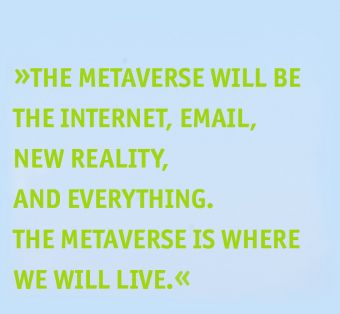
The world is about to enter the Metaverse, says Mark Zuckerberg. The Metaverse, in his vision—or in his eagerness for more power and wealth disguised as a noble contribution to humanity—is a virtual place where we work, have fun, meet friends, watch movies, play games, and, most of all, consume. The Metaverse will be the internet, email, new reality, and everything. The Metaverse is where we will live. Monika Bickert, Metaverse’s vice-president in charge of policy content, wrote an article for Le Monde on November 10, 2021, in which she stressed that the Metaverse is a new kind of life.Facebook, Mark Zuckerberg’s previous company name that he is now trying to sweep under the rug, claims to have 2.9 billion users in 2021. It may be so. If it is, the foundations for Zuckerberg’s Metaverse have already been laid—in a very short time, considering Facebook’s founding in 2004. The Metaverse is not here yet, but Facebook is—and Facebook is the dress rehearsal for the Metaverse.
Picture above: High-Performance Computing Center HLRS University of Stuttgart, Copyright: Boris Lehner for HLRS
Picture left:
The impending Metaverse—as the successor of Facebook in a family that houses its siblings Twitter, Instagram and TikTok—is not an index of a recent crisis: it configures a dynamic that has been going on for quite some time now. However, this crisis—or moment of decision, in its etymological meaning—has become acute in the last couple of years. Everywhere voices are warning that either we do something now or humanity may lose its grip on its destiny. The remarkable novel The Machine Stops1, published by E.M.Forster in 1909, was at the time considered to be just a piece of futuristic divertissement. But its depiction of a proto-Metaverse shows all the characteristics Mark Zuckerberg boasts about his project. Forster’s book was a fantastic effort to anticipate a reality in which humanity has been increasingly living since then, with some dramatic peaks in the last couple of years—one of them being the attempt to invade the Capitol on January 6, 2021, to keep Donald Trump in power. Even our contemporary social media is described in 1909 as the „behavior modification empire“.This description is a rather generic, mild, and euphemistic label and could equally apply to the movie industry, the television industry, and much more. Therefore, we prefer to name it more straightforwardly: antisocial media.
As the computer scientist Jaron Lanier, author of Ten Arguments for
Deleting Your Social Media Accounts Right Now (2018), argued, social media is a challenge to humanity just as serious as the greenhouse effect. So, it is appropriate to say that media are responsible for the “greenhouse effect of the mind” based to a large extent on artificial intelligence and its supporting algorithms.
We could better understand the new developments by looking at ourselves, our perceptions, and our ideas about the world around us. The French philosopher and sinologist Francois Jullien has compared Chinese and European views of the world2 (The Propensity of Things: Toward a History of Efficacy in China, 1999). He concludes that our European view of the world is shaped by our looking for an ideal (eidos), aiming at modelling the world such that we can achieve that ideal. As a consequence, we tend to think in models. It seems to be obvious that thinking in models has led us to describe the world in mathematical terms. This method was feasible as long as that description did not spin out of control. With the advent of the computer, our mathematical description of the world has become the dominant (for some the only) and most efficient description of the world. Artificial Intelligence now aims to turn a de-scription into a pre-scription to use our mathematical models to control our world better.
Several human hopes and desires are driving this prescription. Mathematical models avoid ambiguity by helping us to identify specific solutions in an ambiguous world. We can further claim that our solutions are not distorted by human intervention, with mathematical algorithms executed by a flawless machine—only experts understand that computers are neither flawless nor do they operate without human intervention. The idea of excluding human error allows us to pretend that our digitally created realities based on mathematical models are just—devoid of any prejudice and human flaws. In addition to this idea of an artificially created intelligence, the vision of creating life without resorting to nature is tempting, especially if we believe that this is a species created only from human minds and exempt from all the flaws that come with the dirty and mortal nature that surrounds us.
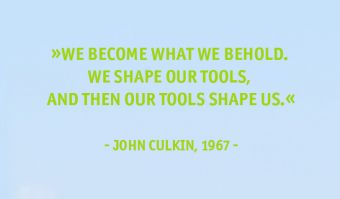
Our enthusiasm for our creations leads us to ignore the warning issued by John Culkin in 1967: „We become what we behold. We shape our tools, and then our tools shape us.“ Taking the models we create for reality has always been the danger of our model-based approach
to the world. Unfortunately, with the computing power in our most current systems, these models get a life of their own and start to spin out of control. This fact itself is a reason to reflect on our understanding of the digital world. Nevertheless, we see disturbing developments that point to human beings‘ abuse of digital technologies beyond that.
After all, Jaron Lanier may have pushed too hard when he called people to delete their „antisocial“ media accounts. He should have stopped short of throwing away the baby with the bathwater. Were it not for the digital tools, to mention one specific event—the ongoing Covid 19 pandemic—the disaster might have been even more extensive. However, his warning is most welcome.
A Program to Address the Situation
If there is still time to remedy this situation, the solution lies in the complete understanding of the meaning of the term “antisocial media” and, in a broader sense, of eCulture. „Understand in order to control,” warned Ludvig Wittgenstein. Humanity must understand eCulture, or eCulture will completely control humanity. Of course, that has always been the issue with every new technology, be it the horseless vehicle, photography, movies, radio, or television. However, none of these innovations compares with the overwhelming power and ubiquitous presence of the antisocial media and artificial intelligence, which have been developing in eCulture—probably the final cultural utopia. Of course, a utopia may be a dystopia or a utopia—that is up to humanity to decide. In order to contribute to the effort towards a utopian eCulture, the Media Solution Center (MSC) has developed the „Reach“ project aiming to promote the understanding of eCulture in as many fields as possible—in the arts, culture, economy, social behaviour—and to create the conditions for eCulture to become a fundamental tool to the advancement of knowledge in a way that promotes civilisation. eCulture has the potential to achieve this goal if humanity can control it. This would be a renaissance.
MSC’s major all-encompassing step is the promotion of the necessary merging between the Humanities (understood as a general umbrella term covering philosophy, the arts, and the disciplines that study the different aspects of human society and its culture) and the Sciences. We have been talking about interdisciplinarity at least since the mid-20th century. Now it is not a question of opting for interdisciplinarity anymore: it has become imperative. A single initiative will not solve a crisis like the one we have experienced in the last couple of years.
If it has been possible for humanity to get an image of the M87* black hole fifty-three million light-years away from Earth, it is because eight observatories scattered all over the Earth convened to transform themselves into one vast and integrated telescope the size of this planet.3 It will take an effort of the same magnitude, probably even more extensive, to confront the Metaverse.
The 21st century saw the emergence of a generation native to eCulture, compared to the older generations for whom it was a novelty. The aggregate power of this new generation provides a unique tool in the forging of a new age for humanity. The MSC wants to be an active part in the effort to avoid a situation in which the limitations of artificial intelligence and its algorithms become the limits of humanity.
MSC has therefore structured its Reach Project as the Research and Creation Center for eCulture and the Humanities. The Center intends to develop a program building a bridge over the ever-growing gap between the Humanities and science and technology. This distancing between the two fields has become widely addressed since the beginning of the 20th century—the conflict between the „two cultures” C.P. Snow described in his 1959 eponymous book.4
Picture left: Logo Media Solution Center Baden-Württemberg
Mission One: Converging Humanities and Science
MSC’s Reach project’s first mission is to support and amplify the conversation between the Humanities and the „hard“ sciences. The Reach Project will not directly address science and digital technology. It will also investigate eCulture as the medium to which science, digital technology, and the Humanities converge to create a distinctive culture, a culture that can face the Metaverse. MSC’s principal arm for that is its academic, nonprofit research program dedicated to today’s culture’s complex and multidisciplinary study. This program includes contributions from the most diversified areas, including physics, neurosciences, biology, the study of social systems, and other complex approaches to the way we are living today surrounded by the internet and all forms of virtual representations. This program will consist of lectures, colloquia, seminars, and short duration courses oriented by the just-in-time principle, as opposed to the just-in-case principle.
Mission Two: CreativeLab
Reach’s second mission—where MSC leaves the academic field to tackle the thing itself—is to support young professionals in their projects leading to the creation of start-ups involved in using the current cutting-edge technology, especially artificial intelligence. This support will come through Reach’s CreativeLab, which will host collectives organised around professional projects requiring cutting-edge studies and all the material and economic support they may need, either in campus residencies or virtually. Creativity plus an understanding of what is going on is the underpinning of the CreativeLab.
Mission Three: Observatory of eCulture
Reach’s third mission is creating an Observatory of eCulture that will gather information about all things related to eCulture, from the internet to robotics to the social impacts of digital technology. Data—especially Big Data—have already been identified as the new source of wealth and power. However, there is barely any research by any creative initiative that does not depend on a well-organized information centre resulting from constant, attentive, and active observation of the world. Therefore, identifying, storing, and analysing the gathered information has become necessary.Reach’s three missions are enabled by the Network the MSC is part of: The HLRS, the High-Performance Computing Center with its supercomputer, the HdM Stuttgart Media University, with its highly specialised faculties, and the Core-Partner ZKM, Center of Art and Media Karlsruhe. These are unique assets not found elsewhere. As a result, MSC has the concept, the material means, and the people to concisely drive this project into reality. And it will—and it will thus be a focal point for this Renaissance in the Making.
Where: at the High-Performance Computing Center HLRS University of Stuttgart, directed by Prof. Dr. Michael Resch, and the Media Solution Center MSC, directed by Matthias Hauser. Duration: as long as it takes.
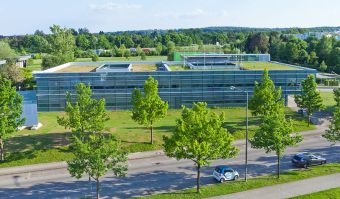
Picture above: High-Performance Computing Center HLRS University of Stuttgart, Copyright: Boris Lehner for HLRS
References
1 E.M. Foster, The machine stops, Penguin Classics, 2011
2 Francois Jullien, The Propensity of Things: Toward a History of Efficacy in China, Merve, 1999
3 The Astrophysical Journal 901:67, September 20, 2020
4 C.P. Snow, The Two Cultures, 1959.
Matthias Hauser
Matthias Hauser has had extensive experience managing the dialogue between Art and Technology. He received a formal education in music. During his professional career as a musician, Matthias Hauser understood that art is a comprehensive system with specific artistic languages in dialogue. His experience in Art Education as a professor of violoncello acquainted him with introducing people to art – which is the base of his arts management practice.As director of an art gallery in La Coruña and Stuttgart for fifteen years, Matthias developed special projects involving art and cutting edge technology for Brands such as Rolls Royce during the 31 edition of Sao Paulo’s Biennial, Gallery Weekend Berlin, and Multimedia Art Dialogues at the Main Palais, Frankfurt. In 2019 Matthias was appointed as the first director of the Media Solution Center in Stuttgart (MSC) – an extension of the High Computing Center (HLRS) at the University of Stuttgart. The MSC bridges between HLRS’s computing capacity — one of the largest high-performance computers– and the needs of industries, corporations, research centers, art institutions, and social organizations in computing resources. Matthias Hauser will face the challenge of creating the conditions for individuals, collectives, and institutions to realize their goals.
Prof. Dr. Michael Resch
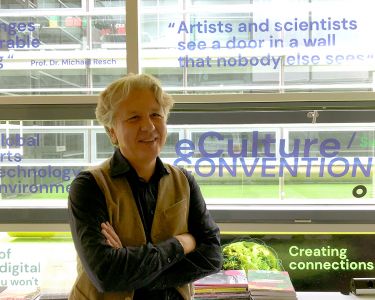
Prof. Michael Resch is the director of the German National Supercomputing Center HLRS and the director of the Institute for High Performance Computing at the University of Stuttgart He is a member of the board of trustees of the Center for Art and Media Karlsruhe (ZKM) and an advisory member of the board of trustees of the German Schiller Association. He is a member of the University Council of the University of Stuttgart and a member of the consulting committee of the Film Akademie Ludwigsburg. He was a Co-founder of the Media Solution Center in 2018 and a Co-founder of the Automotive Solution Center Stuttgart in 2008. Prof. Resch was awarded an honorary professorship in 2014 and an honorary doctoral degree in 2011 by the Russian Academy of Science and an honorary doctoral degree in 2009 by the Donezk National Technical University. Michael Resch is a PI since 2007 in the German clusters of excellence for “Simulation Technology” (2007 – 2018) and “Data-Integrated Simulation Technology” (2019 – 2025) as part of the German Initiative for Excellence in Research. Michael Resch holds a Dipl.-Ing. (MSc) in Technical Mathematics (Technical University of Graz/Austria) and a PhD in Engineering from the University of Stuttgart.
Prof. Dr. José Teixeira Coelho Netto
Dr. Teixeira Coelho is the coordinator of a research group on Computational Cultures and Humanities at the Institute of Advanced Studies of the University of São Paulo, from which he received in 2015 the honorific title of Professor Emeritus for his accomplishments in research, teaching and extension services to the community. He was the director of the Museum of Contemporary Art of São Paulo, which has the most important collection of modern art in Brazil, and the chief curator of Masp – São Paulo Art Museum, a major institution of art in the South Hemisphere. Formerly professor at the Institute of Architecture of University Mackenzie in São Paulo, he has been invited for a number of universities around the world and was granted fellowships from the Fulbright Foundation, Rockefeller Foundation, Japan Foundation and the São Paulo Foundation for the Support of Science, among others. He has published a large number of books on art, culture and cultural policy, among them eCulture, The Final Utopia (2020) and Signs and Wonders (in the Digital Age), 2021. He was also awarded a Portugal Telecom Prize for Literature in Portuguese for his novel História Natural da Ditadura. Since 2020, he has held the position of curator at the MSC.

We are all Creative Tech-ers!
Laure Kaltenbach, Chairman and co-founder of CreativTech, curator and scenographer; Faustine Charles, Lydia Meignen, Paris
We are all Creative Tech-ers!
Why choose between artists and engineers
Chicken or egg, tea or coffee, maths or literature, music or sport, nuclear or green, left or right brain, passion or reason, artist or engineer? Do we really need to choose in every compartment of our lives? What if we could embrace the best of all those so-called oppositions?
The artist, a figure integrated into our socioeconomic models
The opportunities of the health crisis for Culture?
As in all crises, we realise the extent to which culture plays an essential, central, and apodictic role in expressing itself, through the arts, in entertaining ourselves, promoting values, creating cohesion, in giving meaning to what seems to have none. The current health crisis is no exception to the rule and new forms of creation have multiplied to experience this unprecedented time of collective global confinement. Among the encouraging examples, the creation in Italy of Special Artistic Continuity Units (Usca) by the company il Barbonaggio Teatrale with theatre on delivery—the theatre at home—was conceived in response to the prolonged closure of cultural venues. From now on, it is possible to welcome a plastic work at home, such as
“Tipping Point,” a work by Barthélemy Antoine-Lœff. If you don’t come to Lagardère, Lagardère will come to you. Simple and efficient. Beyond its crucial role for individual and collective mental health, culture is the vector of three living dynamics in our territories: it drives and increases the attractiveness of rural areas, cities and regions; it is the engine of a diversified social cohesion; and finally, it creates economic value. Culture is an economic force that is now on everyone’s lips—those of politicians, institutions, companies in the cultural and creative sectors: 2250 billion euros, or 6.1% of world GDP; 353 billion euros in exports, or 3.4% of total world trade; and 29.5 million jobs, or 1% of the world’s active population. In Europe, culture employs more than 8 million people and represents 4.4% of the territory’s GDP in 20191 (i.e. before the COVID-19 crisis). These are higher revenues than telecommunications or the pharmaceutical industry! With more than 800,000 companies, 3.2% of the companies in the European Union, the cultural sector is also a source of human exchanges: in fact, 40% of inter-European tourists travel for cultural purposes.
Culture is now integrated and considered as an asset in our economic models. However, we still need to shift the focus on the role of artists and their contribution to innovation: social, technical, technological, scientific. Lilian F. Schwartz (born in 1927) was a leading figure of innovative artists thanks to science. She is one of the first artists to join the scientific team of a laboratory and served in Bell Labs in 1968 (known particularly for having worked on the Apollo Program). There she became a pioneer in computer-assisted visual experimentation, with 2-D and 3-D animated videos, a great innovation at the time! Yet, Schwartz is presented as a visual artist and not as a contributor to technical innovations, with her works staged hermitically in events and cultural institutions.
Back to the future
Culture is a combination of different imaginary worlds that we cherish beyond our borders. The creation of Ministries of Culture (Germany in 1955, France in 1959) marked a governance based on knowledge, recognition, and the sharing of values. The first international music festival created by Richard Wagner in Bayreuth, to share culture between nationalities and generations, dates back to 1876. More recently, the European Days of Culture were established in 1991. This is a Europe of culture whose milestones reveal both a proactive political construction and an enlightened renewal of artists and their understanding of societal issues. How should creative dynamics and artists take their place in a world that integrates ecological and epidemic ultimatums? Certainly, artists have and always have had a capacity to imagine, to shift, to reveal, to leave the beaten track, to dream, to scare, to question. Certainly, we need more than ever this capacity to invent and crystallise our aspirations. Certainly, we could be satisfied with a place of the artist reserved for museums, galleries, accursed
avant-garde, institutional spaces, or the oppositions between the arts from the street and those from the academic training. Of course, our time amalgamates, and everything becomes „art and culture“. Every evening we declare the death of art, and every morning it is reborn. With or without ashes.
One of the characteristics of our time is the capacity of artists to perform, to hybridise, to „hack“ techniques and technologies. An exploration that becomes polysensorial, simply listening to our senses. And it is in the search of the sense, of our senses, that the artist must create a new place and put his talents, his imaginations in the service of new social hybridisations. More and more of us are questioning ourselves, taking a step back. The artistic approach is a powerful one in a world where the link between the real and the virtual, between the physical and the digital spaces, between the material contents and the 0 and the 1 becomes more and more tenuous. The notion of a digital mirror world to ours, the umpteenth desire to live an increased polysensoriality in other spaces, materialises in the metaverse, a new Eden offering countless horizons. Let’s keep in mind the words of J.R.R. Tolkien in order „not to confuse the prisoner’s escape and the deserter’s flight“: embracing virtual worlds is in no way a flight, but a relevant anchoring to reality. To appropriate parallel digital worlds is not an ultra-modern obsession, unconscious of the stakes and dangers; it is, on the contrary, an opportunity to make those digital worlds deeply human and at the service of humans.
Artists are now producing hybrid works and exploring advanced
technologies for offbeat and sublime realisations. They also give impetus to applications that go far beyond the cultural sector. When Martin Cooper, a Motorola engineer recruited in the early 1970s, built a portable radio by trying to reproduce Captain Kirk’s “Communicator“, he invented the cell phone. The list goes on and on of other inventions, imagined by the creators of Star Trek, that have inspired companies and are now part of our daily lives: the “replicators“, ancestors of 3-D printers; the „Universal translator“ in charge of communicating beings and aliens from all galaxies, today revealed in automatic translation software, algorithms and artificial intelligence (AI); and the freehand kit of Lieutenant Uhura, the “tricorder”, which allows the user to detect and scan diseases, present today in almost all Internet of Things and wearable tech, but also giant screens, video calls, tablets, and of course PCs.
Back to the present: do you know Fragile? This installation, created by the Italian multidisciplinary studio, Fuse, explores human and organic life in its works. The installation, with evolving visual effects, is based on an algorithm that collects tweets to predict the level of stress they generate. As social networks are spaces that bring together an important part of humanity, the work gives a vision of the level of anxiety and, by (black) mirror effect, of the well-being of the actors of these networks. Among other fascinating disciplinary crossings, the TakT duo, building on the advances of neuroscience to understand our emotions, has designed an audiovisual work called „Scientific Emotions“ which deciphers our emotions through both artistic and scientific imagery.
New rules of the game
This context seems to be conducive not only to the reaffirmation of the place of artists in the economic and social ecosystem, but also to the intersectoral spread of talent. The multiplicity of paths, training, decentralised learning, the possibility of combining disciplines and fields of expertise change the rules of the game. In concrete terms, encounters with artists must multiply and go beyond the cultural and creative sectors. The image of the artist as an entertainer, or even as someone who is unfit for scientific and economic rigour, is long gone. This image is not only caricatured but also light years away from the reality of an artist who, like a scientist, relies on the senses, his intuitions to create, invent, draw, compose, repeat, make mistakes, take up again, undo, redo, in a long-term iterative creation cycle. The meeting between researchers, scientists, entrepreneurs, and artists is an exceptional source of creation. But it must be organised so that the result meets everyone’s expectations. The good news? It’s an equation that works every time! On a regional, national, and European scale! Examples are coming from all over the world, at the crossroads of all knowledge: research on biomimicry, which takes nature as a starting point and inspiration, is becoming a reference: from politics to medicine, from the arts to logistics, the behaviour of organic and animal species are rich in lessons and solutions. Bulletproof vests? Born from the observation of the resistance of spider threads! The physical-chemical engineer Kalina Raskin announces that life will endure without us. From now on, she is looking for ways to make different forms of life cohabit within the framework of a responsible innovation that considers the rhythm of nature, and this, thanks to… groups of thinkers from different „worlds”. Inspiring, isn’t it?
Mixing the worlds: a winning solution for the future
Desperately (really) seeking creative co-working
Today, no one questions the crucial role of collaboration in innovation: between brands, between teams of the same company, between teams of companies from different sectors, between generations, between countries, etc. However, the holy grail has not yet been found for an implementation on a European scale that would make it possible to embody these transdisciplinary collaborations on a large scale. We remember the innovative European programs, notably Kaleidoscope (one of the first financial support programs for artistic creation and cooperation, 1996-1998) and Culture 2000 (2000-2006), with disparate effects at European level. How to make collaboration between actors and territories concrete without confusing team-building and innovation?
This European ambition needs a program with a relatively long timeframe so that fertile crossings materialise and that tomorrow, an Italian neuroscience laboratory works with Swedish designers to
create a new banking service, a Dutch dancer gives new foundations to a German algorithm to facilitate inventories in warehouses, a Slovenian AI researcher relies on a French designer to invent a new industrial co-bot, a Portuguese musician virtualises a new Belgian technology to lay the foundations of a humanised call centre, a Luxembourgish quantum physicist makes new discoveries thanks to a Finnish photographer to secure protocols… It is a strong impetus that must be given so that examples do not just multiply but become a Pavlovian reflex for innovation. Will the European Knowledge and Innovation Community (KIC) for the cultural and creative sectors make the magic possible? The stakes are high and concern all stakeholders: companies have concrete innovations for their products or services, explorations but also managerial transformations; research renews its opportunities for opening up, highlighting its skills and contributing to the attractiveness of the scientific field; artists benefit from unprecedented industrial and scientific means to create an ambitious „work-innovation“. Concrete and successful examples of this approach exist. CreativeTech has produced several in France, notably, in the Pays de la Loire region.
Culture is future
Culture au Futur© (Culture is Future) is a transdisciplinary innovation and creation project conceived by CreativeTech for the Pays de la Loire region in France. This original program allows the creation of „innovation-works“ in the framework of workshops bringing together a company, one or more researchers in a scientific field and an artist (or a collective of artists). In other words, it is a question of simultaneously mobilising the cultural, economic and scientific actors of a given territory. The result is startling. The originality lies not only in the method invented by CreativeTech but also in the place of artists in the innovation process: it is indeed the artists who give the initial impulse to the collective work. All industrial sectors, all research fields and all artistic disciplines are concerned. The “innovation-works” already produced reveal the capacity of the trinomials to jointly respond to societal issues (ecology, recycling, over-cycling, acoustic waves, future industry, economic cycles, …) and technical issues (stabilisation of pigments, data restitution, remote control by algorithm or application…).
Pascal Denoël, President of the ZeKat Group, who participated in season 1 of Culture au Futur,sums up the experience as follows: „You abolish all boundaries. Everyone must create according to their technological and artistic sensibilities and within a project that has a dimension that goes beyond the company; everyone must remove their own barriers. At this point I see my collaborators differently as a leader, but they see each other differently. People talk to each other more easily and respect each other much more easily. (…) And the result is tangible: the technological innovations that were conceived together are going to be found in our products, to be marketed. And the spectacle is magnificent.“
Europe strikes back
It’s a credo that Europe is starting to put into action thanks to some truly original programs that think big in space and time. This is particularly the case with the audacious S+T+Arts program launched in 2015, where the world of technology brilliantly meets that of artists. Bringing worlds together also means bringing together nationalities and cultures. The Erasmus program embodies this brilliantly: bringing students together and benefiting from the lessons of other countries to enrich their future professional lives. The good news is that Europe is home to 23 million companies, 2 million scientists, and 1.4 million artists. What are we waiting for to make the intersection of disciplines for innovation the European trademark!
Human first! People at the heart of the transdisciplinary process
Yoga positions: Aligning humans in the centre of our path
The mantra seems „simple“: put in the same space (physical or virtual) a company, a scientist, and an artist. This collective star alignment requires a dedicated environment and a marked methodology to go beyond the often-deceptive concepts of hackathons or lightning exploration projects. It is indeed about combining mind and body, through rituals, a lot of discipline and a lot of intellectual flexibility but not only! Sonia Bergeot, planner for the Colart Fine Arts group of materials, saw the alchemy take place during the workshops of season 1 of Culture au futur: „The manipulation of products with chemists and artists awakens new inspirations for future developments of products or services for the company. That’s where the magic happens.” The credo is that each stakeholder—artist, researcher, company employee and animators-conductors of the “work-innovation”—highlights their own skills, without disguising themselves, in a spirit of curiosity. Indeed, it is a question of giving the best of one’s way of being, thinking, working, and interacting with worlds foreign to yours. This is one of the keys to success: everyone contributes to the project and comes out with collective skills linked to a concrete innovation. A great community of CreativeTechers is born.
The creation of artwork-innovation—“it's alive, alive!”
Within the framework of our interventions, we work on projects at the crossroads of innovation and creation. For example, a company making clothes for professionals had the ambition to think about tomorrow’s work clothes, by collecting data on individuals, to limit difficulties at work. A visual artist poetically re-examined the materials in order to illustrate the dynamics of the company immersed in issues of health and well-being at work. Cross-fertilisation also led us to the hacking of a Smart Guitar with the aim of completely reinventing the scenography of a show and the way in which one can remotely control the instruments on stage thanks to a virtual reality headset and a gyroscopic application. Or a textile manufacturer of more than 200 wished to re-examine the life cycle of its materials and, thanks to the crossed views of researchers in acoustics with that of an artist specialized in the fold, the company was able to upcycle these dormant stocks. The latter were transformed into powerful soundproofing sheets! What a smart collaboration…Ultimately, applying the CreativeTech’s methodology empirically means creating hybrid project methods according to the realities of the actors involved, guided by the same desire: to create a work and find an operational solution to a business problem in a “win-win” and transgenerational logic. Europe is the new playground, and with its protean resources, the possibilities are endless. Finally, some good news!
Join the CreativeTechers’ generation
The winning equation—companies x scientists x method artists x humans—is on its way to be disseminated in Europe. Our famous equation is endowed in—take note, exhibitors!—a proven method and people ready to take up challenges.
Approximately 4.2 million km2, 27 countries, nearly 90 territories with their own systems of governance, about 400 cities with more than 100,000 inhabitants, soon to be 448 million inhabitants, with Ode to Joy as its anthem—does this sound familiar? What if the result of this winning equation made it possible to create a European „overview effect“ (like the planetary overview effect described by the astronauts) that would sublimate all our creative resources in order to deploy a collective and enthusiastic vision of the future in the territories, regions, länders, provinces, and departments of all of Europe. „Arts and Crafts“ reinvented in the 21st century: easy, right?
“The history of science is not only the history of the constitution and proliferation of disciplines, but at the same time the history of the rupture of disciplinary borders, of the encroachment of a problem of one discipline on another, of the circulation of concepts, of the formation of hybrid disciplines that will end up becoming autonomous; finally, it is also the history of the formation of complexes in which different disciplines will aggregate by agglutinating themselves. In other words, if the official history of science is that of disciplinarity, another linked and inseparable history is that of inter-trans-poly-disciplinarity.” Edgar Morin2
References
1 Marc Lhermitte, Hugo Alvarez, EY, January 2021. https://www.ey.com/fr_fr/government-publi-sector/panorama-europeen-des-industries-culturelles-et-creatives-editio.
2 Edgar Morin, “La méthode”, 1981.
CreativeTech
Being: together! Born 2017, CreativeTech is a cultural engineering agency that orchestrates the meeting of artists, scientists, entrepeneurs to generate go-to-market innovations and exhibitions, both in digital and physical locations. This synergy of points of view, experiences and expertise embodies the current hybridization of profiles in all the industries. This Bigbang delivers supernova.tive makers and thinkers and constitutes the DNA of CreativeTech methodology.
Inspiring the future! CreativeTech also strives to think optimistically about the future, always integrating a responsible and conscious approach to social and environmental issues in the different territories. The aim: developing operational innovation for companies as well as institutions toward contemporary questions, such as living in the age of the blockchain and metaverse, hacking Time and Space, tapping into neuroscience to decipher the power of our emotions… to inspire all of us.

Intro: The Next Renaissance is a Renaissance of the Next
Lead of The Next Renaissance Project & Director of the European Creative Business Network (ECBN)
Are we the chicken or the egg?
The next and new is happening daily—in the digital world even every second—as viewers of next developments are also senders turning the next to potential news for others. One click to RT: New-ism meets Instant-ism. So is there really any room for a Renaissance, any chance to even realise the next new dimension in societies´ evolution, before it is surpassed by the next tweet, taking 100 of millions in elevators of soaring hopes or self-enhancing frustration? This is why the movement to think more slowly, more deeply and more from a 360° perspective is gaining traction.
There truly seems no shortage of the next big trend or of moon shot innovations. But there’s no shortage of crises either, from the next pandemic to the next hunger and housing crises, real estate and banking crises, mobility and climate crises. To our societies, crises are intermediate states on the way to their success, the necessary evil, for some even—as in economy—the prerequisite for recovery. This crisis concept is a pact for the wealth promise of societies after World War Two—and its social cohesion and peace.
But if crises become ever faster and ever longer, if recovery periods become shorter or are omitted, then the grand narrative of our society is less and less sustainable: “The Next Big Thing“ is longer the next thing to hope for or to expect. And even more: The belief in “Real Next“ is challenged by the relentless ticker tape of daily updates, breaking news and constant social media notifications popping up. It might be no accident that just in this setting more and more citizens believe that their children will not live a better life than their own—despite the fact that this generation has accumulated an unprecedented amount of wealth and health.
The Next?
“It is hard to see a way to a golden age, especially since we know we need to shift our economic order and a way of life that is materially expansive, socially divisive and environmentally hostile. And doing that cannot be grasped by a business-as-usual approach as it takes a while for new ethical stances and new ways of operating to take root and to establish a new and coherent world view.“1
The impression of missing out on the next is re-enforced by the ever-growing need for the next big transformations to tackle climate change and save the planet from overheating. For 30 years now, transformation toward a sustainable society has been debated in professional circles and while a bundle of theories emerged how to change complex systems in a wicked crisis—from Uwe Scheidewind’s Zukunftskunst to Mariana Mazzucato’s Mission Economy—societies at large are unwilling or reluctant to embrace change, especially quick change, without guarantees about being on the winning side after such change. Even with the emergence of activist groups like Fridays For Future—the youth-led global climate crisis strike movement—and declarations of a climate crisis in many cities, speedy realisation in societal change is not widespread. It is five minutes to midnight and still the “Next” seems to remain a grim inevitability rather than a cheerful freedom.
But what if the “Next“ is something different?
What if… generating the next generation of talents, jobs, housing, cities and streets, growth and wealth in the current system of doing the next thing no longer works given the current paradox of a raging standstill?
What if… for change of the societal pact and its structures to happen, understanding and researching the “next” as a process for the systemic “next” is necessary?
What if… the “next” is an innovative method of change-making?
The Next Renaissance!
The “next” in the 2020s must be a novel system which is able to produce the next generation of talents, jobs, housing, cities and streets, growth and wealth—and a radically different societal pact.
The World Economic Forum just published for the Davos Agenda 2022 a proposal for a radically different pact of state and business. “That redesign of all the different levers that the state has—from procurement, grants, loans, bringing in conditionality to have a proper symbiotic social contract, and more—is much harder than just talking about it… That requires a very different type of public-private partnership,” as Professor Mariana Mazzucato explains.2 in other words, a new social contract is needed. Klaus Schwab, Founder of WEG, and Thierry Malleret call for a new Great Narrative.
C40, a union of 97 cities representing 25% of the global economy, implements the “Race to Zero” global campaign for cities to “immediately proceed“ with carbon reducing projects.3
The UNESCO Creative Network pushes for a new cultural contract in society wherein the public sphere is approached “with a new perspective that public authorities, in cooperation with the private sector and civil society, can make the difference and support a more sustainable urban development suited to the practical needs of the local population.”4
In addition, industries can promote new ways of making the radical “next”—or “innovation“, as industry might call it. For example, even Digital Europe claims “creating digital inclusion and green growth.“5
Innovators from the arts, culture and creative industries of today are also contributing to a transformative re-design of societal systems by radical different collaborations of arts, technology, business and society creating new values — this is what we call the Next Renaissance.
It is all transformative
The world stands at the cusp of a critical moment. Our crises, often dark and gloomy, can be opportunities and can provide gateways from one world to the next as new agendas come together in unprecedented ways. There is a mood and a movement emerging. We are seeing the possibility of creating a different world driven by other principles. It is a compelling story. Think eco-principles and the green transition, the circular economy, new concepts like resilience, co-creation and the participatory imperative—and let’s not forget a digitising world that allows the cultural and creative economy to run through systems like electricity in its inventiveness. Together it is all-transformative.
“It is a compelling story. Think how eco-principles are beginning to shape our mindset and how that provides the frame and therefore courage to move towards a green transition where the circular economy notion plays a crucial part. Think too how newer concepts like resilience help us work through the tasks ahead or how co-creation and the participatory imperative helps harness the collective imagination (since transformation is a collective endeavour). Think here too of the notion that the world is our commons. And not to forget a digitising world that allows, in particular, the cultural creative economy to run through systems like electricity in its inventiveness and with its immersive capacities. Sometimes the speed of the possibilities are dizzying and we always must be alert that we, rather than the technologies, are in control.”6
The Green Transformation “is not just an environmental or economic project: it needs to be a new cultural project for Europe,“ as EU President Ursula von der Leyen pointed out 2021.7 And so started the lead initiative in Europe raising hopes for the Next Renaissance to really happen. But—it should be added—this will not happen without a Cultural Transformation, without a radically different pact of the arts, culture and creative industries with society.
Re-Designing Systems
Our contribution to this Next Renaissance takes a closer look at examples of re-designing the systems of arts, culture and creative industries just as arts, culture and creative industries are re-designing systems of industries and markets, of cities and regions or of technologies and societal changes. And let’s not forget how the arts and culture re-design technologies.
In 1435 “Alberti published the treatise On Painting, leading to inventors using the camera obscura to automate perspectival drawing, and, within decades, Louis Daguerre and William Henry Fox Talbot industrialised it by inventing photography.“8 The iPhone took photography to a final stage of everyday use and empowered potentially everyone to be an innovator, to have a new take on and picture of the world! “Did Alberti imagine streaming media when he wrote On Painting? Imagine the value unleashed by 21st-century infrastructure of media—from streaming to 3D—which supports decades, even centuries, of progress.”9
While this book takes a closer look at examples of re-designing the systems of arts, culture and creative industries, it is not devoted to a historical analysis or even a language-sensitive analysis of historical Renaissance. While some authors here find analogies between the present-day and previous Renaissances, we did not look into the social settings of these times. Instead, this book works with an image, a perception of the historical Renaissance—but this picture does not necessarily resemble more rigorously historical representations of those earlier Renaissances that we get from scholars of the subject. For example, the word “art“ was not used in Renaissance times as we understand that term today. In fact, Science and Art were not distinguished as separate fields in the historical Renaissance as they are today.
Rethought Principles
So we must be strict and clarify a rule: Talking of a Renaissance today does not give us any vocabulary or even an understanding with which to discuss the historical Renaissance. Nevertheless, we are able to develop our own fiction of a future—even if it is built on a fiction of historical truth.
However, the creative economy also redesigns attitudes, behaviours and values: “A changed mindset, rethought principles, new ways of understanding and generating ideas are the cornerstones of change.” 10 After a first rush of technological solutions for a resilient society—the early (almost naïve) Smart City Movement—it is now common sense that without citizen engagement and their adaption of new values and behaviours a resilient society will not succeed.
“The Next Renaissance”’ is a collection of diverging perspectives which are nevertheless all united in one purpose: to thrive and unite through the diversity of creativity and culture for a new social system of changes which is as inclusive as possible—though which in addition takes the uncomfortable beyond the horizon into account. Of course, debating the Next Renaissance is an ongoing, inherently incomplete and—if you like—systematically a-rational undertaking; still it is unavoidably necessary. In the diversity of contributions we received, we discovered common threads for a system re-design—and we might discover other threads as well.
We decided to share these joint “rethought principles” and cluster the book accordingly, taking it as an opportunity to overcome the idea that a system re-design for an inclusive transformation towards a resilient society can be built on sectorial clusters—on a 19th-century thought model of excluding professions from value chains by defining artificial sectorial borders.

Appraisal, not Praise
This book is published in a time of “constant lip service to Renaissance that is so much characteristic of our times. The self-made digital economy tycoons like Steve Jobs, Sergey Brin and Larry Page, or Elon Musk are celebrated as the contemporary equivalents of the Renaissance man…Samuel Beckett’s ‘Fail again. Fail better’ quote has become the most famous inspirational quote of Silicon Valley culture.”11
We must aim not for praise, but for appraisal, a critical assessment of the European role in a global re-design12 and self-reflections. Still, we must not lose sight of the unique capacity of culture, as Geoff Mulgan says, “the imaginative space that is so badly needed now… That may also prompt [them] to work harder to be part of the solutions rather than part of the problem and to help us to be actors not just observers.”13
Time is short to make the big difference and driving this change are many—politicians, activists, civil society, researchers, inventors, artists, entrepreneurs, business, writers and more. We need to harness their collective talents, will, energy, intelligence and resources to create a more human-centred world based on one-planet living.
Innovators in the creative economy—at least all the contributors in this publication—share the commitment and the belief that the Next Renaissance is empowering citizens to be more creative in shaping their own future. In a nutshell: Now is the time to act and to turn ideas into reality.
No chickening out.
Sources
1 Charles Landry
2 https://www.weforum.org/agenda/2022/01/mariana-mazzucato-on-rethinking-the-state/
3 https://www.c40.org/what-we-do/building-a-movement/cities-race-to-zero/
4 https://en.unesco.org/creative-cities/content/why-creativity-why-cities
5 https://www.digitaleurope.org/about-us/
6 Charles Landry
7 von der Leyen, https://europa.eu/new-european-bauhaus/index_en
8 Ali Hossaini
9 Ali Hossaini
10 Charles Landry
11 Pier Luigi Sacco
12 Johannes Ebert
13 Geoff Mulgan
Bernd Fesel
Initiator & Lead of The Next Renaissance Project and Managing Director European Creative Business Network
Mr. Fesel has experience in CCSI for over 30 years and is currently the director of the European Creative Business Network (ECBN), a not-for-profit organization of over 170 members from 44 countries that supports and develops the cultural and creative industries in Europe. Prior to this role, he was a serial entrepreneur within the CCSI sector, held the role of vice director of the European Capital of Culture in the Ruhr Region and was senior advisor to the legacy institute of RUHR.2010 til 2018: the european centre for creative economy in Dortmund. He played a key role in EU initiatives such as like JRC-Creative City Monitor, Voices for Culture program and ENTACT and setup a European Research Alliance on Spillover-Effects of Culture and Creativity. Since 1990 Bernd is founder of startups, architect of novel public organisations, inspirator for programs and policies for CCSI, friend and connector of acclaimed artists as well as influencer and publisher. Also he was appointed adjunct professor at the Caspar-David-Friedrich-Institut in Greifswald.
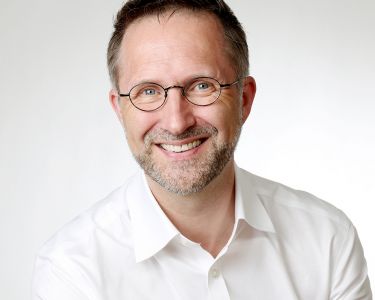

Preface to The Next Renaissance
Minister of Economic Affairs, Innovation, Digitalization and Energy of the State of North Rhine-Westphalia
Preface
Europe is undergoing a period of fundamental change. Whilst this comes with great challenges, we ought to recognise the enormous opportunity behind it. The top five issues of our time in all their complexity – globalisation, digital revolution, climate change, pandemics and natural disasters – are adding extra urgency to the question of where our European society is – or should be – heading. What do we want the future to look like? How are we proposing to get there? What type of innovation do we want to push forward for the benefit of our society? Those are questions of real concern.
Renaissance and its synonym, ‘rebirth’ are words that evoke inspiration. After all, the Renaissance period was marked by a variety of major innovations in art, science, technology, architecture and the trades. The ‘discovery of humanism’ was the game changer. Artists like Leonardo da Vinci, Artemisia Gentileschi or Albrecht Dürer are testimony to what really transformed things back then – the recognition of humans as subjects and as a creative and innovative force.
This wealth of ideas, of human creativity, needs to be called upon once more. We must use the potential of innovation in all its variety and simultaneity across economy and society and use it to get on top of the big challenges – digital transformation and the move towards climate neutrality by 2045. The key to innovation will always be the combination of creativity and technology.
The digital revolution has a huge impact on our proven concept of a democratic and liberal Europe. Future technologies such as artificial intelligence or blockchains hold enormous potential for innovation that we must exploit, but responsibly and in line with ethical values. Digital transformation of public services is the key to instilling trust in the work of government.
The transition to a climate-neutral economy and society is going to affect, if not upturn, all walks of life. We need renewable materials for the circular economy, new architectural and transport strategies, realignment of the energy system and forward-looking town planning philosophies.
There is a multitude of options for creative minds, innovative approaches and new business models. A major role is already set aside for the creative industries when it comes to realising the ‘European Renaissance’ envisaged here.
So, the EIT initiative to start a Knowledge and Innovation Community for the creative industries comes at the right time. North Rhine-Westphalia is backing the first-rate application that has been submitted for the launch of a creative industries KIC. The idea is that, over fifteen years, this agency will be spending some 500 million euros on innovation in the creative sector, designed to address the big challenges Europe is faced with. Such investment will be in line with the principles governing the Knowledge and Innovation Communities which the European Institute of Innovation and Technology (EIT) launched the first call for in 2008, banking on the interaction of education, research and innovation.
In these fast-moving times, the resourcefulness and innovation prowess of the creative industries are needed in Europe more than ever. The sector embodies crucial abilities, something that is more and more appreciated. The World Creativity and Innovation Day has been amongst the United Nations’ official theme days since 2018. In 2020, the World Economic Forum placed creativity at Number 3 of the ’TOP 10 Skills Needed’.
Europe needs to return to the heydays of ingenuity and innovation fervour. With a view to a European Renaissance of creativity, the ICE consortium is providing us with this publication which covers a wide spectrum of topics and will surely make for inspirational reading.
Prof. Dr. Andreas Pinkwart
Minister of Economic Affairs, Innovation, Digitalization and Energy of the State of North Rhine-Westphalia
Prof. Dr. Andreas Pinkwart, born in Seelscheid, Germany in 1960, after a banking apprenticeship he studied macroeconomics and business economics at the University of Münster and the University of Bonn from where he obtained his doctoral degree in 1991. He subsequently ran the office of Dr. Hermann Otto Solms, chairman of the FDP parliamentary group in the Bundestag, before continuing his academic career with professorships in Dusseldorf and Siegen. In 2002, he became a member of the German Bundestag and state chairman of the FDP (Free Democratic Party) in North Rhine-Westphalia. From 2005 until 2010, he was Minister for Innovation, Science, Research and Technology as well as Deputy Prime Minister in North Rhine-Westphalia. In 2011, he returned to the scientific sector. Until June 2017 Prof. Pinkwart was Dean of the HHL Leipzig Graduate School of Management and and ever since holds the Stiftungsfonds Deutsche Bank Chair for Innovation Management and Entrepreneurship. Since June 2017 he is Minister of Economics, Innovation, Digitalization and Energy of the State of North Rhine-Westphalia.
Picture © Ministry of Economic Affairs, Innovation, Digitalization & Energy, NRW
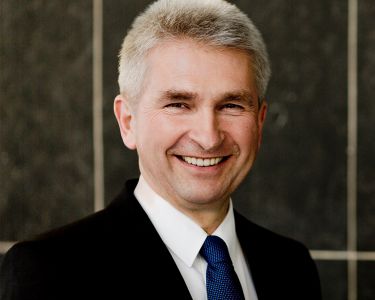

Intellectual Property and the Industry Commons
Industry Commons Foundation
Intellectual Property and the Industry Commons: Unlocking the Renaissance
Recognised as a major influence on economists, Leonard Reed’s 1958 essay ‚I, Pencil’ demonstrated that the invention of even the simplest of objects is the result of mass collaboration. A pencil is made by loggers, graphite miners and factory workers. Its form is predicated on the invention and widespread adoption of writing and drawing, and it requires an ecosystem of other technologies from pads of paper to marketing and distribution networks. The workers involved need to eat food and travel to work, and this all takes place within an elaborate economic and social web.
As interwoven, interdependent, cross-disciplinary and intricate as those systems were, Reed could not have foreseen the world to come. The extent to which the processes, raw materials and interconnected networks would become exponentially and globally more complex sixty or so years later would have been absolutely unthinkable. What had been the paradigm-shifting impact of Reed’s observation now needs to happen again at the next order of magnitude. We live in a context where the affordances of digital technologies, the entirely inescapable global supply chain networks and the ecosystemic challenges of the 21st century implicate and involve every single individual. We can no longer extricate ourselves from those global systems. Collaboration and the intersection of diverse ideas and specialisms are not merely beneficial for innovation in this context but fundamental for survival.
These intertwined framework conditions and cross-domain technological affordances lend themselves to the design of new supporting frameworks that are more inclusive and equitable. For the first time ever, the acceleration of industrial digitalisation provides an opportunity to build radical or disruptive innovation on top of existing intellectual property (IP), in a system that is fully trackable and accountable for all involved. Our tests conducted in the past five years2 demonstrate that ensuring traceability and attribution creates a powerful incentive to share data and other assets across fields, sectors and industries, helping humanity embrace innovation with greater motivation and efficacy than ever before.
Intellectual Property is a broad, complex and discursive area of study, subject to critique as a preventer of innovation and as a barrier to the creation of new ideas. Its fundamental condition as a category of property law has led to its status as a domain of guarded ownership, complicated routes to permission and a punitive legal minefield with steep costs for infringement – intentional or otherwise. The default position for access to industry IP has long been a blanket ‘no’ except under exceptional, usually expensive circumstances.

IP regulation has not followed the evolution of IP value creation.
In his ongoing quest to find out more about how people create and innovate, Professor Brian Uzzi, a professor of leadership at the Kellogg School of Management, Northwestern University, and his team, measured the citations of every paper available in the Web Of Science, a repository of some 30 million scientific papers dating from the early 1900s to the present day.3 The articles with the most significant impact, he discovered, were collaborative. “Since 1950, teams have become more prevalent as a production mechanism,” he said in an interview for the BBC podcast Sideways.4 “Teams are getting bigger over time, [and] they are three to four times more likely to write a hit paper or produce a hit patent than individuals.”
He also noted that these teams were primarily composed of specialists from different disciplines: “Biologists working with economists and anthropologists, or historians working with big data experts and ethnographers.” This meeting of minds across boundaries is known as recombinant innovation, and it has an impressive track record of helping humanity make significant strides forward.
Fear of sharing IP, however, is deeply embedded. Sandra Vengadasalam of the Max Planck Digital Library describes how researchers feel about the issue: “If you ask them ‘What are you afraid of?’ – and it doesn’t matter which discipline – it’s ‘Oh, I’m super afraid to get scooped’.” In other words, there is strong concern that colleagues or competitors will steal a march on you and publish first. “It starts when you want to share your PowerPoint presentation, some pictures of your last microscopic data, whatever,” she continues. “There’s always the fear of ‘Okay, what can I give out? And what about my intellectual property?’”5
In the corporate world, the issue of IP is broad, complex, and carries significant responsibility for erecting barriers to ideas and holding back innovation. Indeed, amongst the closely guarded IP locked away by industry lies a substantial proportion of the estimated $100bn value of data sharing. But this isn’t simply an issue of trust. There can be problems relating to interoperability and conflicting standards, which make sharing difficult, despite the obvious benefits of overcoming them.
Take the example of driverless vehicle data. In 2017, Chris Ballinger, Toyota Research Institute’s CFO and Director of Mobility Services, estimated that it would take ten years for any single company working in the field to collate all the information they need about roads and infrastructure.6 That information is almost instinctively placed under lock and key as it is collected. But if the data is shared between, say, nine other competitors, it could be gathered in a single year, allowing much more rapid progress to market. By pooling information and standardising interoperability, everyone would, metaphorically speaking, be using the same railway tracks.
To increase the value of IP, we need to operate on common railway tracks.
In his book How Innovation Works,7 Matt Ridley lists endeavours for which the free sharing of ideas was pivotal: “…the Dutch East India company’s cargo ship, the Fluyt; Holland’s windmills; Lyons’ silk industry; crop rotation in England; Lancashire’s cotton spinning; America’s engines for steamboats; Viennese furniture; Massachusetts paper makers…” He also notes: “It was the flowering of societies, clubs and mechanics’ institutes that gave Britain its lead in the Industrial Revolution.”
Just as societies and clubs provided meeting grounds and shared points of cultural connection, it is necessary to now share spaces of common understanding with culture as a pivotal element, and creativity as both facilitator and the reason for coming together. For the past decade, MTF Labs has demonstrated that music provides that shared cultural touchpoint, common ground, creative spark and “social glue” that connects otherwise divergent minds.
Music thrives on the melding of diverse perspectives. For instance, the ongoing global success of the Swedish songwriter Max Martin has relied on an extraordinary list of collaborators: death metal artists, classically trained pianists, musicians from Barbados, India and beyond. This has contributed to Sweden being the number one country in the World for music exports per capita.8 Writer and thought-leader Matthew Syed argues that pop music has become the “recombinatorial art form par excellence,” a product of “the constant search for the sweet spot of musical collaboration.”
Crucially, those collaborations are supported by an advanced IP framework, thanks to more than a decade of work by the music industry to develop platform alignment for metadata. That industry is also starting to adopt systems for rights registration at the point of creation, such as Sweden’s Session, now used by Spotify and YouTube,9 which can unlock hundreds more millions of euros in untapped value. The Industry Commons IP Framework Study (2021)10 identified several cross-domain use cases where this kind of approach to IP management is already speeding up time to market. Equally, expanding one’s sphere of influence may uncover unexpected markets. A study of the expansion of the European Open Science Cloud revealed that its FAIR system of data sharing (findable, accessible, interoperable and reusable) turns into a system of data valorisation when deployed by commercial organisations.11
The unlocking of an interoperable Industry Commons of data-driven assets also provides creative innovators with the opportunity to generate new ideas that include intellectual property owned by others. Placing a wealth of existing research, R&D, products, designs and creative works into the hands of creators radically accelerates the innovation process, provides rapid knowledge transfer across domains and carries the potential for cross-sectoral and hybrid projects that could not have taken place within an individual industry vertical or organisation.
Pablo Garcia Tello, Section Head of New Projects and Initiatives at CERN, calls this “The New Alexandria”, inspired by the colossal library of the ancient world, which contained more than 400,000 scrolls and was available to anyone and everyone. Whatever you may take from The New Alexandria, he says, the rule is that you give something back. This would, in his words, “democratise knowledge and innovation while giving credit and recognition to the creators.” Such an innovation ecosystem could, he believes, help to integrate cross-disciplinary innovation and entrepreneurship.
Christer Gustafsson, Professor of Sustainable Management of Cultural Heritage at Uppsala University, believes the innovation that such systems could unlock goes beyond mere economic value: “My focus today is to more-or-less completely change the mindset from starting with this ‘protection oriented’ idea… It could be the change from an industrial society to a post-industrial society.”

IP valorisation is dominated by systemic inequality.
Patenting is still by far the most commonly used system of IP valorisation, even though it still carries the signs of the era that launched it, when married women were not allowed to own any kind of property:
Women do not get a fair share when it comes to patenting and are far less likely to own patents. This disparity is in part because of not only the inherent biases in science and technology and in the patent system itself, but also because of the high costs of even applying for patents. […] Patents are a glaring exception to the unregistered protections provided in other areas of intellectual property, which are more egalitarian in design.12
Currently, European patent granting procedures are expensive, slow (three to five years, on average), burdened with obscure legal terminology and fraught with problems relating to the definition of ideas and similarity to other patents. IP Screener13 makes a powerful case for making all patents findable with AI-assisted technologies, so independent inventors can affordably source and track existing inventions using plain language, build their knowledge from existing inventions and avoid infringing on protected IP.
To the minefield of gender and economic inequality for independent inventors, data-driven systems introduce additional challenges for IP management. Bias inherent in data sets, problems with data provenance verification, and risks of negative impacts on social behaviours have prompted industries to increase the demand for testing of new data-driven industrial applications in low-risk “living labs” environments. This allows them to capture unexpected outcomes from novel applications of frontier technologies before deploying them at scale. The core assets of manufacturing and industrial production have all become digitised, and all industries are now data industries. As data becomes a critical raw material and crossing streams becomes much easier, the risks to widespread bias become all the greater.
Allowing data provenance to remain in the black box presents an enormous risk for society. While this points to a growing need for new regulation and standards for data markets, it also enables new economies and value systems, creating a major new economic paradigm for society. Solving how IP attribution and provenance work in data markets can result in an explosion of new types of innovation, and as data becomes central to every industry vertical, tracking innovation enables unprecedented exploitation of diverse global market segments.
To move the paradigmatic shift of Reed’s “I, Pencil” to the next order of magnitude, a shared commons of trackable, traceable and easily licensable assets must be provided as fuel for a creative and economic renaissance enabled by an explosion of human ingenuity and motivated by the 21st Century’s ecosystemic challenges. We cannot separate ourselves from those ecosystems – or from each other. Whether a pencil, an AI platform, a novel musical instrument or an RNA vaccine, innovation is a major enabler for people to benefit from each other’s contributions. This is what society is for – or should be. It is, therefore, necessary to embrace radical inclusion and stop thinking in terms of ourselves as separate entities with individual characteristics, capabilities and (self-)interests. Instead, let us start with the question: Where do we converge?
REFERENCES
1 According to Harvard Business School Professor Gary Pisano, incremental innovation for existing competencies and business models is routine; radical innovation builds new competencies for an existing business model; disruptive innovation proposes a new business model for existing competencies; and architectural innovation introduces both new competencies and business models. (Pisano, G. 2019, Creative Construction: the DNA of Sustained Innovation, PublicAffairs).
2 Experiments with creative innovation communities in partnership with blockchain technology companies and other decentralised platforms at MTF Labs in Helsinki, have demonstrated that it’s possible to establish new ways of recording, tracking, and tracing intellectual property live, in real-time, at the point of creation, using distributed ledger technology. These ideas have been codified and scaled up in the Industry Commons IP Framework study (2021).
3 https://insight.kellogg.northwestern.edu/article/science_as_team_sport/
6 Fortune Magazine, 22 May 2017: http://fortune.com/2017/05/22/toyota-mit-blockchain-driverless-cars/
7 Ridley, M., 2020. How Innovation Works: and why it flourishes in freedom, Harper, NY
8 Export Music Sweden, 2020: https://report2020.exms.org/
9 https://musically.com/2021/11/18/rights-data-startup-session-gets-1m-from-spotify-and-youtube/
10 https://industrycommons.net/ip-framework.pdf
12 Marcowitz-Bitton, Miriam; Kaplan, Yotam and Michiko Morris, Emily (2020). Unregistered Patents & Gender Equality. Harvard Journal of Law & Gender.
Michela Magas
Michela Magas is a designer who bridges the worlds of science and art, design and technology, academic research and industry with a track record of over 25 years of innovation. She is innovation advisor to the European Commission and the G7 leaders, member of President von der Leyen’s High Level Round Table for the New European Bauhaus, and member of the Advisory Board of CERN IdeaSquare (ISAB-G). In 2017 she was the first woman from the creative industries to be awarded European Woman Innovator, and in 2016 she was presented with an Innovation Luminary Award for Creative Innovation by the European Commission and Intel Labs Europe. She created the concept of the Industry Commons which has galvanised European industry around cross-domain data interoperability. She is the Founder and CEO of Stockholm-based MTF Labs, a global community platform of around 8000 creative innovators and scientific researchers, which provides a test case for innovation in areas as diverse as neuroscience, forestry and microcomputing. For 20 years she ran Stromatolite Design Lab in London creating design futures with global clients such as Apple, Nike and Nokia.
Picture © Nebojsa Babic square
Andrew Dubber
Andrew Dubber is is an author, academic, public speaker and broadcaster, Director of MTF Labs, and Steering Board Member of the Industry Commons Foundation. He has written extensively on the digital transition, cultural identity in popular music, and social innovation in the cultural sector, including Radio in the Digital Age (Polity, 2013) and Understanding the Music Industries (Sage, 2012). He is the manager of Erasmus+ projects about STEAM education and is an active participant in EU Horizon projects about innovation and the Creative Industries. Until 2015, Dubber was UK Arts and Humanities Research Council Knowledge Transfer Fellow and Professor of Music Industry Innovation at Birmingham City University’s Centre for Media and Cultural Research. As an academic he led and contributed to practice-based research and Knowledge Exchange projects focusing on digital mediation, intellectual property, the creation of meaning from media objects within social and cultural networks, and innovation for social change. As an early adopter of new media platforms, Dubber has been blogging since 2002 and podcasting since 2004.
Picture © Michela Magas
Rhodri Marsden
Rhodri Marsden is a writer and musician based in the UK. He was the technology columnist for The Independent newspaper from 2006 until 2016, and subsequently took on that role for The National, a leading English language paper based in the UAE. His other writing, on subjects ranging from male-pattern baldness to amateur perfume makers, have appeared in dozens of publications including The Guardian, i, Daily Telegraph, New Statesman, The Times, Glamour and Cosmopolitan. His annual fundraising efforts for the homeless every Christmas Eve on Twitter provided the catalyst for his most recent book, A Very British Christmas. A sought-after producer and musical director, he had an unlikely top 20 iTunes hit in 2019 with a disco album on the subject of Brexit, and he continues to perform as part of the much-loved pop group Scritti Politti.
Picture © Laura Ward


The future belongs to the creative
Hamburg Kreativ Gesellschaft

The future belongs to the creative
How companies use the potential of the creative industries to stay innovative
Tesla is not a car manufacturer. Tesla is a software company that also makes cars. The car is one product of many, limits are not set. Tesla founder Elon Musk always thinks in terms of opportunities and possibilities, but never in terms of traditions. And that’s new. These are new realities of life that now pose major challenges for numerous companies, especially when it comes to developing innovations. Because tomorrow’s innovations are at odds with today’s industries. In this piece Hamburg Kreativ Gesellschaft mbH shows how looking into the future of content and creative industries is a tool to improve innovation today—across all industries.
The automotive industry is currently experiencing new realities very accutely, especially as it is in the midst of the biggest transformation process in its history. If we leave aside the most obvious challenge—namely the technical component—from the combustion engine to the emission-free automobile, we see a development whose dimensions should not be underestimated: User behaviour is changing dramatically. Not everyone wants their own car and car-sharing is becoming more and more common. In addition, there is a growing environmental awareness, but also social areas of conflict (for example, available and affordable housing) are displacing the supposed self-evidence of owning a car.
Picture above: Welcome at Play Day Final, Copyright by Laura Müller
Picture left: Demo Prototype, Copyright by Laura Müller
The image of the future
The new mobility—especially in large cities—is creating an acute need for innovation in the industry far beyond the ecological-technological sphere. Thus, data- and content-based business models are becoming a central component of a sustainable business model. For the automotive industry (as for many other industries), it will also be a matter of crossing previous industry boundaries and working in an interdisciplinary manner in order to remain capable of innovation. Above all, however, companies will have to deal more and more intensively with the future. We often still cling to the idea that we can’t determine the future, but that it will be determined. But that may prove to be a mistake. Instead, we will have to create tools and methods to really look ahead. Only in this way will the picture emerge toward which we must work.
In 2019, nextMedia.Hamburg and the Cross Innovation Hub (part of Hamburg Kreativ Gesellschaft mbH) developed Content Foresight, a unique, Europe-wide tool for bringing together different perspectives, different know-how, different inspirations, and also very different creative approaches in a media- and technology-diffuse world. Content Foresight has since proven to be a highly effective method for making reliable predictions for the content industry based on creative input and interdisciplinary collaboration with other industries. Just one example: If autonomous driving becomes established in the medium term, mobility providers in particular will have to become much more involved in other business areas than before. Because when the car drives itself, drivers will have time and space for new forms of occupation, new forms of media use. This, in turn, requires creative and content-related input, i.e., content! And that promises enormous potential for creative and media professionals.
Content Foresight promotes creative innovation work
The Content Foresight innovation program we developed is a tool for testing new applications and future business areas for the content and media industry. Content Foresight is based on the research-proven methods of Strategic Foresight and was adapted and further developed by us for the content industry. Beyond the productive interdisciplinary setting, Content Foresight thrives on impulses, ways of thinking and specific skills of external creative professionals who are included in the innovation process. These professionals come from the different submarkets of the creative industries to form a so-called „pool of creatives“. As part of the project, they are not only paid for their contributions, but also meet the participating companies at eye level and can build a new network. Applicants so far have been people from the various submarkets of the creative industries, with a focus on different digital competencies, i.e. software development, PC games, interaction/UX design, sound, virtual and augmented reality and storytelling.
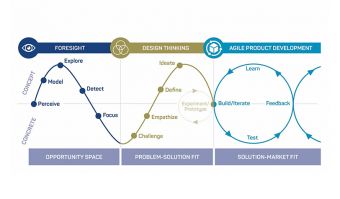
The new renaissance of the creative
The „New Renaissance“ that is emerging now, at the beginning of the 21st century, will have to leave behind the purely growth-oriented, resource-consuming innovations and thus bring about socially desirable changes. The term Renaissance was chosen deliberately because the „old“ Renaissance, i.e. the period between the 14th and 16th centuries, led to a boost in innovation in various areas; it was the time when technology and art, science and creativity merged. We want to build on this—especially in times of the COVID-19 pandemic—in order to contribute to overcoming the crises of our time. Because it is a sector that we hold in high esteem which is becoming the driving force behind this movement: the creative industries. It seems to be the sustainable winner in the merging of all areas of our lives. It is characteristic of the new renaissance that problems and crises can be solved more and more effectively across all areas and sectors. What was once separate, the creative person is able to connect with bridges and lead to innovative solutions. The creative industries are now an innovation-driving sector of the economy that is successfully leading other economic players into the new renaissance.
Picture left: Foresight Process / Copyright: Rohrbeck Heger GmbH
In recent years, the content-producing players in the creative industries—the publishing, media and music sectors, and of course journalism—have been the first sectors to digitise and transform themselves and they continue to do so. This is because the traditional media companies are facing a permanent change in terms of the behaviour and demands of the users of their products and services. Subscriptions are becoming memberships, content providers are becoming curators, and monothematic offerings are becoming lifeworlds and services that must be able to be mapped seamlessly on all platforms. As a result, data-driven business models are moving further into the foreground. Diversified business models must be found to suit the sovereignty, flexibility, and individuality of these users. With the credo of „meeting users where they are“, the industry has had a self-imposed target since the 2010s and continues to be dependent on technology and data, and thus on monopoly-like infrastructure providers, such as platforms, software and hardware providers. One also observes within the content industry an increasing merger of different providers into cooperations, alliances or mergers—and with it an increasing willingness to innovate, indeed an innovative power.
In other words, the content industry has the best prerequisites for the new renaissance.
Picture right: Status Quo, Copyright by Laura Müller

Looking to the future promotes the innovative power of today
In our view, Strategic Foresight is therefore the most suitable method for bringing together areas that are supposedly alien to one another to exchange ideas and find concrete solutions to their current and future challenges. After all, looking into the future promotes innovation today. However, companies still too often face major hurdles in perceiving and exploiting this potential. But simply dealing with a time horizon of five years is still unusual in companies. In order to better cope with the approaching, rapid changes and not only remain capable of acting, but also to be able to shape the future, even more courage and willingness to take risks will be required in the future.
This willingness also includes cooperation across industry and company boundaries. Most industries and management strategies still seem to be unfamiliar with open and cross-innovation processes. Yet the increasing complexity of our world is due not least to the convergence of markets and industries. So while classic competitive thinking can make long-term innovation even more difficult, it is often neutral and supra-organisational approaches that can create new spaces of opportunity and change mindsets. And above all, the involvement of the creative industries creates additional potential. Their ways of thinking and working not only provide new impetus for the innovation process itself, but are also becoming indispensable in view of the need to shape a new, sustainable, equitable future.
Picture below: Michail Paweletz reads 2034, Copyright: Laura Müller
For the practical application of content foresight, we rely on the following approaches:
1. With a cross-innovation approach, we create a setting that is considered to be particularly conducive to innovation and can thus bring two different sectors into innovation work in a targeted manner, in which we work in a user- and solution-oriented manner with the help of methodologically sound processes.
2. The focus is on methods of strategic foresight, which not only look at the development of possible futures, but also specifically enable the identification of so-called opportunity spaces and thus recommendations for action to successfully anticipate them.
3. In the subsequent design thinking process, concrete prototypes are developed alongside the joint visions. In addition, we rely on special impulses in these processes through targeted collaboration with actors from the creative industries.
4. As a public provider, we also act as a neutral player in this process and create trust among the companies involved and, where applicable, among competing companies.
With this setting, in a format that is unique in Europe, we are not only creating an experimental area for concrete approaches to current and future challenges, but also new impulses and foundations for the sustainable innovative capacity of the participating players.

So what do the possible futures look like when actors from the content industry work together with mobility experts? Where are the opportunity spaces? Content Foresight – Mobility by nextMedia.Hamburg and the Cross Innovation Hub produced the following triad of innovations:
Business ideas using the example of the content & mobility interface
I.
2024. For a time horizon of five years, the Hamburger Morgenpost and Schwan Communications have developed a tangible solution for linking content and mobility offers that can already be implemented with current technologies. The prototype Digital Guided Tour /HAM offers users multimedia content (video, audio, text) that functions in a wide variety of means of transportation, is coupled with them, and whose playout is adapted to the means of transportation. In this way, it not only offers content providers new distribution channels, but also creates incentives for the use of public and/or climate-friendly means of transport in the city—from e-scooters to sharing offers and public transport. This applies not only to local residents, but also to the more than seven million tourists who visit the Hanseatic city every year, thanks to the integration of tourist attractions and historical content.
II.
2029. The project team of MaibornWolff and pilot Hamburg planned the next step: With S.T.E.P—the Seamless Travel Experience Platform—mobility and entertainment/information are individually tailored to the user. Instead of having to actively choose from countless options how to get from A to B and which content can be consumed on the way, a digital twin creates situationally optimal decision bases for seamless travel planning. The blockchain-based application already developed promises all-in-one processing. In a planning horizon of about five to 10 years, app chaos on smartphones will then be as much a thing of the past as login madness. Through a public-private ownership model, in which the public sector acts as a regulator, a critical mass of services and users* can be aggregated, which can fully keep an eye on the optimisation of passenger transport, independent of the economic success of individual providers.
III.
2034. What’s next? How do we envision mobility and content when blockchain technologies and AI-supported systems have long since become part of our everyday lives and our data precedes our decisions? Representatives from NDR, Axel Springer, HOCHBAHN, IAV, ITS Hamburg 2021 and Wunder Mobility give us an impression of this in their concept of experiential mobility. In the sense of a pre-prototype, the team developed a vision of mobility in a time horizon of about 15 years, which considers social (e.g. environmental protection, education), political (e.g. data sovereignty), technological (e.g. autonomous driving, artificial intelligence as technology serving people, digital identity) and individual aspects (e.g. consumption, convenience) in equal measure and integrates them into product and service scenarios.
The vision, spoken by ARD news anchor Michail Paweletz, is publicly available here.
Open even to unfamiliar input
So… You can’t do it without looking into the future. But… Everyone looks at the future differently. To find the best solution together, it is crucial to organise an exchange—and to learn from each other. This is the only way to create innovations.
If you want to be innovative tomorrow, you have to be open today, even for unusual input—and above all for new content!
Quotes from company representatives:
Dr. Johanna Leuschen, Head of NDR Audio Lab (Norddeutscher Rundfunk)
„We believe that in the future we will always get the content that is best suited to our mood, in the current mobility situation, in the time available. The keyword here is personalisation. The user focus is and will remain essential. For journalism, AI could be useful in an assisting role: Tasks that do not necessarily require creativity (weather, election or sports results) could be taken over by algorithms. Then journalists could devote themselves entirely to creative and research-intensive topics. And we assume that companies in general, not just content providers, should look at an audio and voice strategy and tailor their offerings for a voice-driven world in the long term. Discoverability is going to be a big challenge going forward.“
Nicolas Meibohm, Head of Connected Car (Axel Springer SE)
„We often still cling to the idea that we can’t determine the future, it will be determined. But that is exactly the mistake. So now, once we really look ahead, we get a picture we can work toward. This program has set a benchmark and proven that interdisciplinary collaboration really makes sense.“
Hendrik Menz, ehemals Director Business Development (pilot Screentime GmbH)
„It takes a wide range of relevant expertise and value-added fields to absorb the necessary complexity of a holistic approach.“
Dr.Nina Klaß
Dr. Nina Klaß is an expert in content and tech innovation. She leads nextMedia.Hamburg (part of Hamburg Kreativ Gesellschaft mbH) where she developed and executed a range of highly recognized innovation programs such as the Content Foresight project. Previously, she was head of digital product marketing & sales management at SPIEGEL Group. She is active as funding committee member, jury and advisor of innovation programs worldwide.
Picture © Oliver Reetz
Egbert Rühl
Egbert Rühl has been active as a cultural and arts facilitator his whole life – in many different genres and functions. He is the managing director of the Hamburg Kreativ Gesellschaft. In this role, he is responsible for strategy and tactics, guidance and moderation, budget compliance, and contact with politics and administration.
Picture © Oliver Reetz

Marc Eppler
Marc Eppler is responsible for nextMedia.Hamburg’s partner management and he operates programs such as Content Foresight. Previously, he worked at the Franco-German culture channel ARTE in Strasbourg.
Picture © Oliver Reetz

Stranger To The Trees
Artist in Residence at the Faculty of Maths and Physical Sciences, University College London & Fellow of the Royal Society of Arts
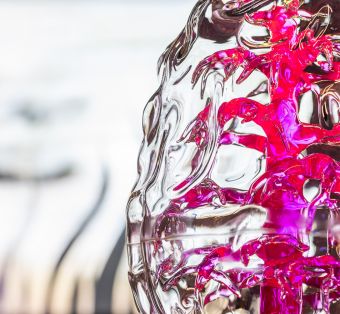
STranger to the trees
Hybrid art uncovering a new materiality in our world, for crisis or awakening…
The Green Transition of our society is urgent and will drive the renewal of cities and economy alike, as we overcome the Covid-19 pandemic. However, to move beyond our current relationship with what is casually called “the environment”, we must in fact reconfigure the understanding of humankind’s influence on the planet.
Stranger To The Trees (STTT) is a transdisciplinary art-led project that sheds light through a hybrid artistic form on the invisible but harsh reality of how microplastics are changing the materiality of the world. The work steps outside of the human perspective by focussing on the possibility of coexistence between microplastics and trees. In so doing, the work addresses a fundamental necessity—that of moving beyond a human-centric view to achieve a more-than-human understanding of the echoes of human activity.
STTT is a multimedia, interactive installation that combines sound, sculpture and video, alongside a scientific publication (Austen, 2022). A combination of these forms of output sheds light conceptually, factually and emotionally on the possibilities and meanings of microplastics and birch trees coexisting in the time of the climate crisis.
Microplastics are a ubiquitous and irrevocable anthropogenic new material dispersed throughout the environment reaching the furthest and wildest crannies of the planet. Particles of plastic have been found in the clouds, on top of the tallest mountains and in the deepest ocean trenches. This artificial material represents the uncompromising impact of human activity on the planet and has already been observed to be an evolutionary prompt for microorganisms. Furthermore, microplastics’ presence is an embodiment of our addiction to the extraction of fossil fuels, or as they should properly be named, long carbon reserves.
We cannot call back these tiny fractionations of humanity’s exploitative industrial legacy. They persist even beyond our reaches, changing the materiality of the world and the entities within it, even ourselves. What we can do is to reconfigure our understanding of the consequences of this undeniable reality. The artwork Stranger to the Trees addresses this issue through the lens of coexistence. The work realises in hybrid artistic form the new materiality of the entanglement of forests and plastic pollution.
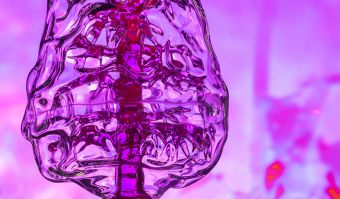
The project was driven by a motivation to understand the stark reality of microplastic pollution from a more-than-human perspective. Central to the concept is the fact that plastic pollution is, like forests, itself a carbon sink. In the context of fossil fuel extraction and the carbon cycle, the question arises of whether microplastic interaction with trees might, beyond the instinctive horror of artifice pervading nature, carry another meaning. The research for the project, which is still ongoing in the form of a long-term experiment, mixes artistic and scientific methods to explore how birch, a pioneer tree species, and microplastic particles interact.
Stranger to the Trees successfully melds DIY and traditional scientific research with artistic research and production. The diverse outputs, each impactful in its own way, together provide access to a new understanding of what we perceive as nature. The project showcases a modality by which to develop the aesthetic, cognitive and embodied knowledge needed in order to move towards a more just, resilient future in which humans cooperate with those entities with which we share the planet.
References
Austen, K, Maclean, J, Balanzategui, D and Hölker, F, “Microplastic inclusion in birch tree roots”, Science of the Total Environment, 808 (2022) 152085 https://doi.org/10.1016/j.scitotenv.2021.152085
More info: https://www.katausten.com/portfolio/stranger-to-the-trees/
Other partners involved (think of artists/ producers/ industry/ science collaborators): STTT is realised within the framework of the European Media Art Platforms EMARE program at WRO Art Center with support of the Creative Europe Culture Programme of the European Union
All Photos: Copyright by Andreas Baudisch
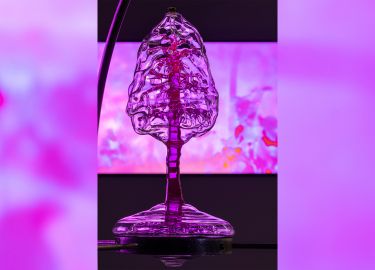
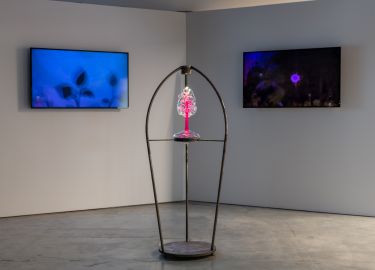
Kat Austen
Kat Austen is a person. In her artistic practice, she focusses on environ-mental issues. She melds disciplines and media, creating sculptural and new media installations, performances and participatory work. Austen’s practice is underpinned by extensive research and theory, and driven by a motivation to explore how to move towards a more socially and environmentally just future. Working from her studio in Berlin, Austen is currently Artist in Residence at the Faculty of Maths and Physical Sciences, University College London, Senior Teaching Fellow at UCL Arts and Sciences and Associate Artist Fellow at Institute for Advanced Sustainability Studies, Potsdam. Her studio hosts two Scientists in Residence through the STUDIOTOPIA programme hosted by Ars Electronica. She is a Fellow of the Royal Society of Arts. Austen was Artist in the Arctic 2017 for Friends of Scott Polar Research Institute (University of Cambridge) for her project The Matter of the Soul. In 2018 Austen was selected as inaugural Cultural Fellow in Art and Science at the Cultural Institute, University of Leeds for the same project. Austen has been awarded residencies internationally, including EMAP / EMARE Artist in Residence at WRO Art Center, AiR at NYU Shanghai, ArtOxygen Mumbai and LAStheatre.
Picture: © Andreas Baudisch